

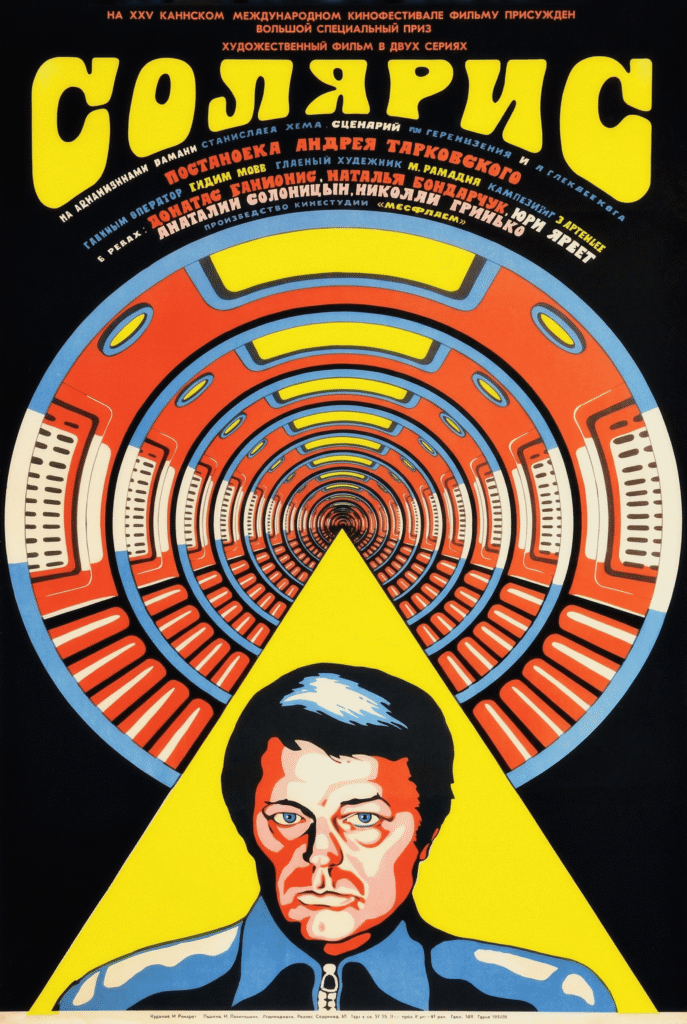
Original title: Solyaris
Based on: The novel “Solaris” (1961) by Stanisław Lem
Director: Andrei Tarkovsky
Screenplay: Andrei Tarkovsky, Fridrikh Gorenshteyn
Cinematography: Vadim Yusov
Music: Eduard Artemyev; J.S. Bach — Chorale Prelude in F minor
Cast: Donatas Banionis, Natalya Bondarchuk, Jüri Järvet, Vladislav Dvorzhetskiy, Nikolay Grinko, Anatoliy Solonitsyn, Olga Barnet
Filming locations: Mosfilm Studios, Moscow; Expressway Shutilovsky, Moscow, Soviet Union
Subtitles: English (EN), Romanian (RO)
Synopsis and Main Themes: Psychologist Kris Kelvin is sent to a space station orbiting the mysterious ocean planet Solaris, where the crew has been behaving erratically. He discovers that the planet is materializing the deepest memories and repressed guilt of its inhabitants — and soon finds himself confronted with a living replica of his dead wife, Hari. Rather than exploring outer space, the film turns inward, asking what it means to be human when faced with the irreversibility of loss. The film explores memory, guilt, love, and the limits of human knowledge.
About the Director and Cinematic Style: Solaris represents Tarkovsky’s radical transformation of Stanisław Lem’s novel — stripping away its epistemological ambitions to focus almost entirely on the inner life of its protagonist. Tarkovsky uses the science fiction genre as a vessel for his recurring themes: the weight of the past, the impossibility of true communication, and the spiritual dimension of love. The film’s deliberately slow pace, long takes, and hypnotic photography create a uniquely contemplative experience unlike anything else in science fiction cinema.
Critical Reception and Impact: Solaris won the Grand Prix Spécial du Jury and the Prize of the Ecumenical Jury at the 1972 Cannes Film Festival. Soviet authorities had promoted the film as a response to Kubrick’s 2001: A Space Odyssey, but Tarkovsky’s deeply personal, interior vision confounded expectations. Over the decades it has been recognized as one of the masterpieces of science fiction and of world cinema — a work that poses fundamental questions about consciousness, ethics, and what we owe to the dead.
Historical Context and Cinematic Legacy: Released in 1972, Solaris arrived at a moment when Soviet cinema was being used as ideological currency in the Cold War cultural competition with the West. Yet Tarkovsky turned the assignment into something entirely his own — a film more concerned with Dostoevsky than with space exploration. Stanisław Lem himself publicly criticized the adaptation, feeling Tarkovsky had abandoned the novel’s philosophical core in favour of a domestic melodrama — a disagreement that reveals less about the film’s failure than about its radical reorientation of science fiction from the external to the internal. Its influence has been immense, from Andrei Zvyagintsev to Denis Villeneuve, and its central insight — that space exploration is ultimately a journey into the self — has become one of the defining ideas of the genre.
You cannot copy content of this page

It's free. No subscription required




Comments (0)
Please login to comment.
Please login to review.