

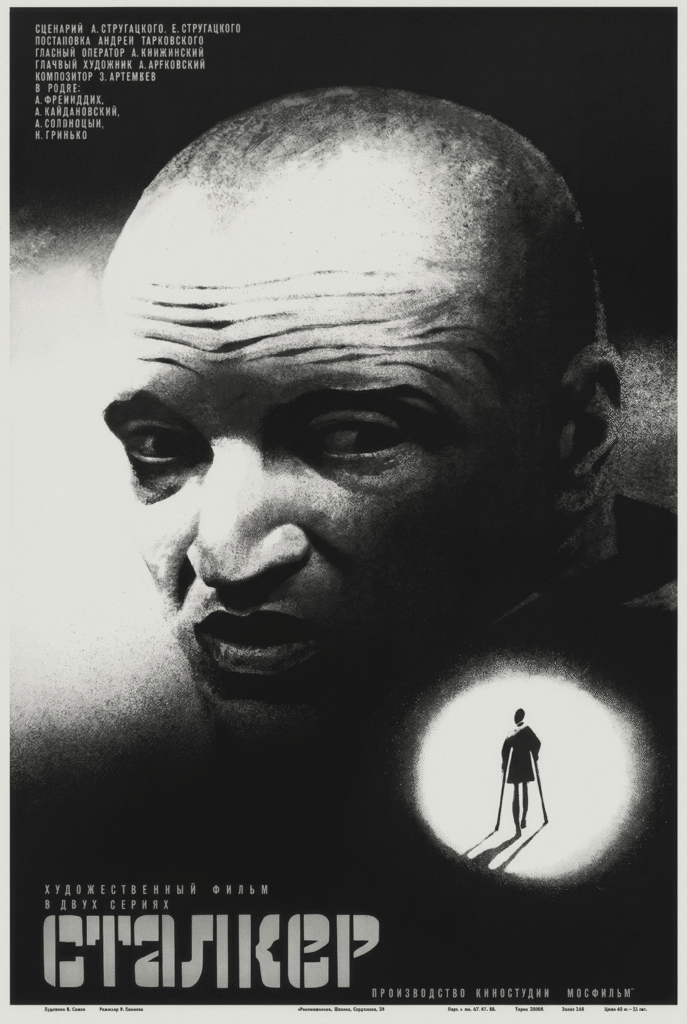
Original title: Stalker
Based on: The novel “Roadside Picnic” (1972) by Arkadiy and Boris Strugatskiy
Director: Andrei Tarkovsky
Screenplay: Arkadiy Strugatskiy, Boris Strugatskiy, Andrei Tarkovsky
Cinematography: Aleksandr Knyazhinskiy
Music: Eduard Artemyev
Cast: Aleksandr Kaydanovskiy, Anatoliy Solonitsyn, Nikolay Grinko, Alisa Freyndlikh, Natalya Abramova, Faime Jurno, Evgeniy Kostin
Filming locations: Tallinn and Jägala River area, Estonia, Soviet Union; Mosfilm Studios, Moscow
Subtitles: English (EN), Romanian (RO)
Synopsis and Main Themes: A guide known only as the Stalker leads two men — a Writer and a Professor — through a mysterious, forbidden territory called the Zone, where the laws of physics bend and at whose center lies a Room that allegedly grants one’s deepest wish. The journey is slow, ritualistic, and fraught with unseen danger. Yet the greatest peril is not physical: as the three men draw closer to the Room, none of them is truly prepared to confront what they most desire. The film explores faith, doubt, the terror of self-knowledge, and the question of whether human beings are capable of inhabiting their own dreams.
About the Director and Cinematic Style: Stalker marked a turning point in Tarkovsky’s career — both in its radical formal austerity and in the depth of its spiritual inquiry. Shot in desaturated, almost monochromatic tones broken by passages of colour, the film achieves a hypnotic quality unlike anything else in cinema. Aleksandr Knyazhinskiy’s cinematography renders industrial ruin and overgrown nature as equally sacred. The film was notoriously reshot from scratch after a laboratory error destroyed the original footage — and the final version is widely considered the more powerful result.
Critical Reception and Impact: Stalker won the Prize of the Ecumenical Jury at the 1980 Cannes Film Festival. It has since been recognized as one of the defining masterworks of world cinema, consistently appearing at the top of critics’ polls and cited by filmmakers across generations as a transformative influence. Its vision of a post-industrial sacred space and its meditation on belief without certainty have made it an enduring reference point for cinema, literature, and philosophy alike.
Historical Context and Cinematic Legacy: Made during the late Soviet period, Stalker operates as an oblique but unmistakable critique of a society that had lost the capacity for genuine spiritual life. The Zone — wild, ungovernable, beyond the reach of authority — stands in implicit contrast to the grey conformity of the world outside its borders. The toxic industrial locations where the film was shot near Tallinn may have contributed to the health problems that later afflicted Tarkovsky, his wife Larisa, and actor Anatoliy Solonitsyn — all of whom died of cancer within a decade. The film’s influence extends far beyond cinema: it inspired novels, video games, and an entire subgenre of “Zone fiction,” while the Chernobyl exclusion zone’s haunting resemblance to Tarkovsky’s imagery after the 1986 disaster sealed the film’s prophetic status in the cultural imagination.
You cannot copy content of this page

It's free. No subscription required
Comments (0)
Please login to comment.
Please login to review.