

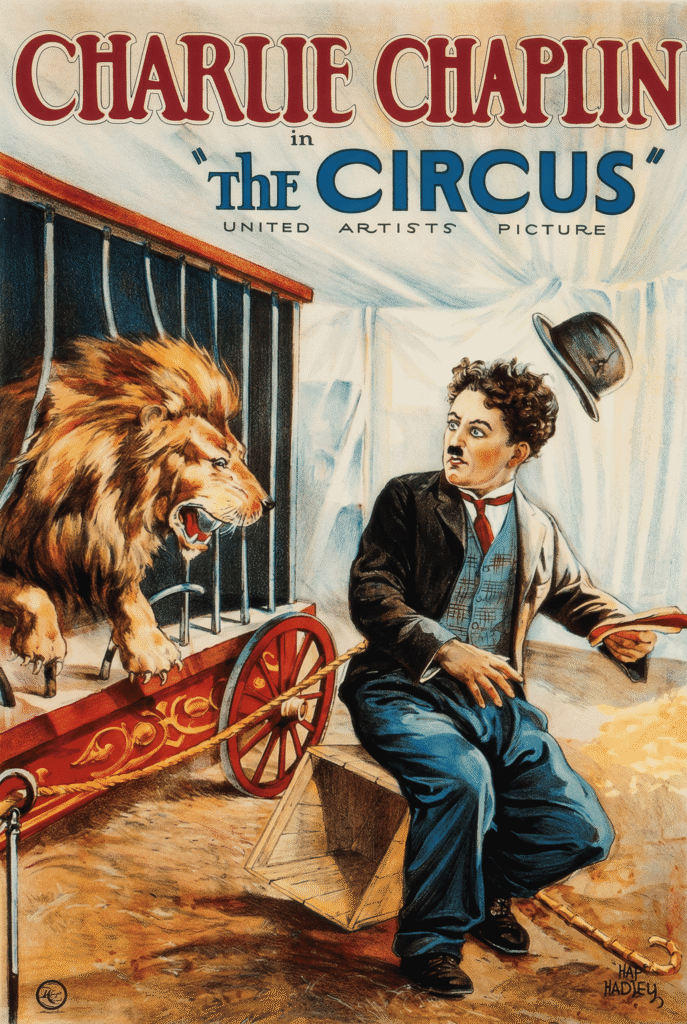
Original title: The Circus
Based on: Original screenplay by Charles Chaplin
Director: Charles Chaplin
Screenplay: Charles Chaplin
Cinematography: Roland Totheroh
Music: Charles Chaplin (score composed in 1967, including the song “Swing Little Girl”)
Cast: Charles Chaplin, Al Ernest Garcia, Merna Kennedy, Harry Crocker, George Davis, Henry Bergman, Tiny Sandford, John Rand, Steve Murphy
Filming locations: Charlie Chaplin Studios, Hollywood, California
Subtitles: English (EN), Romanian (RO)
Synopsis and Main Themes: The Tramp, broke and hungry, stumbles into a circus where, while fleeing the police, he inadvertently makes the audience roar with laughter. The circus owner, a tyrant who beats his stepdaughter, hires him on the spot. The irony is that the Tramp can only be funny unintentionally — he is comic only when he doesn’t know he is. Falling in love with the owner’s daughter, he discovers she loves the circus tightrope walker instead. The film explores with tenderness and melancholy the paradox of the comedian who brings joy to others but remains alone — an autobiographical metaphor for Chaplin’s own place in the world of cinema.
About the Director and Cinematic Style: Charles Chaplin — director, writer, actor, producer, and composer — controls every aspect of the film with obsessive precision. The Circus marks a return to the pure physical comedy of his early shorts, with meticulously choreographed slapstick sequences: the chase through the hall of mirrors, the scene inside the lion’s cage, and the high-wire act where he is attacked by monkeys. But beneath the apparent burlesque, Chaplin weaves a thread of deep melancholy — the ending, in which the circus moves on without him, is one of the most moving sequences in his entire body of work.
Critical Reception and Impact: At the first Academy Awards ceremony in history (1929), the Academy decided to withdraw Chaplin from competitive categories and instead bestow upon him a Special Award “for versatility and genius in acting, writing, directing, and producing The Circus.” Critics were divided — Variety called it Chaplin’s best comedy film, while The New Yorker found it “a little disappointing.” The production was one of the most difficult of Chaplin’s career, marked by a public divorce, a tax lawsuit, a fire that destroyed the sets, and damaged negatives that required costly reshoots.
Historical Context and Cinematic Legacy: Released in January 1928, The Circus appears at a turning point for Chaplin and for silent cinema. The final sequences were filmed just four days after the premiere of The Jazz Singer, which revolutionized the industry with synchronized dialogue. Chaplin, who would resist sound longer than any other great director, creates in the ending of The Circus an involuntarily prophetic metaphor: the circus moves on, and the Tramp is left alone in the empty ring. When he composed the soundtrack for the 1967 re-release, Chaplin chose to accompany this scene with “Blue Skies” — the song made famous by Jolson in The Jazz Singer — but played slowly and sorrowfully, like a funeral march for an era that was ending. The film remains a profound meditation on the loneliness of the comedian and the price paid by those who bring joy to the world without being able to keep any for themselves.
You cannot copy content of this page

It's free. No subscription required
Comments (0)
Please login to comment.
Please login to review.