

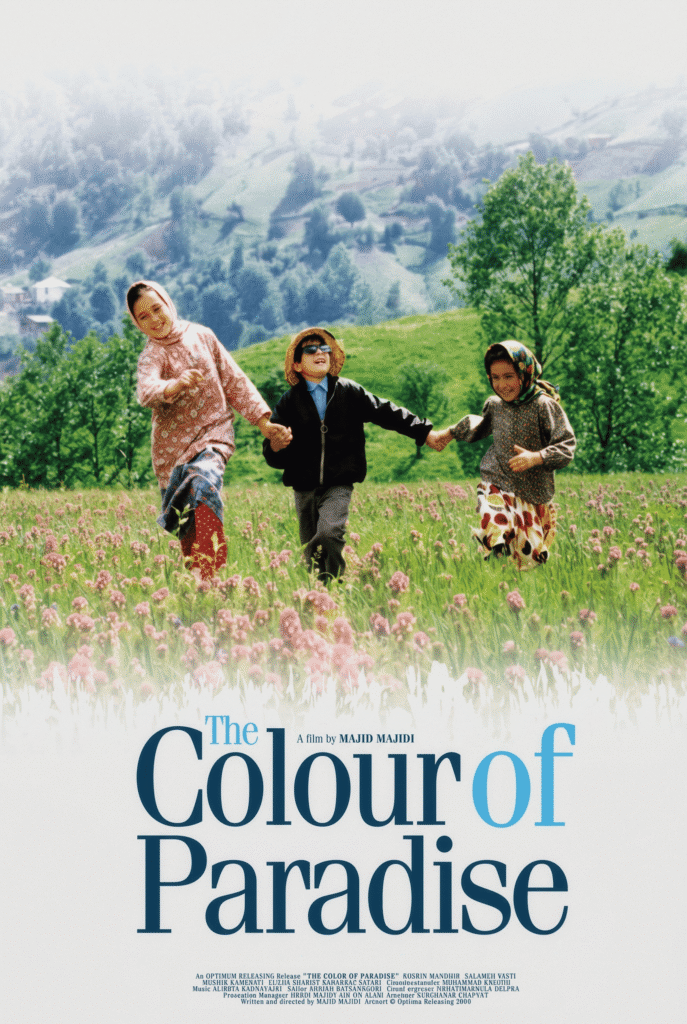
Original title: Rang-e khoda
Based on: Original screenplay by Majid Majidi
Director: Majid Majidi
Screenplay: Majid Majidi
Cinematography: Mohammad Davudi
Music: Kayvan Jahanshahi, Alireza Kohan Deyri
Cast: Hossein Mahjoub, Mohsen Ramezani, Salameh Feyzi, Farahnaz Safari, Elham Sharifi, Ahmed Aminian, Moghadam Behboodi, Morteza Fatemi, GanAli Khorami, Kamal Mirkarimi
Filming locations: Iran
Subtitles: English (EN), Romanian (RO)
Synopsis and Main Themes: Mohammad, a blind eight-year-old, returns home from his Tehran school for the summer to find his widowed father increasingly ashamed of him — a burden he fears will cost him a desired remarriage. While his grandmother and sisters embrace the boy with unconditional love, Hashem arranges to send Mohammad away to apprentice with a blind carpenter in a distant village. The film explores the moral blindness of a father who cannot see what his son perceives through touch alone: that the world conceals beauty in every thing.
About the Director and Cinematic Style: Coming directly after Children of Heaven, The Color of Paradise deepens Majidi’s exploration of childhood as a form of spiritual sight. Working again with cinematographer Mohammad Davudi, he immerses the film in the textures and sounds of the Iranian countryside — birdsong, running water, the grain of wood under fingertips — constructing a sensory world that the blind boy inhabits more fully than any sighted character. The camera’s tenderness toward Mohammad is itself a moral argument.
Critical Reception and Impact: The Color of Paradise won the Grand Prix des Amériques at the 1999 Montreal World Film Festival — Majidi’s second consecutive win at that festival after Children of Heaven. At the Fajr International Film Festival it won Crystal Simorgh awards for Best Film, Best Director, Best Actor (Hossein Mahjoub), and Best Cinematography. Iran submitted the film as its official entry for Best International Feature Film at the 72nd Academy Awards, but it did not advance to the final nominations.
Historical Context and Cinematic Legacy: The Color of Paradise arrived at the peak of international interest in Iranian cinema — a moment when filmmakers like Kiarostami, Panahi, and Makhmalbaf were transforming global perceptions of what art cinema could be. Majidi occupied a distinct position within this wave: where others favored formal experimentation and ambiguity, he pursued emotional directness and spiritual transparency. The film’s international success — particularly in the United States, where it was distributed by Sony Pictures Classics — introduced Majidi’s humanist vision to audiences beyond the festival circuit. Its portrayal of disability as a form of heightened perception rather than deficiency influenced subsequent Iranian films dealing with illness and difference, and confirmed that Majidi’s cinema, rooted in faith and compassion, could move audiences across entirely different cultural and religious frameworks.
You cannot copy content of this page

It's free. No subscription required
Comments (0)
Please login to comment.
Please login to review.