

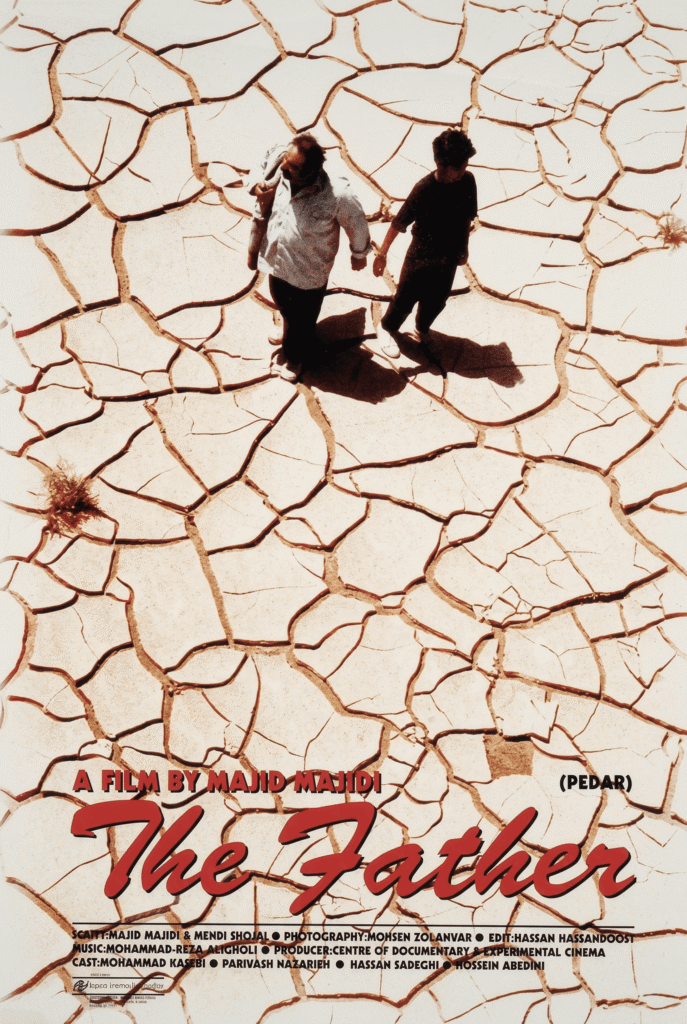
Original title: Pedar
Based on: Original screenplay by Majid Majidi, Seyed Mehdi Shojai
Director: Majid Majidi
Screenplay: Majid Majidi, Seyed Mehdi Shojai
Cinematography: Mohsen Zolanvar
Music: Mohammad Reza Aligholli
Cast: Mohammad Kasebi, Parivash Nazarieh, Hassan Sadeghi, Hossein Abedini
Filming locations: Kashan, Iran
Subtitles: English (EN), Romanian (RO)
Synopsis and Main Themes: Mehrollah, a fourteen-year-old boy in rural Iran, accidentally causes his father’s death in a motorcycle accident. To support his mother and sisters, he leaves for a southern port city to find work. Returning months later with savings and gifts, he discovers that his mother has remarried a local policeman. Furious and grief-stricken, he refuses to accept the new arrangement — until a dangerous journey through the desert forces him and his stepfather to confront each other as human beings. The film explores the weight of grief on a child too young to carry it, and the slow, reluctant passage toward acceptance.
About the Director and Cinematic Style: The Father is Majidi’s first fully realized feature and the clearest early announcement of the themes he would develop throughout his career — the family under pressure, the child forced into adult responsibilities, the Iranian landscape as moral mirror. Working with cinematographer Mohsen Zolanvar in the arid landscapes of southern Iran, Majidi finds in the desert a natural metaphor for Mehrollah’s inner emptiness. The film is more overtly emotional than his later work, but already unmistakably his.
Critical Reception and Impact: The Father won three Crystal Simorgh awards at the 1996 Fajr International Film Festival, including Best Film, Best Leading Actor (Mohammad Kasebi), and Best Supporting Actress (Parivash Nazarieh). At the Torino International Festival of Young Cinema it received the Jury Special Prize, the C.I.C.A.E. Award, and the Holden Award for Best Script, as well as an International Jury Award Honorable Mention at the São Paulo International Film Festival — a remarkable international debut that anticipated the global recognition Children of Heaven would bring just one year later.
Historical Context and Cinematic Legacy: The Father arrived at a transformative moment for Iranian cinema. By the mid-1990s, a generation of filmmakers — Kiarostami, Makhmalbaf, Panahi — had placed Iran at the center of international art cinema discourse, creating conditions in which a debut feature by a little-known director could reach major European festivals. Majidi seized this opening with a film that was at once deeply local — rooted in Iranian social reality, family structure, and landscape — and immediately legible to international audiences. In retrospect, The Father is significant not only as the origin point of Majidi’s filmography but as a document of the social tensions of post-revolutionary Iran: the pressure on young men to assume patriarchal roles, the fragility of widowed women’s autonomy, and the unspoken costs of grief in a society with few spaces for its expression.
You cannot copy content of this page

It's free. No subscription required
Comments (0)
Please login to comment.
Please login to review.