

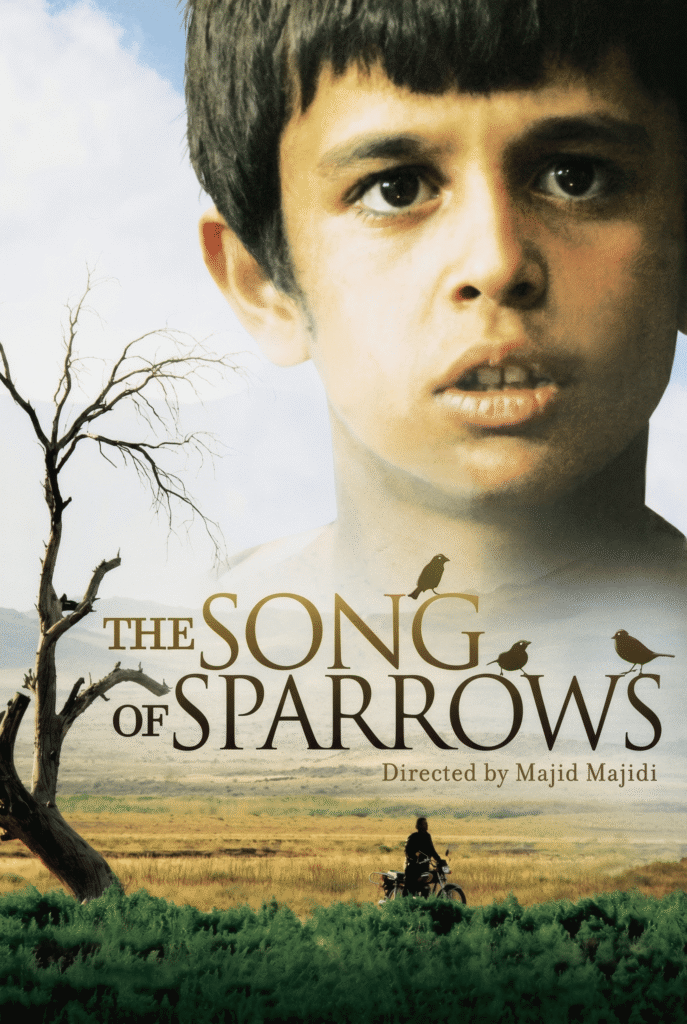
Original title: Avaze gonjeshk-ha
Based on: Original screenplay by Mehran Kashani and Majid Majidi
Director: Majid Majidi
Screenplay: Mehran Kashani, Majid Majidi
Cinematography: Turaj Mansuri
Music: Hossein Alizadeh
Cast: Reza Naji, Maryam Akbari, Kamran Dehghan, Hamid Aghazi, Shabnam Akhlagi, Neshat Nazari, Hassan Rezaee, Ponya Salehi
Filming locations: Tehran, Iran
Subtitles: English (EN), Romanian (RO)
Synopsis and Main Themes: Karim, an ostrich farmer on the outskirts of Tehran, loses his job when one of the birds escapes. Forced to travel daily into the city on his motorcycle to find work, he accidentally becomes an improvised taxi driver — and gradually, almost without noticing, begins to be seduced by the materialism and petty ambitions of urban life. The film explores the corruption of simple values by consumer culture, the fragility of human integrity under economic pressure, and the quiet heroism of returning to what truly matters.
About the Director and Cinematic Style: With The Song of Sparrows, Majidi returns to the rural-urban tension that has defined much of Iranian cinema. His camera is unhurried and observational, lingering on the textures of domestic life and the open landscapes surrounding Tehran. The film’s tone shifts subtly from comedy to melancholy as Karim’s transformation deepens — a tonal control that reveals Majidi’s confidence as a storyteller working in a minor key.
Critical Reception and Impact: At the 58th Berlin International Film Festival, lead actor Reza Naji won the Silver Bear for Best Actor — the first Iranian actor ever to receive this distinction. The film was Iran’s official submission for Best Foreign Language Film at the 81st Academy Awards, and the National Board of Review named it one of the Top Five Foreign Films of the year. Critics praised Naji’s performance and Majidi’s quiet moral precision.
Historical Context and Cinematic Legacy: The Song of Sparrows arrived during a period of significant tension between Iranian cinema’s international prestige and its increasingly difficult domestic conditions. By 2008, many of Iran’s most celebrated filmmakers were working under tightening censorship or facing outright bans — yet Majidi maintained the ability to make quietly subversive films within the system. The film’s critique of materialism and urban alienation resonated far beyond Iran, speaking to anxieties shared across the developing world as rapid urbanization disrupted traditional communities. It stands as one of the clearest expressions of Majidi’s core philosophical commitment: that dignity is not found in accumulation but in attention — to family, to nature, to the small, unhurried rhythms of an honest life. Its influence is felt in the work of younger Iranian directors who continue to navigate the same tension between tradition and modernity.
You cannot copy content of this page

It's free. No subscription required
Comments (0)
Please login to comment.
Please login to review.