

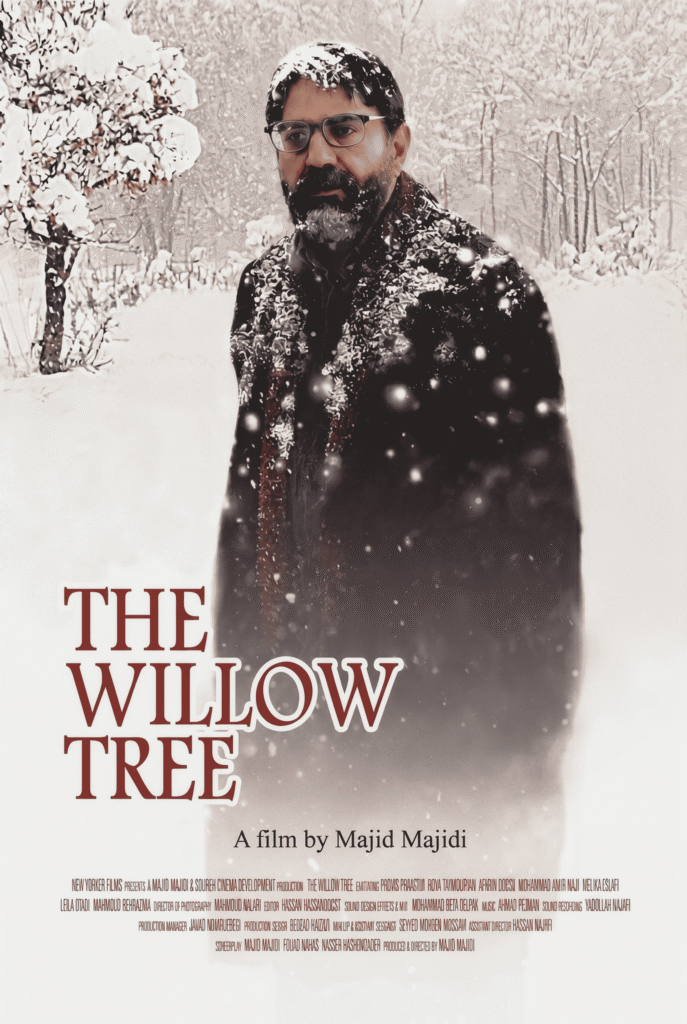
Original title: Beed-e majnoon
Based on: Original screenplay by Majid Majidi, Fouad Nahas, and Nasser Hashemzadeh
Director: Majid Majidi
Screenplay: Majid Majidi, Fouad Nahas, Nasser Hashemzadeh
Cinematography: Mahmoud Kalari
Music: Ahmad Pezhman
Cast: Parviz Parastui, Roya Teymourian, Soghra Obeisi, Melika Eslafi, Mahmoud Behraznia, Dawlat Asadi, Reza Naji, Leila Otadi
Filming locations: Paris, France; Iran
Subtitles: English (EN), Romanian (RO)
Synopsis and Main Themes: Youssef, a blind professor of Persian literature in Paris, regains his sight after a successful operation and returns to Tehran transformed — only to find that the world he can now see is not the one he had imagined. Beauty becomes an obsession, gratitude curdles into desire, and the life he had built with patience and grace begins to collapse. The film explores the paradox of vision as spiritual blindness, the fragility of contentment, and the devastating consequences of surrendering to what one cannot possess.
About the Director and Cinematic Style: With The Willow Tree, Majidi ventures into more psychologically complex territory than his earlier work, crafting a film closer to moral fable than social realism. His camera observes Youssef’s inner disintegration with characteristic restraint — close-ups of faces, hands, and objects carry the emotional weight that dialogue refuses to bear. The result is one of Majidi’s most interior and formally rigorous films.
Critical Reception and Impact: The Willow Tree won four awards at the Fajr International Film Festival in Tehran in 2005, affirming its strong domestic reception. Internationally, critical response was divided: Parviz Parastui’s performance and Mahmoud Kalari’s cinematography were widely praised, while some critics found the film’s moral allegory overly explicit compared to Majidi’s earlier work. It remains nonetheless one of the most formally ambitious films of his career.
Historical Context and Cinematic Legacy: Released in 2005, The Willow Tree marks a pivotal moment in Majidi’s evolution as a filmmaker — a deliberate departure from the child-centered humanism that had defined his international reputation. By centering the story on an educated, privileged adult whose spiritual crisis is self-inflicted, Majidi challenged both his domestic audience and his international admirers. The film engages with a strand of Persian literary and Sufi tradition — the idea that sight without wisdom is a curse, not a gift — embedding its moral argument in a cultural framework with deep roots in Iranian thought. It remains one of the most formally accomplished and thematically ambitious films of Majidi’s career, and one of the rare Iranian films of its era to explore male desire and moral failure with such unflinching directness. Its influence is visible in a later generation of Iranian filmmakers willing to place flawed, spiritually compromised protagonists at the center of their narratives.
You cannot copy content of this page

It's free. No subscription required
Comments (0)
Please login to comment.
Please login to review.