

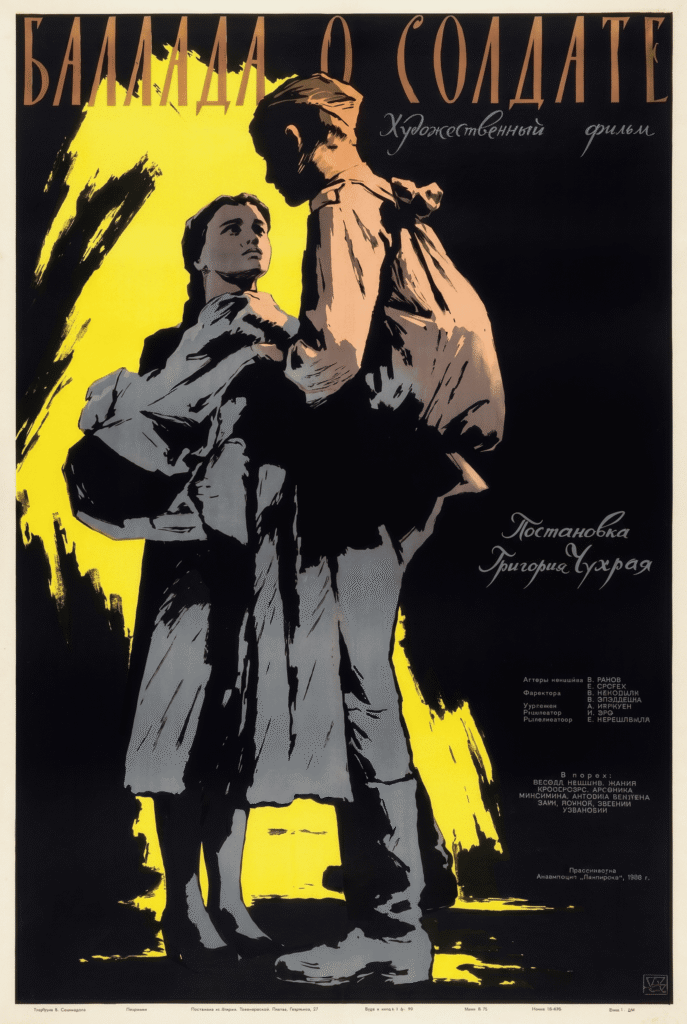
Original title: Ballada o soldate
Based on: Original screenplay by Grigoriy Chukhray and Valentin Yezhov
Director: Grigoriy Chukhray
Screenplay: Grigoriy Chukhray, Valentin Yezhov
Cinematography: Vladimir Nikolayev, Era Savelyeva
Music: Mikhail Ziv
Cast: Vladimir Ivashov, Zhanna Prokhorenko, Antonina Maksimova, Nikolay Kryuchkov, Evgeniy Urbanskiy, Elza Lezhdey, Aleksandr Kuznetsov, Evgeniy Teterin, Gennadiy Yukhtin, Valentina Telegina
Filming locations: Mosfilm Studios, Moscow, Russia
Subtitles: English (EN), Romanian (RO)
Synopsis and Main Themes: During World War II, nineteen-year-old soldier Alyosha Skvortsov destroys two German tanks and, rather than accepting a medal, asks for a short leave to visit his mother. The journey home becomes an odyssey across a war-ravaged country: he encounters broken families, waiting wives, and strangers clinging to whatever human warmth remains. The film is less a war picture than a meditation on time, tenderness, and the irreversible cost of conflict on ordinary human lives.
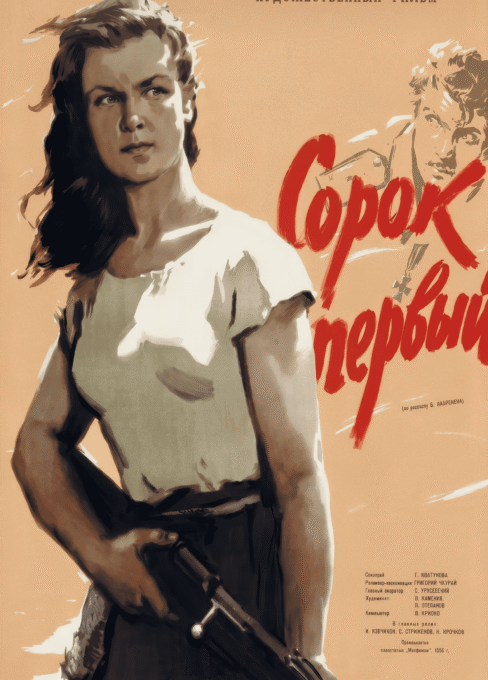
About the Director and Cinematic Style: Grigoriy Chukhray (1921–2001) fought in World War II as a paratrooper, an experience that shaped his entire filmmaking vision. After graduating from VGIK under Mikhail Romm, he made his debut with The Forty-First (1956). In Ballad of a Soldier, Chukhray deploys a lyrical, episodic structure rooted in close observation of faces and landscapes. His camera lingers on small gestures and fleeting encounters, finding in the rhythm of train journeys and dirt roads a poetic counterpoint to the violence just offscreen.
Critical Reception and Impact: The film was rapturously received internationally and hailed as a landmark of the Soviet Thaw. At the 1960 Cannes Film Festival it received the Special Jury Prize, with a citation for high humanism and exceptional artistic qualities. It went on to win the BAFTA Award for Best Film in 1962, shared with The Hustler, and received an Academy Award nomination for Best Original Screenplay in 1961. Both the film and Chukhray were awarded the Lenin Prize in 1961, the highest cultural honor in the Soviet Union.
Historical Context and Cinematic Legacy: Ballad of a Soldier arrived during the Khrushchev Thaw, a brief cultural opening following Stalin’s death that allowed Soviet filmmakers to shift from propaganda toward personal, humanist storytelling. Alongside The Cranes Are Flying and Ivan’s Childhood, it defined a new Soviet cinema grounded in individual experience rather than collective ideology. Its influence extended across generations: the film’s episodic structure and understated emotional register shaped the work of directors from Andrei Tarkovsky to later European filmmakers seeking to balance lyrical imagery with narrative momentum. Released in the United States in 1960 as part of a Russian-American cultural exchange, it became one of the first Soviet films to earn genuine popular and critical recognition in the West, challenging Cold War stereotypes about what cinema from the USSR could be.
You cannot copy content of this page

It's free. No subscription required
Comments (0)
Please login to comment.
Please login to review.