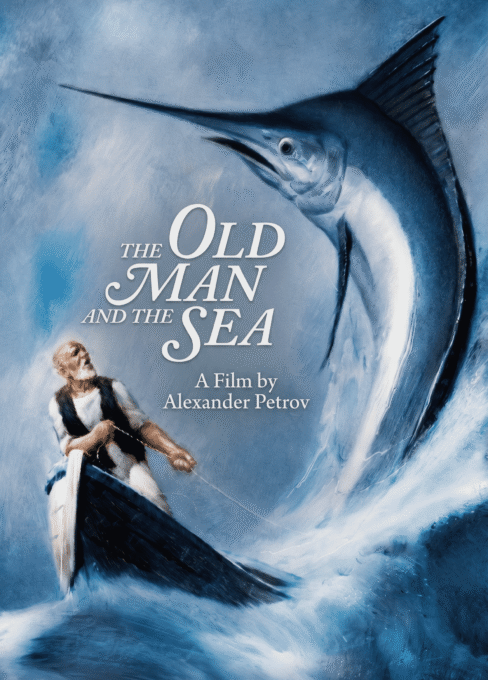
Synopsis and Main Themes: Santiago, a Cuban fisherman worn down by years and sea, has gone eighty-four days without a catch. Alone far out at sea, he hooks an immense marlin — and what follows is a days-long struggle that becomes something beyond contest: a confrontation with his own limits, with aging, with the strange kinship between hunter and hunted. Hemingway's novella is stripped to its essentials — endurance, dignity, the sea as both adversary and witness — and Petrov renders it without sentimentality, as a meditation on what a man can still be when everything has been taken from him.
About the Director and Cinematic Style: For The Old Man and the Sea, Petrov moved to Canada and worked with Pascal Blais Studio in a co-production spanning Russia, Canada, and Japan — the most ambitious undertaking of his career. He and his son Dmitri spent over two years painting more than 29,000 frames directly with their fingertips on oversized glass sheets, building a visual scale the paint-on-glass technique had never before attempted. The ocean breathes, the light shifts, and the marlin moves through water with the weight of something real.
Critical Reception and Impact: The Old Man and the Sea won the Academy Award for Best Animated Short Film at the 72nd ceremony (2000) — the culmination of a decade in which Petrov had received three prior nominations. It also won the Grand Prix and Audience Award at the Annecy International Animated Film Festival (2000), the Grand Prize at the Cinanima festival (1999), the Genie Award for Best Animated Film (Canada, 1999), and the Jutra Award for Best Animated Film (Quebec, 2000). It was also nominated for the BAFTA Award for Best Animated Short Film.
Historical Context and Cinematic Legacy: Hemingway's novella, published in 1952, won the Pulitzer Prize the following year and contributed directly to his Nobel Prize for Literature in 1954. It occupies a singular place in twentieth-century American literature — spare, elemental, and almost mythological in its reduction of human experience to one old man, one fish, and the open sea. Petrov's adaptation arrived at the end of the millennium as both a technical landmark and a statement about what hand-made cinema could still achieve in an era of digital production. Its international co-production model opened new possibilities for independent animated filmmaking. It remains Petrov's most celebrated work and one of the most visually extraordinary short films ever made.
You cannot copy content of this page

It's free. No subscription required