

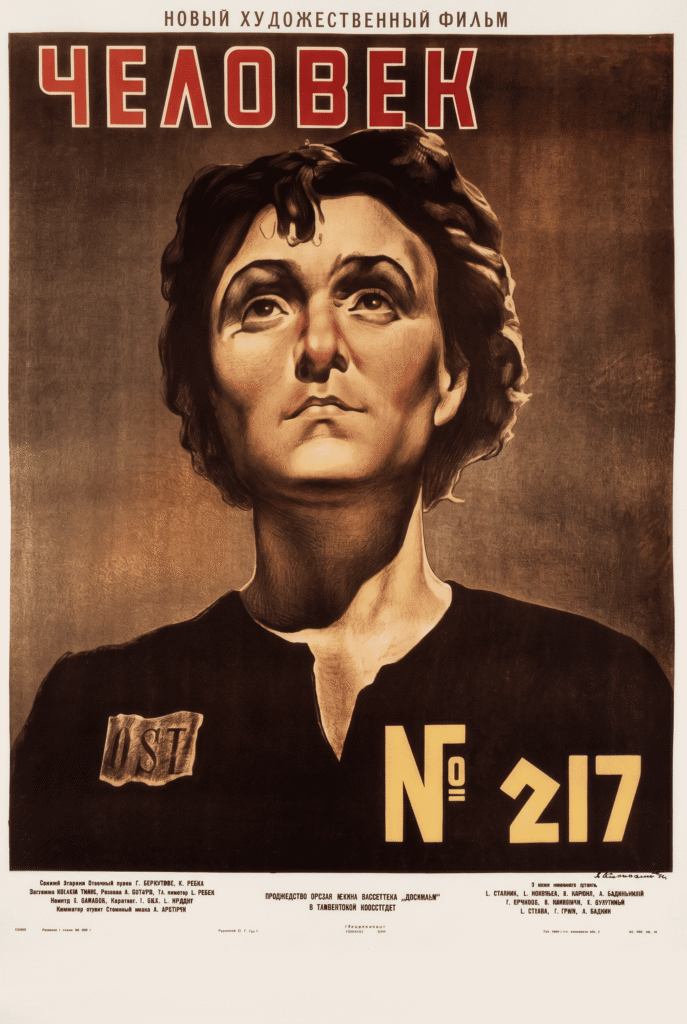
Original title: Chelovek No. 217
Based on: Original screenplay by Yevgeny Gabrilovich and Mikhail Romm
Director: Mikhail Romm
Screenplay: Yevgeny Gabrilovich, Mikhail Romm
Cinematography: Era Savelyeva, Boris Volchek
Music: Aram Khachaturyan
Cast: Yelena Kuzmina, Anna Lisyanskaya, Vasiliy Zaychikov, Nikolai Komissarov, Grigory Mikhaylov, Vladimir Vladislavskiy, Tatyana Barysheva, Lidiya Sukharevskaya, Pavel Sukhanov, Heinrich Greif
Filming locations: Mosfilm, Moscow, Soviet Union; Tashkent Studios, Tashkent, Uzbekistan
Subtitles: English (EN), Romanian (RO)
Synopsis and Main Themes: Tanya Krylova, a young Soviet woman, is captured during the Nazi invasion and sold into forced labor in Germany, where she serves a bourgeois German family who strip her of her name and refer to her only as Number 217. The film follows her two years of systematic dehumanization — domestic servitude, physical abuse, isolation — alongside two fellow prisoners whose fates intersect with hers. Beneath the anti-Nazi framework runs a question that the film raises without fully answering: what does it take to remain human when everything human has been methodically taken away.
About the Director and Cinematic Style: Mikhail Romm was born in Irkutsk in 1901 into a Jewish family exiled to Siberia for political activity, and came to cinema after training as a sculptor and working as a translator and writer. His directorial debut, Boule de Suif (1934), an adaptation of Maupassant, won a prize at Venice. By 1945, he had directed the Lenin biopics Lenin in October (1937) and Lenin in 1918 (1939) — films made under direct Stalinist oversight — as well as Dream (1941), widely considered his finest prewar work. In Girl No. 217, Romm and cinematographers Era Savelyeva and Boris Volchek use deep shadows, close observation of domestic spaces, and an almost clinical attention to Tanya’s physical deterioration to give the propaganda framework a texture of genuine documentary unease.
Critical Reception and Impact: Girl No. 217 was selected for the Official Competition at Cannes in 1946, where it did not win a prize. In the Soviet Union it received the Stalin Prize — the highest state cultural distinction — and was widely seen as a landmark in Soviet wartime cinema, praised for the rawness of Yelena Kuzmina’s performance and for being the only Soviet feature film produced during the Stalin era to address the experience of Ostarbeiter — Soviet civilians forced into slave labor in Germany. Romm himself later repudiated the film’s approach, writing that its schematic characterizations and melodramatic staging no longer seemed honest to him, and that the experience had moved him toward the more contemplative documentary method he would pursue in Ordinary Fascism (1965).
Historical Context and Cinematic Legacy: The film addresses a subject almost entirely absent from Western wartime cinema: the Ostarbeiter system, through which the Nazi regime deported approximately 2.8 million Soviet civilians to Germany as forced laborers between 1941 and 1944. That Girl No. 217 is propagandistic in its characterizations — the German family presented as emblematic of all Germans — does not diminish the historical weight of what it documents. Soviet returnees from German forced labor faced suspicion and often repression at home under Stalin, a reality the film pointedly ignores. Its lasting significance lies precisely in the tension between its official function and its subject: the film was commissioned to condemn the enemy, but in doing so it preserved a record of a crime that postwar Europe preferred to leave largely unexamined. Romm’s later Ordinary Fascism (1965) may be read as his attempt to do, more honestly, what Girl No. 217 could only do in the language its time permitted.
You cannot copy content of this page

It's free. No subscription required


Comments (0)
Please login to comment.
Please login to review.