

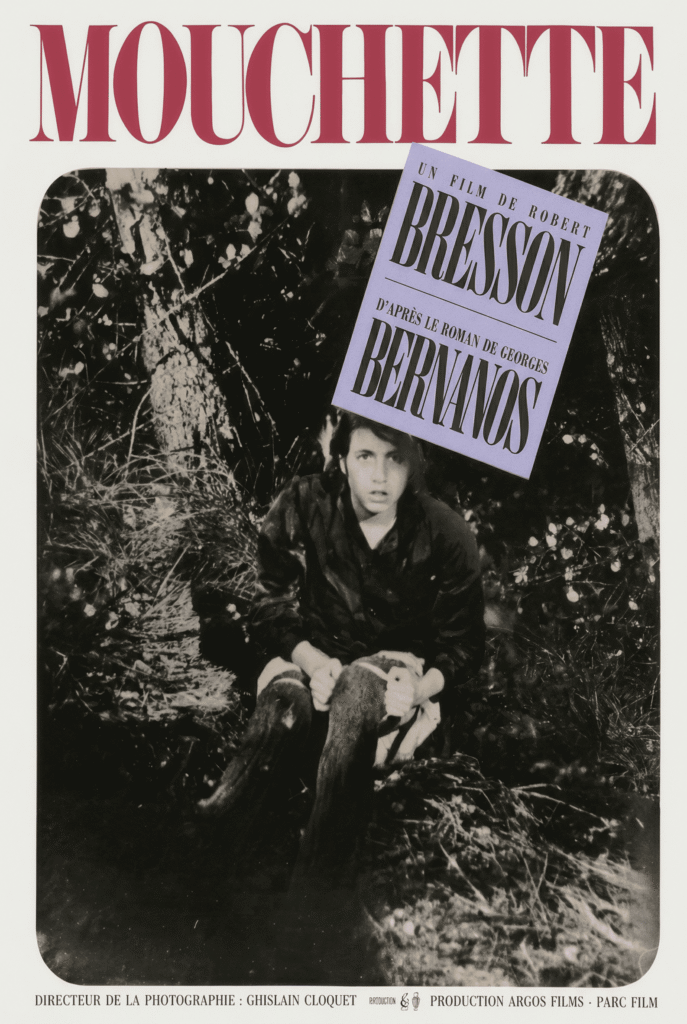
Original title: Mouchette
Based on: Novel by Georges Bernanos (1937)
Director: Robert Bresson
Screenplay: Robert Bresson (adaptation)
Cinematography: Ghislain Cloquet
Music: Jean Wiener
Cast: Nadine Nortier, Jean-Claude Guilbert, Marie Cardinal, Paul Hébert, Jean Vimenet, Suzanne Huguenin, Marine Trichet, Raymonde Chabrun
Filming locations: Apt, Vaucluse, France
Subtitles: English (EN), Romanian (RO)
Synopsis and Main Themes: Mouchette is a fourteen-year-old girl living in a bleak French village. Her mother is dying, her father is a drunk who beats her, and her classmates torment her with casual cruelty. She finds no refuge anywhere — not at school, not at home, not in the brief encounter with a poacher who assaults her and whom she protects out of something deeper than Stockholm syndrome. Every gesture of kindness the world offers her is laced with condescension or ulterior motive. The film follows her final days with unflinching precision. The film explores absolute solitude, the systematic humiliation of the powerless, and the question of what remains when every exit has been sealed.
About the Director and Cinematic Style: Robert Bresson, at the height of his formal mastery, strips Mouchette of every cinematic convention designed to elicit sympathy — there is no swelling music, no tearful close-up, no redemptive arc. Nadine Nortier, a non-professional actress, delivers Mouchette’s suffering through posture, gesture, and silence rather than expression. Bresson’s camera observes hands, feet, mud, doors — the material world pressing against a girl who has no space left in it. The famous final sequence unfolds with a restraint so absolute that its violence registers not as spectacle but as gravity.
Critical Reception and Impact: Mouchette premiered at the 1967 Cannes Film Festival, where it was received with admiration but also discomfort — its unrelenting bleakness challenged even sympathetic audiences. Critics recognized it immediately as one of Bresson’s most powerful works. Jean-Luc Godard declared it the film that proved Bresson was the greatest living French filmmaker. Over the decades, its reputation has only grown, and it is now regarded as one of the essential works of European cinema.
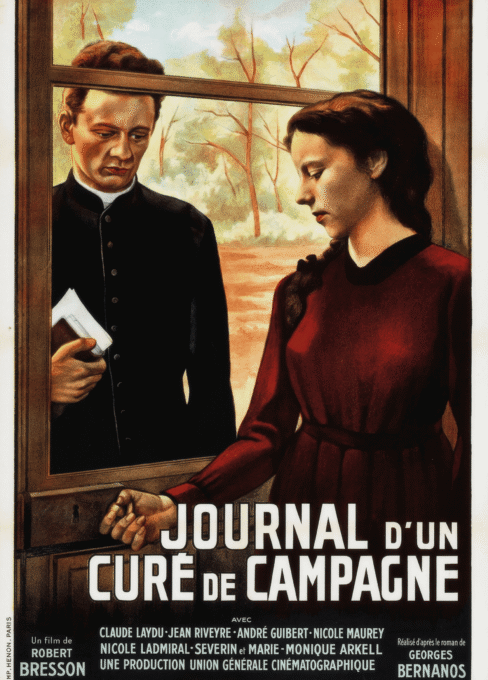
Historical Context and Cinematic Legacy: Released in 1967, Mouchette adapts Georges Bernanos’s short novel Nouvelle histoire de Mouchette — Bresson’s second encounter with Bernanos after Diary of a Country Priest. The film arrived in the same year as the Summer of Love, yet it belongs to no cultural moment — its depiction of rural poverty and systematic cruelty exists outside of time. Bresson’s refusal to sentimentalize suffering or offer the audience a single moment of cathartic relief has made Mouchette a touchstone for filmmakers committed to moral seriousness — from the Dardenne brothers to Cristian Mungiu to Chloé Zhao. The film demonstrates Bresson’s most radical conviction: that cinema’s highest function is not to make us feel, but to make us see — and that seeing clearly, without the comfort of aesthetic distance, is itself a moral act.
You cannot copy content of this page

It's free. No subscription required

Comments (0)
Please login to comment.
Please login to review.