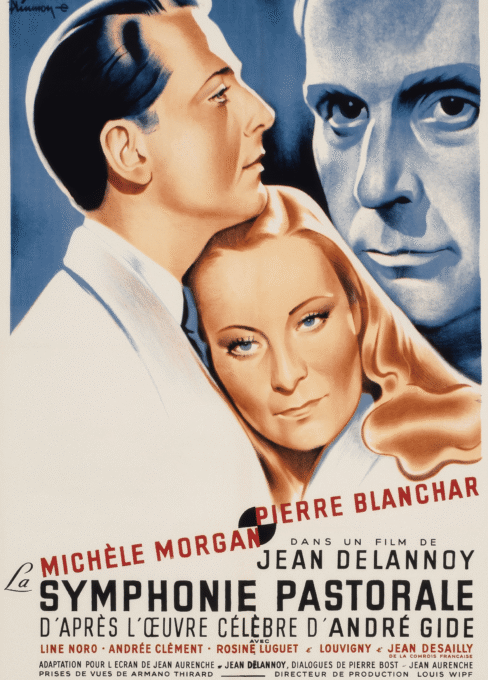
Synopsis and Main Themes: In a snow-bound Swiss alpine village, a Protestant pastor takes in a young blind orphan, Gertrude, and raises her alongside his own family. As Gertrude grows into a young woman, the pastor — already married — falls in love with her without admitting it to himself, using Scripture to justify feelings he refuses to name. His eldest son Jacques loves her too, honestly and openly. When a medical operation restores Gertrude's sight, she sees clearly — not only the world around her, but what the pastor's love has actually cost. The film turns on self-deception, the corruption of piety, and the cruelty that good intentions can conceal.
About the Director and Cinematic Style: Jean Delannoy was born in 1908 near Paris and came to directing through acting, journalism, and a long apprenticeship as a film editor at Paramount's Joinville studios in the early 1930s. By 1946 he had already directed L'Éternel Retour (1943), written by Jean Cocteau, which established him as a director capable of literary prestige and visual atmosphere. In La Symphonie pastorale, his refined craftsmanship is everywhere apparent: Armand Thirard's black-and-white photography transforms the Swiss alpine landscape into a moral arena, its frozen whiteness both beautiful and merciless, while the taut editing gives the weighty dialogue room to breathe without becoming static.
Critical Reception and Impact: La Symphonie pastorale won the Grand Prix — the festival's highest prize, equivalent to the later Palme d'Or — at the inaugural Cannes Film Festival in 1946. Michèle Morgan received the Best Actress award, becoming the first winner of this prize in Cannes history. Georges Auric's score received the Grand Prix de la S.A.C.E.M. for best musical score. The film was an international success, widely regarded at the time as the finest French film of the postwar period. It remains Delannoy's most celebrated work and the film that secured his international reputation.
Historical Context and Cinematic Legacy: André Gide published his novella in 1919, in the aftermath of the First World War, as a study in moral self-deception under the guise of Christian virtue. Delannoy and screenwriter Jean Aurenche transposed it to the screen in 1946 with the wounds of a second war still fresh — a moment when questions of complicity, self-justification, and the distance between professed values and actual conduct had acquired urgent historical weight. The use of a Protestant Swiss setting is itself pointed: a landscape of apparent moral clarity that the film systematically undermines. Later critics, particularly those of the French New Wave, were less kind to Delannoy, seeing the film's polished surface as emblematic of the stifling "tradition of quality" in French cinema. But La Symphonie pastorale endures as a model of literary adaptation, and Gide's novella has continued to attract filmmakers and theater directors across cultures and generations.
You cannot copy content of this page

It's free. No subscription required