

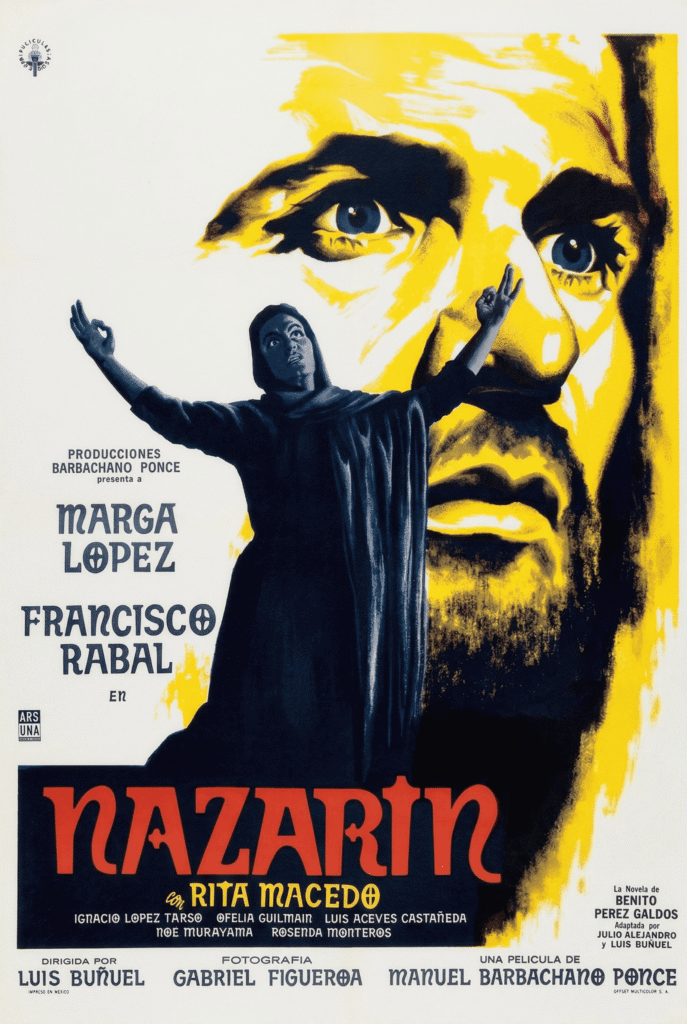
Original title: Nazarín
Based on: Novel by Benito Pérez Galdós (1895); adapted for the screen by Julio Alejandro and Luis Buñuel
Director: Luis Buñuel
Screenplay: Julio Alejandro, Luis Buñuel; dialogue by Emilio Carballido
Cinematography: Gabriel Figueroa
Music: Rodolfo Halffter
Cast: Francisco Rabal, Marga López, Rita Macedo, Ignacio López Tarso, Ofelia Guilmáin, Luis Aceves Castañeda, Noé Murayama, Rosenda Monteros
Filming locations: Jonacatepec, Morelos, Mexico
Subtitles: English (EN), Romanian (RO)
Synopsis and Main Themes: Father Nazarín is a Catholic priest in turn-of-the-century Mexico who takes the teachings of Christ literally — giving away everything he owns, sheltering the outcast, turning the other cheek without exception. But his radical charity brings him nothing but disaster: he is expelled from his parish, pursued by the law, and followed by two troubled women whose devotion to him is tangled with need and obsession. Every act of goodness provokes a worse consequence. The film explores whether pure Christian virtue can exist in the real world, or whether saintliness, divorced from human complexity, becomes its own form of destruction.
About the Director and Cinematic Style: Luis Buñuel, the great surrealist provocateur, approaches Nazarín with a deceptive simplicity that masks one of his most subversive arguments. The film is shot in stark, neo-realist black and white by Gabriel Figueroa, Mexico’s greatest cinematographer, whose compositions of dusty roads, crumbling walls, and harsh sunlight strip away any romantic notion of poverty or holiness. Buñuel refuses to mock Nazarín openly — instead, he lets reality dismantle the priest’s idealism with methodical, almost clinical precision.
Critical Reception and Impact: Nazarín won the International Grand Prix at the 1959 Cannes Film Festival. The award was controversial — Catholic critics celebrated what they saw as a sincere portrait of Christian devotion, while Buñuel’s admirers recognized it as a devastating critique of that very devotion. Buñuel himself remained characteristically ambiguous, reportedly saying that if the film seemed pro-Catholic, he had failed. The ambiguity has only deepened the film’s reputation over the decades, making it one of the most debated works in Buñuel’s career.
Historical Context and Cinematic Legacy: Made in 1959 during Buñuel’s prolific Mexican period, Nazarín adapts a novel by the Spanish writer Benito Pérez Galdós, transposing its setting from 19th-century Spain to Porfirian Mexico. The film occupies a pivotal position in Buñuel’s filmography — it marks the transition from his Mexican commercial work to the late masterpieces that would follow his return to European production with Viridiana (1961), a film that extends Nazarín’s central question with even more corrosive irony. Tarkovsky admired Nazarín deeply, and its influence can be felt in the spiritual wanderings of Andrei Rublev. The film remains one of cinema’s most unsettling examinations of what happens when absolute goodness meets an indifferent world — a question Buñuel poses without ever offering the comfort of an answer.
You cannot copy content of this page

It's free. No subscription required

Comments (0)
Please login to comment.
Please login to review.