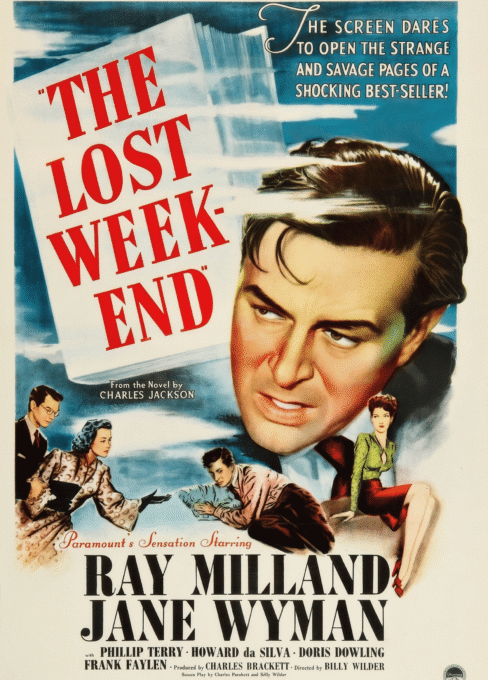
Synopsis and Main Themes: Don Birnam, a New York writer blocked by self-doubt and consumed by alcoholism, manages to stay behind in his apartment while his brother and girlfriend leave for a weekend trip. What follows is a four-day descent: through bars and pawnshops, through theft and humiliation, through the detoxification ward at Bellevue and the hallucinatory terrors of delirium tremens. The film refuses moral distance — Wilder places the camera inside Don's craving, making the audience feel the pull of the next drink as much as its destruction. Addiction here is not weakness but illness, and the film was among the first in Hollywood to insist on that distinction.
About the Director and Cinematic Style: Billy Wilder was born in Austria-Hungary in 1906 and fled Europe after Hitler's rise, arriving in Hollywood in 1933 with barely enough English to write a script. By 1945 he had already co-written Ninotchka (1939) and directed Double Indemnity (1944), establishing himself as one of the most technically accomplished and cynically observant filmmakers in Hollywood. In The Lost Weekend, he uses John F. Seitz's deep-focus cinematography and Miklós Rózsa's theremin score to construct a New York that feels simultaneously real — much of it shot on location on Third Avenue and at Bellevue — and inescapably claustrophobic, a city that offers no exit for a man determined to stay inside his own need.
Critical Reception and Impact: The Lost Weekend received seven Academy Award nominations at the 18th ceremony in 1946 and won four: Best Picture, Best Director, Best Actor for Ray Milland, and Best Adapted Screenplay. At Cannes the same year, it shared the Grand Prix du Festival and Milland won Best Actor a second time. It also won Golden Globes for Best Picture, Best Director, and Best Actor. The Hollywood Reporter called it the best horror picture of the year and one of the finest pieces of filmmaking Hollywood had produced in many years. It is one of only four films in history — alongside Marty (1955), Parasite (2019), and Anora (2024) — to have won both the Academy Award for Best Picture and the highest prize at Cannes. In 2011 it was inducted into the National Film Registry.
Historical Context and Cinematic Legacy: The Lost Weekend arrived at a moment when Hollywood studios routinely avoided subjects considered too dark, morally ambiguous, or socially disreputable for mainstream audiences. The liquor industry mounted a campaign to suppress the film before its release, reportedly offering Paramount five million dollars to destroy the negative — an offer Wilder cheerfully declined. Its frank treatment of alcoholism as a medical condition rather than a moral failing marked a turning point in what American cinema was permitted to say about human behavior, opening a path that led through the social problem films of the late 1940s and early 1950s to the more unsparing cinema of the following decades. Wilder himself went on to direct Sunset Boulevard (1950), Stalag 17 (1953), Witness for the Prosecution (1957), and Some Like It Hot (1959), consolidating a body of work unmatched in its range across tone and genre. The Lost Weekend remains his most morally serious film, and the one that most clearly announced what Hollywood was capable of when it chose honesty over comfort.
You cannot copy content of this page

It's free. No subscription required