

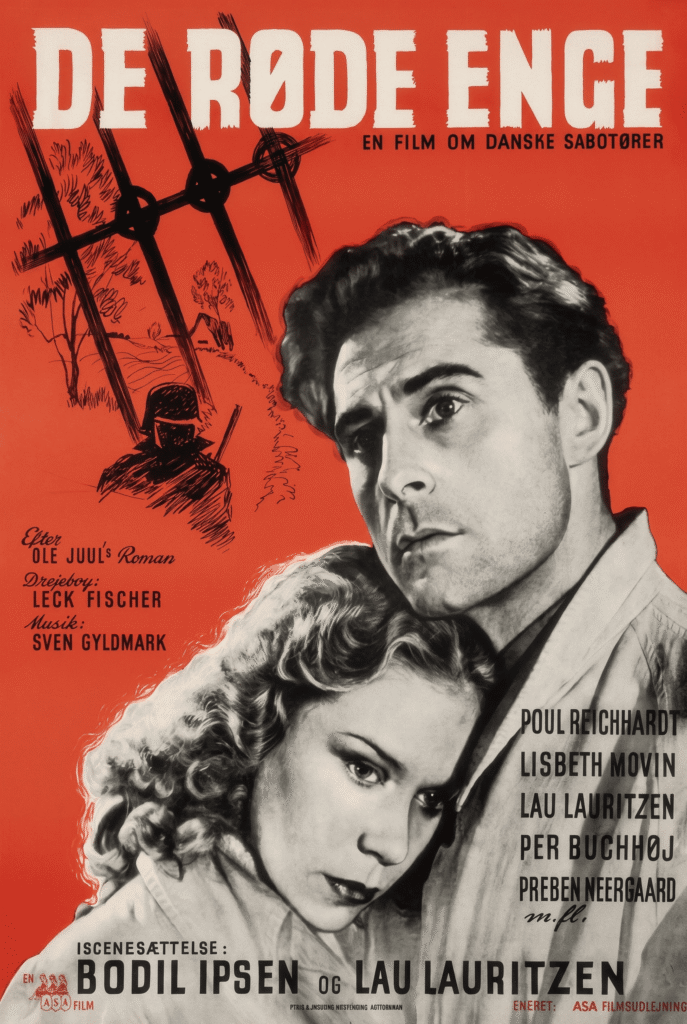
Original title: De røde enge
Based on: the play by Leck Fischer and the novel by Ole Juul
Director: Bodil Ipsen, Lau Lauritzen
Screenplay: Leck Fischer, Ole Juul
Cinematography: Rudolf Frederiksen
Music: Sven Gyldmark
Cast: Poul Reichhardt, Lisbeth Movin, Per Buckhøj, Gyrd Løfquist, Kjeld Jacobsen, Preben Kaas, Arne Hersholdt, Karl Jørgensen, Lau Lauritzen, Preben Neergaard
Filming locations: Denmark (specific locations not documented on IMDb)
Subtitles: English (EN), Romanian (RO)
Synopsis and Main Themes:
In a Gestapo prison cell, young Danish saboteur Michael awaits execution. Through a series of flashbacks, he retraces the events that led to his capture: a weapons airdrop on the Jutland moors, the planning of a factory sabotage, and a traitor hidden within the resistance group. De røde enge weaves together fatalism and collective courage, exploring how ordinary people bear the weight of impossible choices under occupation — and what it costs them to remain human.
About the Director and Cinematic Style:
Bodil Ipsen (1889–1964) began her career on the stage of the Royal Danish Theatre, becoming one of Denmark’s most celebrated actresses before turning to directing in 1942. Her debut, Afsporet, co-directed with Lau Lauritzen Jr., was the first Danish film noir. De røde enge, their second collaboration, channels the visual grammar of American noir — low-key lighting, fragmented narrative, claustrophobic interiors — into an unmistakably European wartime register, grounding tension in character rather than action.
Critical Reception and Impact:
De røde enge premiered in Denmark in 1945, months after the end of the German occupation, and was received as both an artistic achievement and an act of national witness. At the inaugural Cannes Film Festival in 1946 — the first held after World War II — it was among eleven films awarded the Grand Prix du Festival International du Film, the highest prize of the festival and predecessor to the Palme d’Or. Bodil Ipsen became the first woman to receive this distinction.
Historical Context and Cinematic Legacy:
The inaugural Cannes Film Festival of 1946 was itself a statement: held only one year after the end of World War II, it gathered cinema from nations that had been at war or under occupation, and almost every competing film bore the mark of that experience. De røde enge was shot in Denmark in the summer of 1945 — the bodies of executed resistance fighters, as one contemporary observer noted, barely cold. That proximity to lived reality gives the film an authenticity no reconstruction could replicate. Within Danish cinema, it stands as a founding document of a national noir tradition that Ipsen and Lauritzen had begun with Afsporet (1942). Its influence reaches forward into the spare, morally serious films of the Danish New Wave and, more recently, into the international success of Scandinavian crime drama, which inherits its preference for psychological pressure over spectacle. The film remains a touchstone of Danish film history and a rare wartime document made by those who had just lived through what they were filming.
You cannot copy content of this page

It's free. No subscription required

Comments (0)
Please login to comment.
Please login to review.