

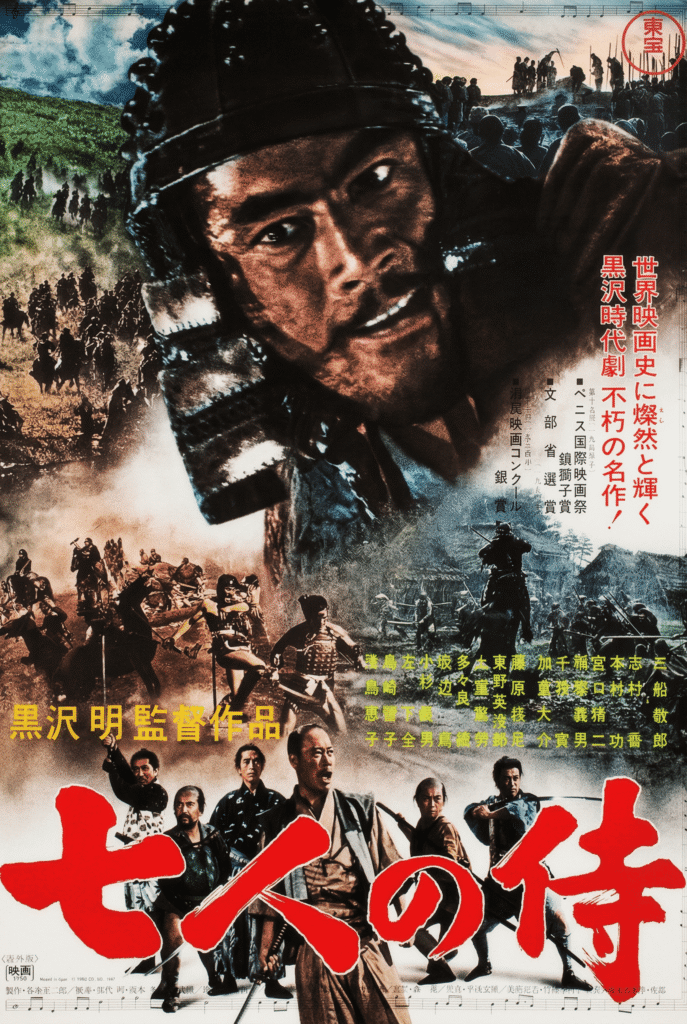
Original title: Shichinin no Samurai
Based on: Original screenplay by Akira Kurosawa, Shinobu Hashimoto, Hideo Oguni
Director: Akira Kurosawa
Screenplay: Akira Kurosawa, Shinobu Hashimoto, Hideo Oguni
Cinematography: Asakazu Nakai
Music: Fumio Hayasaka
Cast: Toshirô Mifune, Takashi Shimura, Keiko Tsushima, Kamatari Fujiwara, Daisuke Katô, Isao Kimura, Minoru Chiaki, Seiji Miyaguchi
Filming locations: Izu Peninsula, Shizuoka, Japan; Toho Studios, Tokyo
Subtitles: English (EN), Romanian (RO)
Synopsis and Main Themes: A defenseless farming village, terrorized by bandits who return after every harvest to steal their crops, sends a delegation to find samurai willing to fight for nothing more than food. They recruit seven — each with his own reasons, his own wounds, his own relationship to honour. What follows is a meticulously orchestrated siege in which the samurai train the farmers to defend themselves and together face a force that vastly outnumbers them. The film explores class, duty, sacrifice, the futility of violence, and the bitter truth that those who fight are rarely those who reap the harvest.
About the Director and Cinematic Style: Akira Kurosawa spent over a year preparing Seven Samurai, creating detailed biographies for every character before writing a single scene. The result is a film of extraordinary narrative density — three and a half hours that feel like a single breath. Kurosawa’s use of multiple cameras, telephoto lenses, and dynamic editing revolutionized action filmmaking. The battle in the rain — mud-soaked, chaotic, stripped of all romance — remains one of the most viscerally powerful sequences ever filmed. Asakazu Nakai’s cinematography shifts between sweeping landscape compositions and intimate, almost documentary close-ups of exhausted faces.
Critical Reception and Impact: Seven Samurai won the Silver Lion at the 1954 Venice Film Festival and was nominated for two Academy Awards. Its commercial success in Japan was enormous, though its unprecedented production cost and extended shooting schedule had nearly bankrupted Toho Studios. International reception was rapturous — Western critics recognized immediately that Kurosawa had created something that transcended genre: an action film with the depth of a novel, a war film with the compassion of a humanist treatise.
Historical Context and Cinematic Legacy: Released in 1954, less than a decade after Japan’s defeat in the Second World War, Seven Samurai emerged from a nation redefining its relationship to its own martial past. Kurosawa, deeply influenced by John Ford and the American Western, created a film that would in turn reshape Hollywood itself — The Magnificent Seven (1960) was its direct remake, and its structural DNA flows through every team-assembly narrative from The Dirty Dozen to the Marvel Cinematic Universe. But the film’s deepest legacy lies not in its action sequences but in its final image: the samurai graves on the hillside, the farmers singing in the rice paddies below. The warriors won the battle but lost the war — and the farmers, who needed them and then forgot them, inherit the earth. No action film before or since has ended with such devastating moral clarity.
You cannot copy content of this page

It's free. No subscription required

Comments (0)
Please login to comment.
Please login to review.