

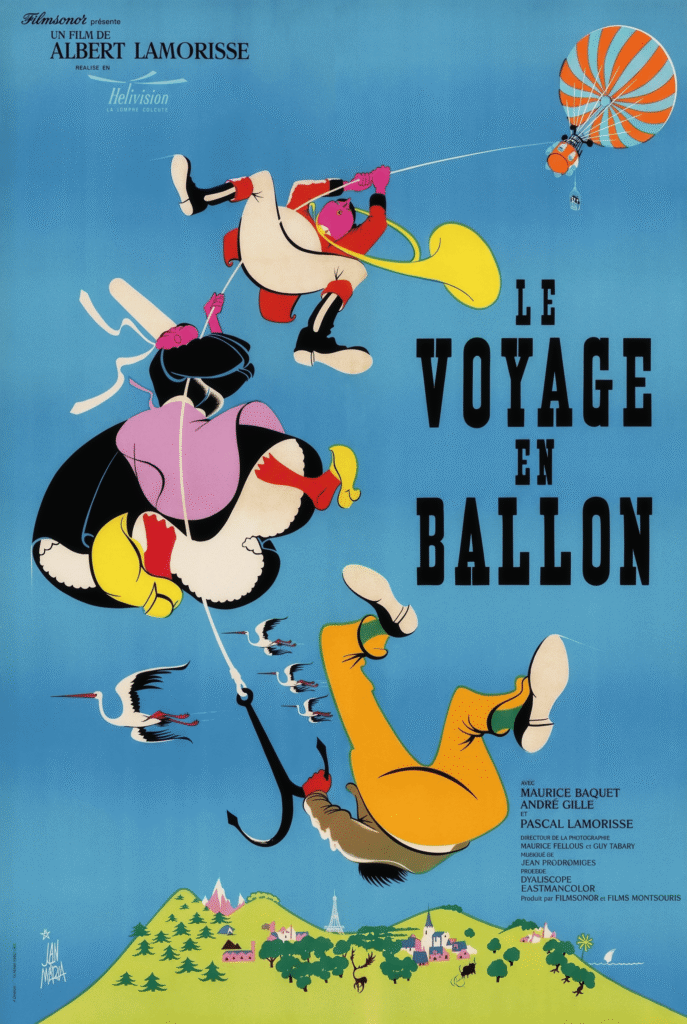
Original title: Le voyage en ballon
Based on: Original screenplay by Albert Lamorisse
Director: Albert Lamorisse
Screenplay: Albert Lamorisse
Cinematography: Maurice Fellous, Guy Tabary
Music: Jean Prodromidès
Cast: André Gille, Maurice Baquet, Pascal Lamorisse, Charles Bayard, Jack Lemmon (Narrator, English version), Louis Saintève, Paul Villé
Filming locations: El Torcal, Antequera, Málaga, Spain; France (aerial footage)
Subtitles: English (EN), Romanian (RO)
Synopsis and Main Themes: A French inventor builds a hot-air balloon and sets off on a journey across France with his mechanic. His young grandson Pascal stows away at the last moment, transforming a solitary adventure into something shared and unexpected. Seen from above, France becomes a landscape of cathedrals, vineyards, mountain ranges, and coastal light — a country made strange and beautiful by altitude. The film is less a story of plot than of wonder: what the world looks like when you have left the ground and are not yet sure where you will land.
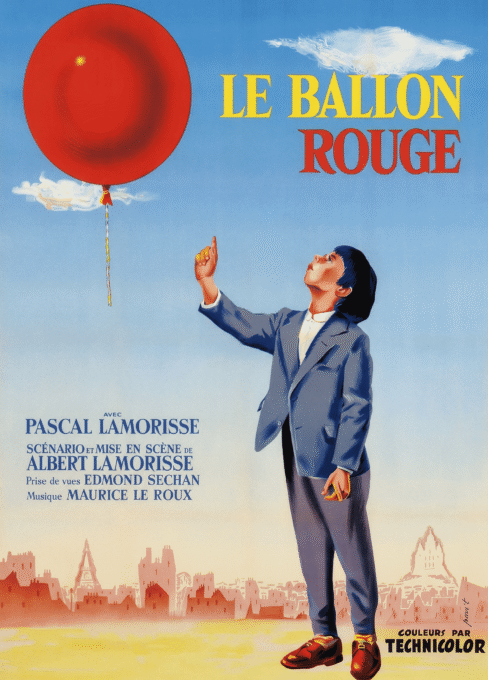
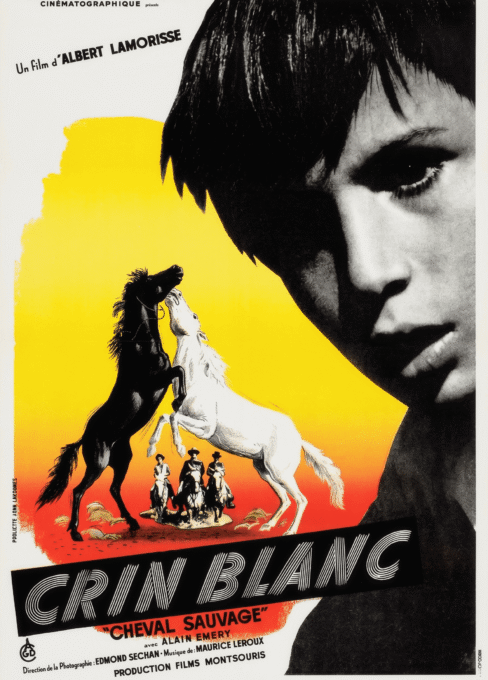
About the Director and Cinematic Style: By 1960 Albert Lamorisse had already won the Palme d’Or at Cannes twice — for White Mane (1953) and The Red Balloon (1956) — and Stowaway in the Sky was his first feature-length work. For it, he developed Hélivision, a system of aerial photography using a camera mounted on a helicopter, which allowed him to film the balloon in flight from perspectives that had never appeared in cinema before. The result is a film that often feels less like narrative fiction than like a sustained visual poem — France seen from the height of clouds, in Eastman Color, with a lightness that no studio could fabricate.
Critical Reception and Impact: The film was received warmly at its French premiere in September 1960 and screened in competition at the Venice Film Festival the same year, where it received the OCIC Award. Jack Lemmon, who narrated the English-language version, was so taken with the film that he purchased the American distribution rights — an unusual act of personal enthusiasm from a major Hollywood star. The film reached American audiences in 1962 under the title Stowaway in the Sky.
Historical Context and Cinematic Legacy: Stowaway in the Sky arrived at a pivotal moment in French cinema — the same year that Godard, Truffaut, and Chabrol were reshaping what film could be — yet it belonged to none of those conversations. Lamorisse had always operated outside critical fashion, and this film consolidated what was already clear: that his subject was not society or psychology but the physical world itself — its light, its scale, its indifference to human drama. The Hélivision technique he invented for this film was subsequently adopted for aerial sequences in the early James Bond productions, among other uses. Lamorisse died in 1970 while shooting an aerial documentary in Iran; the film he was making, The Lovers’ Wind, was completed by his family from his notes and received a posthumous Oscar nomination for Best Documentary Feature in 1979.
You cannot copy content of this page

It's free. No subscription required

Comments (0)
Please login to comment.
Please login to review.