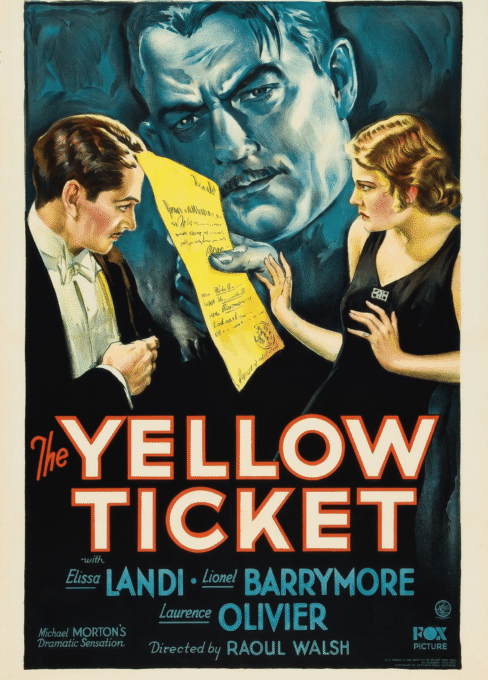
Synopsis and Main Themes: In Czarist Russia of 1913, Marya Kalish, a young Jewish teacher, applies for the "yellow ticket" — the travel document issued only to prostitutes — in order to reach her dying father imprisoned in Saint Petersburg. Once there, she meets Julian Rolfe, a British journalist, while falling under the predatory attention of the powerful Baron Andrey. The film turns on the degradation imposed by a discriminatory system and the price a woman pays simply to move freely through her own country.
About the Director and Cinematic Style: Raoul Walsh (1887–1980), born in New York and apprenticed under D.W. Griffith, had been directing since 1915, accumulating a long career at Fox that included silent landmarks such as The Thief of Bagdad (1924) and What Price Glory? (1926). By 1931 he was navigating the demands of early sound cinema, and The Yellow Ticket gave him the opportunity to collaborate with cinematographer James Wong Howe, one of the most innovative cameramen of the era. Together they brought to the film astonishingly composed sequences built on deep-focus photography and dramatic shadow — a visual ambition that set the film apart from more theatrically inert stage adaptations of the period.
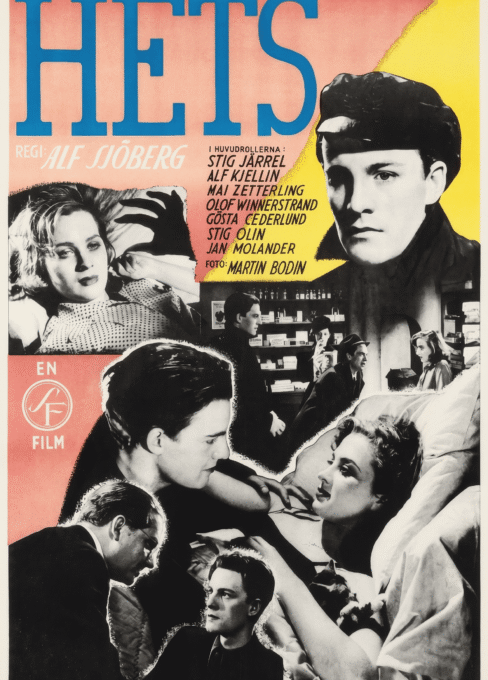
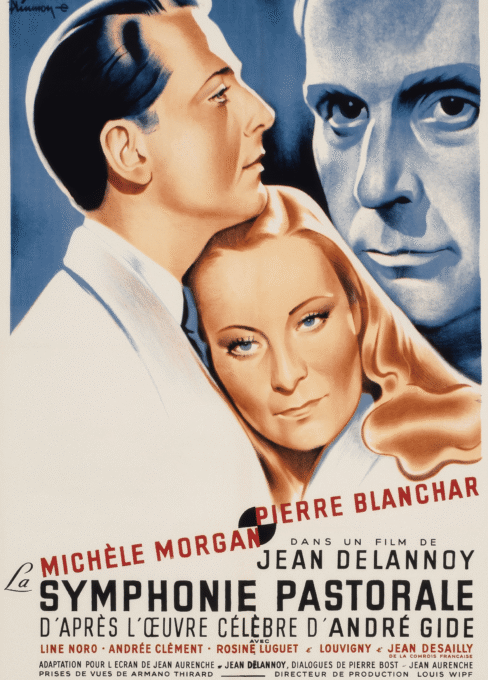
Critical Reception and Impact: The Yellow Ticket received modest contemporary attention, recognized primarily as a vehicle for Lionel Barrymore's domineering villainy and as an early screen appearance for a twenty-four-year-old Laurence Olivier, borrowed from RKO for the role. Its frank treatment of sexual coercion and brief nudity marked it as a distinctly pre-Code production. In August 1932, it was among the titles selected for the inaugural Venice Film Festival — a noncompetitive event where an audience referendum stood in for official jury prizes.
Historical Context and Cinematic Legacy: The Yellow Ticket arrived at a moment when pre-Code Hollywood could engage openly with antisemitism, state violence, and sexual exploitation in ways that would soon become impossible under the Production Code of 1934. Its subject — the "yellow ticket" system that confined Jewish women to a degraded status in Tsarist Russia — carried immediate political resonance for American audiences in the early 1930s. The film is also a document of a transitional cinematic moment: the collaboration between Walsh and James Wong Howe produced visual solutions whose ambition anticipated the deep-focus work that would later define 1940s Hollywood cinematography. The play itself had already been adapted multiple times — in 1916, 1918, and 1928 — and the 1931 version remains the most cinematically distinguished of the cycle.
You cannot copy content of this page

It's free. No subscription required