

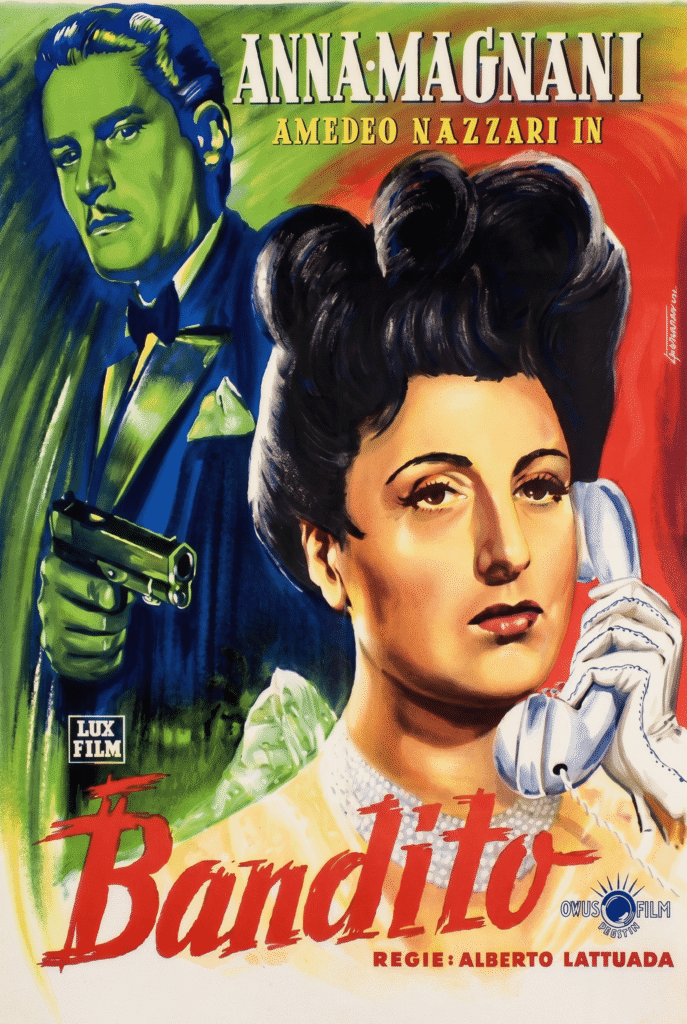
Original title: Il bandito
Based on: Original screenplay by Alberto Lattuada, Oreste Biancoli, Mino Caudana
Director: Alberto Lattuada
Screenplay: Alberto Lattuada, Oreste Biancoli, Mino Caudana
Cinematography: Aldo Tonti
Music: Felice Lattuada
Cast: Anna Magnani, Amedeo Nazzari, Carla Del Poggio, Carlo Campanini, Eliana Banducci, Mino Doro, Folco Lulli, Mario Perrone, Amato Garbini, Gianni Appelius
Filming locations: Lux Film, R.D.L. (Turin, Piedmont, Italy)
Subtitles: English (EN), Romanian (RO)
Synopsis and Main Themes: Ernesto returns to Turin from a German prisoner-of-war camp to find his city in ruins, his mother dead, and his sister vanished. When he finally traces her to a brothel and the confrontation turns fatal, he becomes a fugitive — and falls into the orbit of Lidia, a prostitute who leads a gang of robbers. The film moves from the rawness of postwar destitution to noir melodrama, tracing a man destroyed not by the war itself but by what the war left behind: a world that offers no path back to ordinary life.
About the Director and Cinematic Style: Alberto Lattuada was born in Milan in 1914, the son of composer Felice Lattuada. Trained as an architect and active as a film critic and photographer, he co-founded the Cineteca Italiana in Milan in 1940 before directing his first feature, Giacomo l’idealista, in 1943. Il bandito was his third film and his most explicit engagement with the postwar moment. Lattuada’s approach is deliberately hybrid: location shooting and non-professional extras give the Turin sequences documentary force, while his editing — which he considered the core of filmmaking — drives the film into noir territory with a controlled, unsentimental rhythm.
Critical Reception and Impact: Il bandito was selected for the Official Competition at Cannes in 1946 without winning a prize. Amedeo Nazzari won the Nastro d’Argento for Best Actor for his performance — the Italian industry’s recognition of a role of considerable emotional range. Critics noted the film’s uneasy but productive tension between neorealist observation and Hollywood genre conventions: the Turin of bombed streets and bureaucratic indifference belongs to Rossellini’s world, while the gangster sequences that follow draw from American noir. The pairing of Nazzari and Anna Magnani — electric in their few shared scenes — was widely remarked upon.
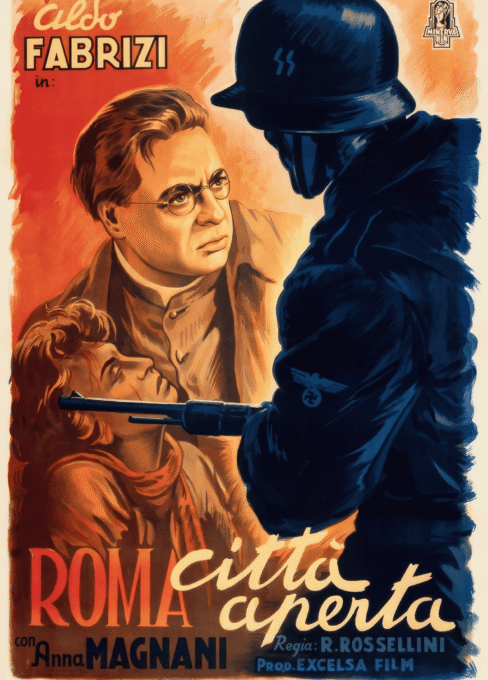
Historical Context and Cinematic Legacy: Il bandito belongs to the wave of Italian films made in 1945–46 that confronted the psychological wreckage of war and occupation, alongside Rossellini’s Rome, Open City and De Sica’s Shoeshine. Where those films center on collective suffering, Lattuada focuses on individual moral collapse — on what happens to a man when every institution that might absorb his return has ceased to function. The film anticipates later Italian crime cinema and the social fatalism of filmmakers like Francesco Rosi. Lattuada himself went on to co-direct Variety Lights (1950) with Federico Fellini — whose early career he actively supported — and to direct what many consider his masterpiece, The Overcoat (1952), an adaptation of Gogol. A retrospective of his work at the Locarno Film Festival in 2021 helped restore his place as one of the most original and underestimated directors of postwar Italian cinema.
You cannot copy content of this page

It's free. No subscription required
Comments (0)
Please login to comment.
Please login to review.