

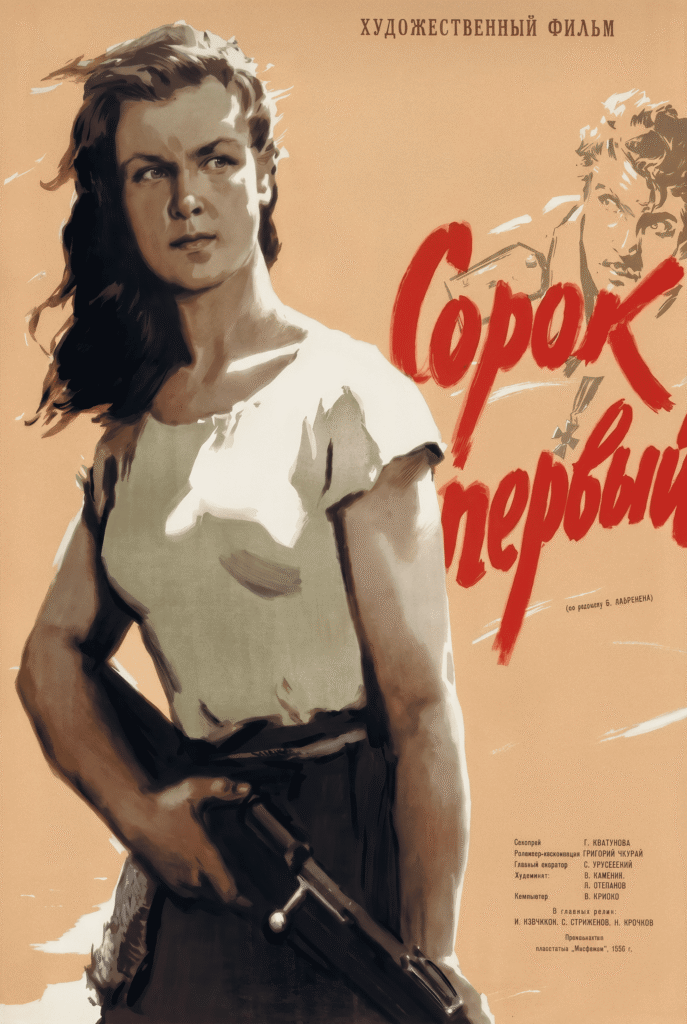
Original title: Sorok pervyy
Based on: Novel “Sorok pervyj” by Boris Lavrenyev
Director: Grigoriy Chukhray
Screenplay: Grigoriy Koltunov
Cinematography: Sergey Urusevskiy
Music: Nikolai Kryukov
Cast: Izolda Izvitskaya, Oleg Strizhenov, Nikolay Kryuchkov, Nikolai Dupak, Georgi Shapovalov, Pyotr Lyubeshkin, Lev Kovylin, Yuriy Romanov, Daniil Netrebin, Asanbek Umuraliyev
Filming locations: Karakum desert, Turkmenistan; Mosfilm Studios, Moscow
Subtitles: English (EN), Romanian (RO)
Synopsis and Main Themes: During the Russian Civil War, a Red Army unit retreating across the Karakum desert captures a White Army officer, Lieutenant Govorukha-Otrok, and assigns sniper Maryutka — who has forty confirmed kills — to guard him. Stranded together on a desert island after a shipwreck on the Aral Sea, the two enemies fall in love. The film holds the tension between ideology and feeling without resolving it in favor of either — and its ending, one of the most devastating in Soviet cinema, refuses every form of consolation.
About the Director and Cinematic Style: The Forty-First was Grigoriy Chukhray’s feature debut. A decorated WWII paratrooper wounded four times — including at Stalingrad — Chukhray brought to his filmmaking a soldier’s knowledge of what war costs at the level of the individual body and conscience. His visual approach in this film is shaped in equal measure by the extraordinary cinematography of Sergey Urusevskiy, whose handling of desert light, open water, and the isolation of the island gives the film the quality of a landscape painting in motion. Chukhray keeps ideology present but never lets it overwhelm the human particularity of his two protagonists.
Critical Reception and Impact: The Forty-First was received with considerable enthusiasm both in the Soviet Union — where it was a major box office success — and internationally. At the 10th Cannes Film Festival in 1957, it received the Special Jury Prize, with the jury’s citation specifically honoring its “genuine script, humanism, and high poetry.” The award marked a significant moment: a Soviet film being recognized at Cannes for its humanity rather than its ideology, at the height of the Cold War.
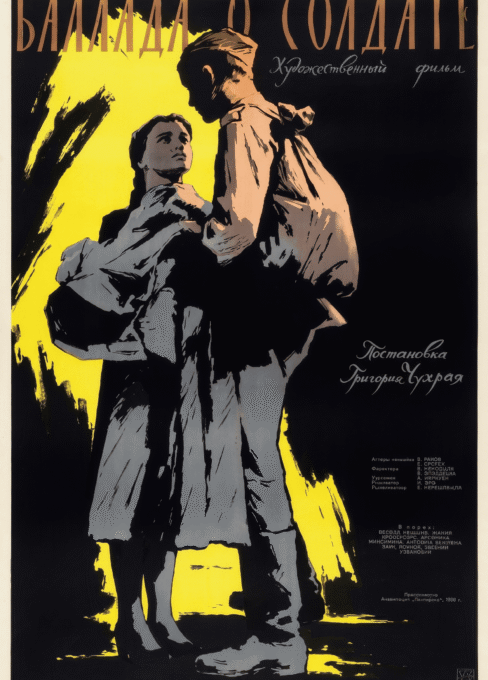
Historical Context and Cinematic Legacy: The Forty-First appeared in 1956, the year of Khrushchev’s secret speech denouncing Stalin — a pivotal moment of cultural thaw in the Soviet Union. The film would have been impossible just a few years earlier: its central romance between soldiers on opposite sides of the Civil War carried an implicit critique of ideological absolutism that Stalin-era censors would never have permitted. Chukhray navigated this carefully, but the film’s emotional logic is unmistakable — love does not recognize class enemies. Together with Ballad of a Soldier (1959) and The Cranes Are Flying (1957), The Forty-First forms the core of what historians now call Thaw Cinema — a body of Soviet films that reasserted the individual human being at the center of history, against decades of collectivist abstraction. Urusevskiy’s cinematography, in particular, became a reference point for an entire generation of Soviet and Eastern European directors.
You cannot copy content of this page

It's free. No subscription required
Comments (0)
Please login to comment.
Please login to review.