

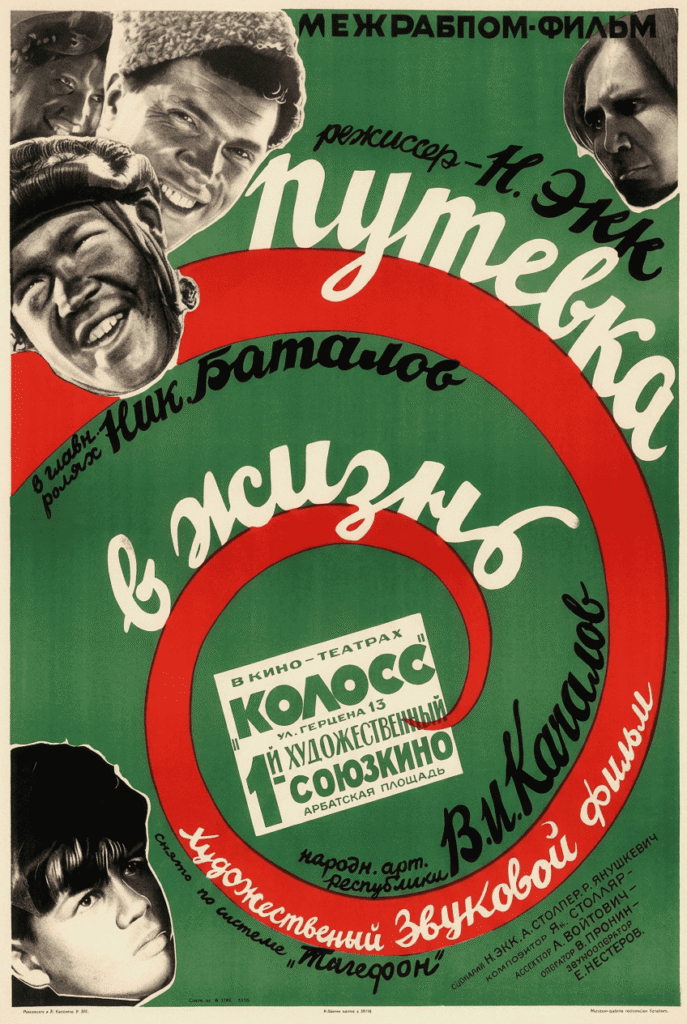
Original title: Putyovka v zhizn
Based on: Original screenplay by Nikolai Ekk and Aleksandr Stolper, inspired by the pedagogical ideas of Anton Makarenko
Director: Nikolai Ekk
Screenplay: Nikolai Ekk, Anton Makarenko, Aleksandr Stolper
Cinematography: Vasili Pronin
Music: —
Cast: Nikolay Batalov, Yvan Kyrlya, Mikhail Dzhagofarov, Mikhail Zharov, Aleksandr Novikov, Mariya Andropova, Vladimir Vesnovsky, Mariya Gonfa, Vasili Kachalov (narrator)
Filming locations: Mezhrabpomfilm Studios, Soviet Union
Subtitles: English (EN), Romanian (RO)
Synopsis and Main Themes: In the chaotic aftermath of revolution and civil war, Moscow’s streets are overrun with homeless children — orphaned, hardened, and organized into criminal gangs. A determined state educator named Sergei proposes a radical alternative to prison: a labor colony where the boys will build a railway with their own hands and, in doing so, rebuild themselves. The film balances genuine tenderness toward its young protagonists with the severity of their circumstances, asking whether society can reclaim those it has already abandoned — and at what cost.
About the Director and Cinematic Style: Nikolai Ekk was born in 1902 in Riga and trained at the State Institute of Cinematography in Moscow (GIK), studying alongside the generation shaped by Eisenstein and Pudovkin. The Road to Life was his feature debut — and a landmark one. Working with the domestically developed Tagephone sound-on-film system, Ekk avoided the static theatricality that plagued most early talkies, keeping his camera fluid and his montage instincts intact. He cast non-professional street children alongside trained actors, lending the film an urgency that no studio performance could replicate.
Critical Reception and Impact: The film was an immediate success both at home and internationally, enjoying lengthy theatrical runs in Europe and the United States. At the inaugural Venice International Film Festival in 1932, Nikolai Ekk received the prize for Most Convincing Director — determined by audience referendum. American critics responded with enthusiasm; Lincoln Kirstein, writing for Arts Weekly, called it unforgettable and compared it favorably to the finest newsreels of the era.
Historical Context and Cinematic Legacy: The Road to Life arrived at a moment when the Soviet Union was confronting the mass phenomenon of hundreds of thousands of street children left without shelter after years of war, revolution, and famine. The film drew directly on the pedagogical ideas of Anton Makarenko, whose labor colony experiments had attracted official attention, and translated them into a piece of socialist-realist cinema before that doctrine had fully hardened into dogma. Technically, its significance was decisive: as the first Soviet sound feature, it established the parameters for an entire national cinema’s transition to the new medium. Its influence extended beyond the USSR — the film circulated widely in Europe and shaped early debates about socially committed filmmaking. Decades later, its portrait of institutional redemption and the fate of children no one will claim continues to resonate, earning retrospectives at the Museum of Modern Art in New York and major film archives worldwide.
You cannot copy content of this page

It's free. No subscription required
Comments (0)
Please login to comment.
Please login to review.