

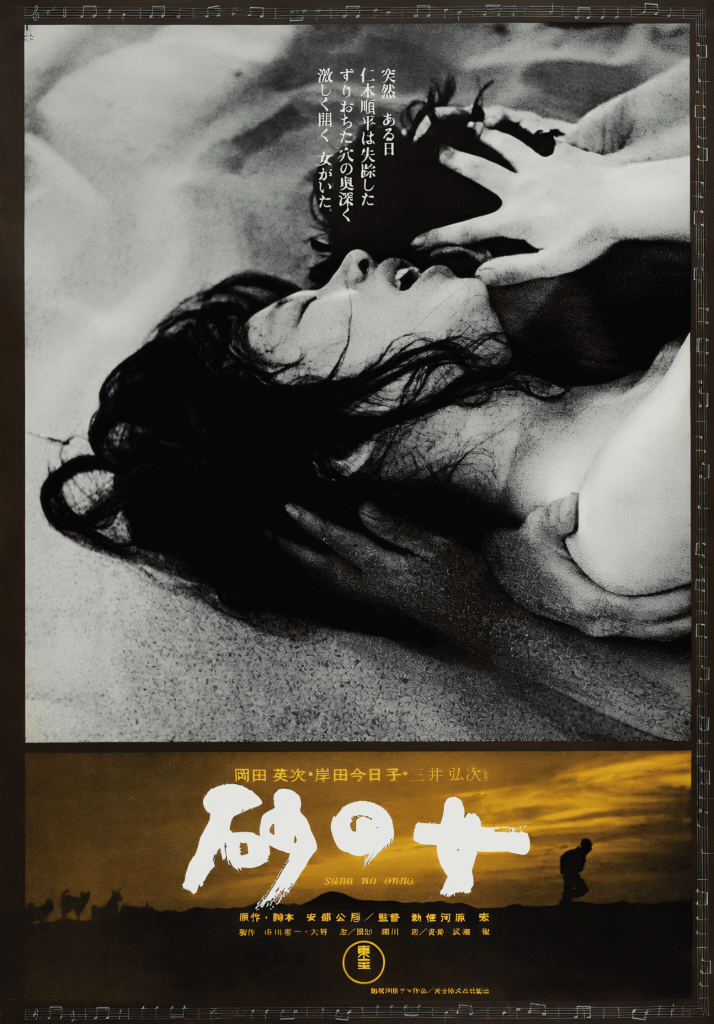
Original title: Suna no Onna
Based on: Novel by Kôbô Abe (1962)
Director: Hiroshi Teshigahara
Screenplay: Kôbô Abe
Cinematography: Hiroshi Segawa
Music: Tôru Takemitsu
Cast: Eiji Okada, Kyôko Kishida, Kôji Mitsui, Hiroko Itô, Sen Yano
Filming locations: Tottori Sand Dunes, Tottori Prefecture, Japan
Subtitles: English (EN), Romanian (RO)
Synopsis and Main Themes: An amateur entomologist searching for rare insects in the sand dunes along the Japanese coast is offered shelter for the night at the bottom of a deep sand pit, in the house of a young widow. By morning, he discovers the ladder has been removed — he is trapped. The woman’s task, and now his, is to shovel sand endlessly to prevent the pit from swallowing the house. Escape attempts fail, rage gives way to exhaustion, exhaustion to routine, routine to something resembling acceptance. The film explores captivity and freedom, the absurdity of labour, desire born of confinement, and the slow, unsettling discovery that the prison may be indistinguishable from life itself.
About the Director and Cinematic Style: Hiroshi Teshigahara, a filmmaker equally at home in avant-garde art and narrative cinema, transforms Kōbō Abe’s existentialist novel into a sensory experience of extraordinary intensity. Hiroshi Segawa’s cinematography turns sand into a living, breathing antagonist — grains cascade down walls, fill crevices, coat skin and hair until the human body seems to dissolve into landscape. Teshigahara frames his two characters in extreme close-ups and disorienting angles that make the pit feel simultaneously claustrophobic and infinite. Tōru Takemitsu’s score — spare, atonal, percussive — amplifies the film’s atmosphere of entrapment without ever resolving into comfort.
Critical Reception and Impact: Woman of the Dunes won the Special Jury Prize at the 1964 Cannes Film Festival and was nominated for the Academy Award for Best Foreign Language Film and Best Director — an extraordinary double recognition for a Japanese avant-garde work. Critics were stunned by the film’s ability to sustain tension and philosophical inquiry simultaneously across its two-and-a-half-hour runtime. It established Teshigahara as one of the most original voices in world cinema and remains his most celebrated achievement.
Historical Context and Cinematic Legacy: Released in 1964, Woman of the Dunes emerged from a Japanese cultural moment in which existentialist philosophy — imported from Sartre, Camus, and Kafka — was being absorbed and transformed by artists who gave it a distinctly Japanese inflection. Kōbō Abe, who wrote both the novel and the screenplay, was Japan’s foremost literary existentialist, and his collaboration with Teshigahara produced one of the rare cases in which a film equals or surpasses its literary source. The film’s central metaphor — endless, purposeless labour in a hole from which there is no escape — has been read as an allegory for everything from the human condition to postwar Japanese society to the nature of marriage. Its influence reaches from Andrei Tarkovsky, who admired it deeply, to contemporary filmmakers like Apichatpong Weerasethakul and Tsai Ming-liang, who share its commitment to duration, landscape, and the body as a site of philosophical revelation.
You cannot copy content of this page

It's free. No subscription required





Comments (0)
Please login to comment.
Please login to review.