

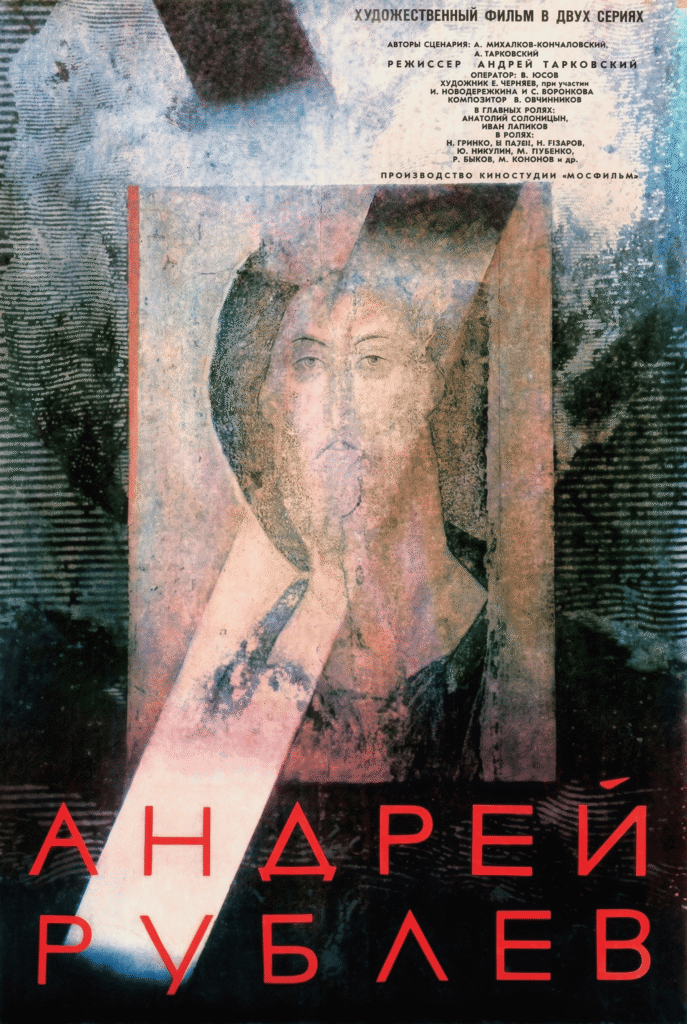
Original title: Andrey Rublyov
Based on: Original screenplay by Andrei Tarkovsky and Andrei Konchalovsky
Director: Andrei Tarkovsky
Screenplay: Andrei Tarkovsky, Andrei Konchalovsky
Cinematography: Vadim Yusov
Music: Vyacheslav Ovchinnikov
Cast: Anatoliy Solonitsyn, Ivan Lapikov, Nikolay Grinko, Nikolay Sergeev, Irma Tarkovskaya, Nikolay Burlyaev, Yuriy Nazarov, Yuriy Nikulin
Filming locations: Pskov, Suzdal, Vladimir, Soviet Union
Subtitles: English (EN), Romanian (RO)
Synopsis and Main Themes: A meditation on the life of Andrei Rublev, the greatest icon painter of medieval Russia, set against the brutal backdrop of the 15th century — a time of Tatar invasions, political fragmentation, and religious upheaval. The film unfolds in eight episodes spanning several decades, tracing Rublev’s spiritual journey from doubt and silence to the transcendent act of creation. At its centre lies a fundamental question: how can an artist sustain faith in beauty and humanity when surrounded by cruelty, destruction, and suffering? The film explores art, conscience, violence, faith, and the ambiguous relationship between the individual and history.
About the Director and Cinematic Style: Andrei Rublev is Tarkovsky’s most ambitious and historically expansive film. Shot in luminous black and white by Vadim Yusov — with a stunning final sequence in colour — the film refuses linear narrative in favour of a mosaic structure, each episode complete yet resonant with the others. Tarkovsky draws on medieval Russian painting, Orthodox theology, and his own convictions about the spiritual function of art to create a work that is simultaneously a historical fresco, a philosophical inquiry, and a deeply personal statement.
Critical Reception and Impact: Completed in 1966, Andrei Rublev was immediately suppressed by Soviet authorities, who found its depiction of Russian history too dark and its spiritual dimension politically unacceptable. The film was shown at the 1969 Cannes Film Festival, where it won the FIPRESCI Prize, screened out of competition. It was not officially released in the Soviet Union until 1971, in a slightly cut version. Over the decades it has come to be regarded as one of the greatest films ever made.
Historical Context and Cinematic Legacy: The suppression of Andrei Rublev marked the beginning of Tarkovsky’s long conflict with Soviet cultural authorities — a conflict that would ultimately force him into exile. Yet the film’s legacy proved unstoppable. Its influence on world cinema has been incalculable: from Béla Tarr to Terrence Malick, from Aleksandr Sokurov to Paul Schrader, virtually every major contemplative filmmaker of the last half-century has had to reckon with Tarkovsky’s vision of cinema as a spiritual medium. The film’s central question — whether art can survive and transcend the violence of its time — resonates far beyond medieval Russia, speaking directly to every era in which creation must confront destruction. Andrei Rublev remains the foundational text of that tradition.
You cannot copy content of this page

It's free. No subscription required
Comentarii (0)
Please login to comment.
Please login to review.