

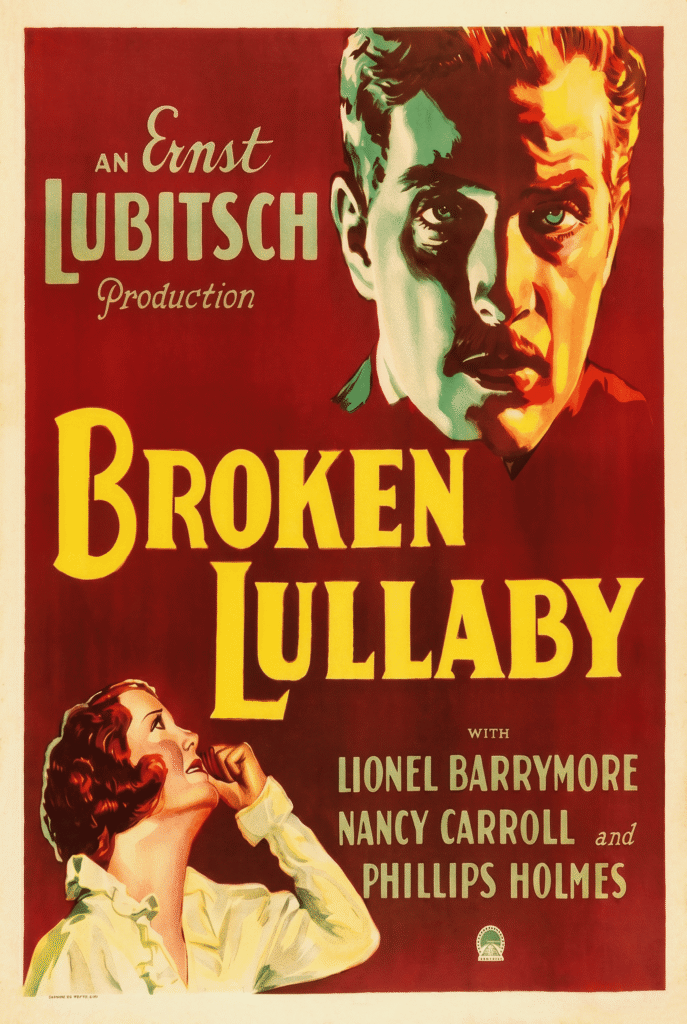
Original title: The Man I Killed (also known as Broken Lullaby)
Based on: Play L’Homme que j’ai tué by Maurice Rostand; adapted by Reginald Berkeley and Samson Raphaelson
Director: Ernst Lubitsch
Screenplay: Reginald Berkeley, Samson Raphaelson
Cinematography: Victor Milner
Music: —
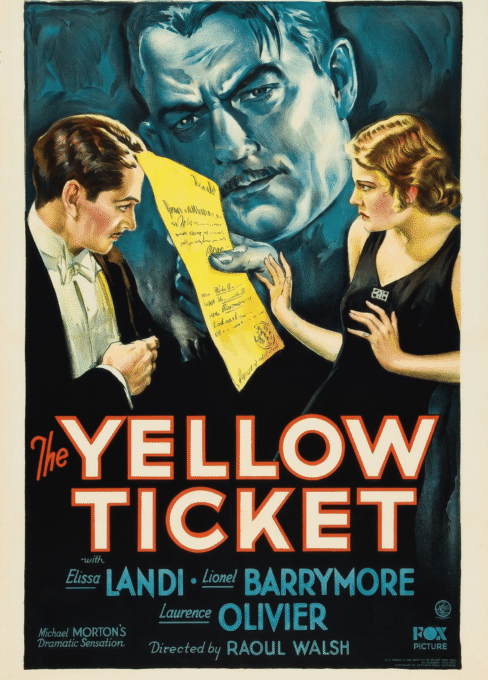
Cast: Lionel Barrymore, Nancy Carroll, Phillips Holmes, Louise Carter, Lucien Littlefield, Tom Douglas, Zasu Pitts, Frank Sheridan, George Bickel, Emma Dunn
Filming locations: Paramount Studios – 5555 Melrose Avenue, Hollywood, Los Angeles, California, USA
Subtitles: English (EN), Romanian (RO)
Synopsis and Main Themes: Haunted by the memory of the German soldier he killed during the war, young French musician Paul Renard travels to Germany to find the dead man’s family — driven not by confession but by an obscure need for absolution he cannot name. Welcomed as a surrogate son by the grieving father and drawn toward the dead man’s fiancée, Paul inhabits the family he destroyed. The film is a meditation on guilt, reconciliation, and the private cost of war — not on battlefields but in the silence of rooms where loss has taken permanent residence.
About the Director and Cinematic Style: Ernst Lubitsch arrived in Hollywood from Berlin in 1922 and built his reputation on sophisticated, effortlessly witty comedies at Warner Bros. and then Paramount — what critics would come to call “the Lubitsch Touch.” Broken Lullaby was his sole dramatic sound film, and a deliberate formal experiment: the film opens with a blast of Eisensteinian montage — cannons, bells, a one-legged soldier framed against a victory parade — before shifting to the long, unbroken takes of its German interiors. Victor Milner’s cinematography moves between urgency and stillness with rare precision.
Critical Reception and Impact: The film received favorable notices at its January 1932 release — Mordaunt Hall of The New York Times called it further evidence of Lubitsch’s genius, praising Lionel Barrymore’s performance as unmatched. It was presented at the Venice International Film Festival. Commercially, however, it failed, and its critical standing eroded over decades — Pauline Kael dismissed it as sentimental hokum, Otis Ferguson as a Teutonic tearjerker. A sustained reassessment came later: Jonathan Rosenbaum called it one of the most piercing and cinematically supple of all Lubitsch’s films, and it has since been screened in major retrospectives on both sides of the Atlantic.
Historical Context and Cinematic Legacy: Broken Lullaby appeared at the height of a cycle of serious anti-war films in Hollywood and Europe — alongside Pabst’s Westfront 1918 and Milestone’s All Quiet on the Western Front — at a moment when the memory of the Great War still shaped public consciousness and pacifist sentiment was politically charged. That Lubitsch, known above all for wit and lightness, chose this material was itself a statement. The film was banned in Czechoslovakia for its pacifist stance. Its formal audacity — the collision of montage and long take, of comedy and elegy — anticipates strategies that later directors would explore more systematically. The story’s enduring power has continued to attract filmmakers and retrospective programmers alike, confirming that its quiet reckoning with guilt and reconciliation has lost none of its weight.
You cannot copy content of this page

It's free. No subscription required
Comentarii (0)
Please login to comment.
Please login to review.