

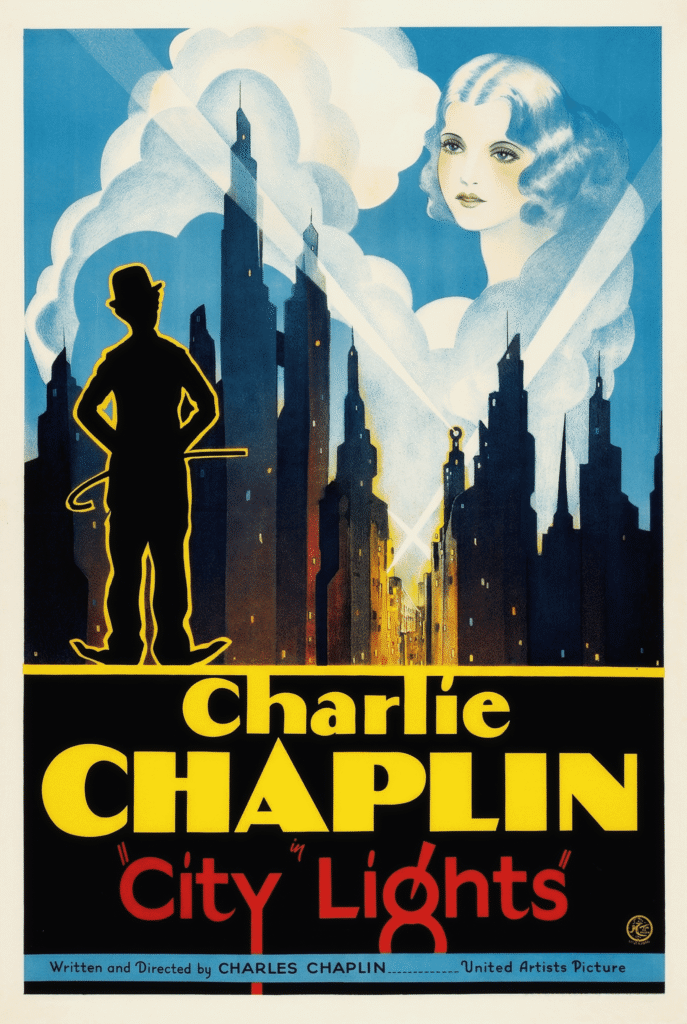
Original title: City Lights
Based on: Original screenplay by Charles Chaplin
Director: Charles Chaplin
Screenplay: Charles Chaplin
Cinematography: Gordon Pollock, Roland Totheroh
Music: Charles Chaplin
Cast: Charles Chaplin, Virginia Cherrill, Florence Lee, Harry Myers, Allan Garcia, Hank Mann
Filming locations: Chaplin Studios, 1416 N. La Brea Avenue, Hollywood, Los Angeles, California, USA
Subtitles: English (EN), Romanian (RO)
Synopsis and Main Themes: The Tramp falls in love with a blind flower seller who mistakes him for a wealthy man. Determined to help her, he takes on a series of humiliating jobs and befriends an alcoholic millionaire who recognizes him only when drunk and forgets him when sober. Through slapstick and heartbreak in equal measure, the Tramp raises enough money for an operation that could restore the girl’s sight — knowing that when she sees him for the first time, the illusion will be shattered. The film explores love as selfless sacrifice, the cruelty of class, and the devastating question of whether we can love someone as they truly are.
About the Director and Cinematic Style: City Lights was Chaplin’s great act of defiance against the sound revolution. Three years after The Jazz Singer had transformed the industry, he released a virtually silent film — with a synchronized orchestral score he composed himself, but no spoken dialogue. The decision was both artistic and existential: the Tramp could not speak without ceasing to be universal. Chaplin’s direction achieves a miraculous balance between broad physical comedy — the boxing match, the party scenes — and moments of devastating emotional precision, culminating in a final close-up that many consider the single greatest shot in cinema history.
Critical Reception and Impact: City Lights was an enormous commercial and critical success upon its release in 1931, proving that audiences still craved Chaplin’s silent art even in the sound era. Critics praised its seamless fusion of comedy and pathos. James Agee later called the final scene “the greatest piece of acting and the highest moment in movies.” The film’s box-office triumph gave Chaplin the financial independence to continue making films entirely on his own terms for decades to come.
Historical Context and Cinematic Legacy: Released in 1931, two years into the Great Depression, City Lights arrived at a moment when the Tramp’s poverty was no longer a comic conceit but a mirror of millions of real lives. Chaplin had spent nearly three years perfecting the film, reshooting scenes obsessively — the flower girl’s first encounter with the Tramp alone required 342 takes. The gamble of releasing a silent film in 1931 could have ended his career; instead, it produced what many regard as his finest work. The film’s influence on the relationship between comedy and emotion in cinema has been incalculable — from Fellini to Wes Anderson, from Pixar to the Dardenne brothers. Its final scene — a close-up of recognition, hope, and terror held in a single face — remains the benchmark against which all cinematic endings are measured.
You cannot copy content of this page

It's free. No subscription required
Comentarii (0)
Please login to comment.
Please login to review.