

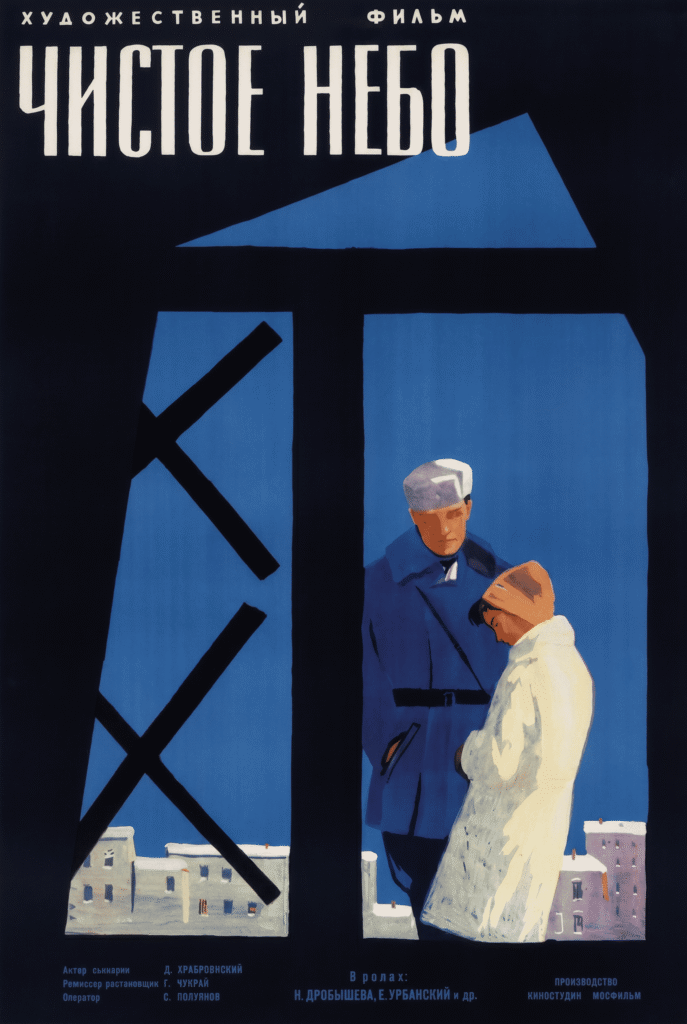
Original title: Chistoe nebo
Based on: Original screenplay by Daniil Khrabrovitsky
Director: Grigoriy Chukhray
Screenplay: Daniil Khrabrovitsky
Cinematography: Sergei Poluyanov
Music: Mikhail Ziv
Cast: Nina Drobysheva, Evgeniy Urbanskiy, Natalya Kuzmina, Vitaliy Konyaev, Georgiy Kulikov, Leonid Knyazev, Georgiy Georgiu, Oleg Tabakov, Alik Krylov, Vitali Bondarev
Filming locations: Mosfilm Studios, Moscow
Subtitles: English (EN), Romanian (RO)
Synopsis and Main Themes: Sasha Lvova falls in love with fighter pilot Aleksei Astakhov on the eve of the Second World War. Aleksei becomes a decorated hero, then is shot down, captured by the Germans, and upon returning home is accused of treason — stripped of his rank, his Party membership, and his right to fly. The film follows Sasha’s refusal to abandon him through years of official disgrace, and Aleksei’s struggle to reclaim an identity the system has destroyed. At its center is a question the Khrushchev era could barely articulate: what does the state owe the man it broke in its own service?
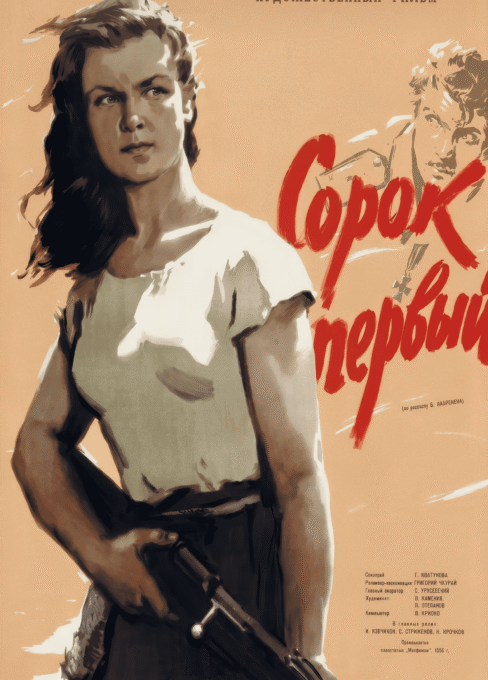
About the Director and Cinematic Style: By 1961 Grigoriy Chukhray had already established himself as one of the defining voices of Soviet Thaw cinema with The Forty-First (1956) and Ballad of a Soldier (1959). Clear Skies is his most politically direct film — a work that names Stalinism as the source of its protagonist’s suffering without ever using that word. Chukhray and cinematographer Sergei Poluyanov use color expressively: the aerial sequences are filled with open light and space, while the postwar scenes of shame and social exclusion are closed, interior, heavy. The contrast between sky and ground is the film’s central visual argument.
Critical Reception and Impact: Clear Skies was an immediate success both critically and commercially in the Soviet Union, where it was voted Best Film of the Year by readers of Soviet Screen magazine. Internationally, it won the Grand Prix at the 2nd Moscow International Film Festival in 1961 — tied with Kaneto Shindo’s The Naked Island — and the Golden Gate Award for Best Director at the 5th San Francisco International Film Festival the same year. It also received the Best Foreign Film Award at the Edinburgh International Film Festival and prizes at film festivals in Mexico.
Historical Context and Cinematic Legacy: Clear Skies appeared five years after Khrushchev’s secret speech and directly engaged with its consequences: the rehabilitation of those unjustly accused during the Stalin years, the reintegration of returning prisoners, the moral reckoning a society owes its victims. That Chukhray managed to make this film through the Soviet censorship apparatus — and that it was not only permitted but celebrated — speaks to how far the cultural thaw had advanced by 1961, and how short that opening was yet to prove. The film’s ending, in which Aleksei’s Party membership is restored following Stalin’s death and Khrushchev’s denunciation, was the only resolution the system would allow — yet even within that constraint, Chukhray made the cost of rehabilitation visible. Together with The Forty-First and Ballad of a Soldier, Clear Skies completes a trilogy of films through which Chukhray mapped the full moral geography of the Soviet twentieth century.
You cannot copy content of this page

It's free. No subscription required
Comentarii (0)
Please login to comment.
Please login to review.