

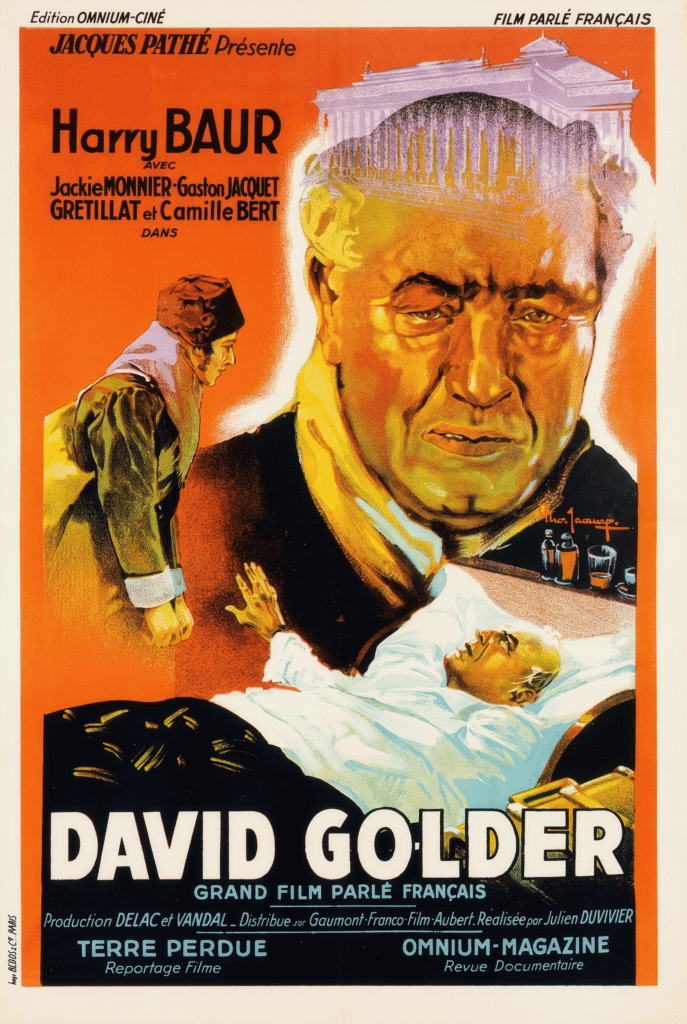
Original title: David Golder
Based on: Novel David Golder by Irène Némirovsky
Director: Julien Duvivier
Screenplay: Julien Duvivier
Cinematography: Georges Périnal, Armand Thirard
Music: —
Cast: Harry Baur, Paule Andral, Jackie Monnier, Jean Bradin, Gaston Jacquet, Jean Coquelin, Camille Bert, Jacques Grétillat, Paul Franceschi, Léon Arvel
Filming locations: Les Films Marcel Vandal et Charles Delac (France)
Subtitles: English (EN), Romanian (RO)
David Golder, a self-made Jewish businessman of Eastern European origin, has built an empire through ruthlessness and will. As his health begins to fail, his wife Gloria and his daughter Joyce — whom he discovers is not his biological child — continue to drain him without remorse. The film is a study in the logic of wealth as self-annihilation: a man who has devoted his life to accumulation discovers, too late, that he has purchased nothing that survives him. On the ship home, a young Jewish immigrant — everything Golder once was — offers him the only moment of humanity the film allows.
About the Director and Cinematic Style: Julien Duvivier was born in Lille in 1896 and came to cinema through the stage, working as an assistant to Louis Feuillade and Marcel L’Herbier before directing his first film in 1919. He made over twenty silent films without breaking through, until sound opened a new register for his talent. David Golder was his first talking picture — and simultaneously the sound debut of actor Harry Baur — marking the beginning of one of the defining partnerships of 1930s French cinema. Jean Renoir described Duvivier as a great technician, a rigorist, a poet. In David Golder, his visual language retains the mobile, expressive quality of silent cinema while using sound to deepen the oppressive weight of domestic spaces and business dealings.
Critical Reception and Impact: David Golder was Duvivier’s first commercial and critical success, establishing him as a major voice in French sound cinema and launching the Duvivier–Harry Baur collaboration that would produce six films across the decade. The film was praised for the relentless precision of Baur’s central performance — a characterization of physical and moral decline that critics considered among the most powerful in French cinema of its era. No major festival prizes are on record for the film, but its cultural impact was immediate: it positioned Duvivier within the production company Film d’Art — founded by Marcel Vandal and Charles Delac — and set the trajectory for the decade of masterworks that followed.
Historical Context and Cinematic Legacy: Irène Némirovsky published the novel David Golder in 1929, when she was twenty-six years old. A Ukrainian-born Jewish writer who had fled the Russian Revolution and settled in France, she drew on her own family — her cold, calculating father and her indifferent mother — to construct the portrait of the Golder household. The novel provoked immediate controversy: Jewish critics accused Némirovsky of perpetuating antisemitic stereotypes, a charge that has accompanied the work ever since. Némirovsky herself was arrested in 1942 and died in Auschwitz that same year, her masterwork Suite Française surviving only as a manuscript discovered among her papers decades later. Duvivier went on to direct Poil de carotte (1932), La Bandera (1935), Pépé le Moko (1937), and Un Carnet de bal (1937) — cementing his place among the defining directors of French poetic realism and earning the description, from Jean Renoir, of one of the true poets of French cinema.
You cannot copy content of this page

It's free. No subscription required
Comentarii (0)
Please login to comment.
Please login to review.