

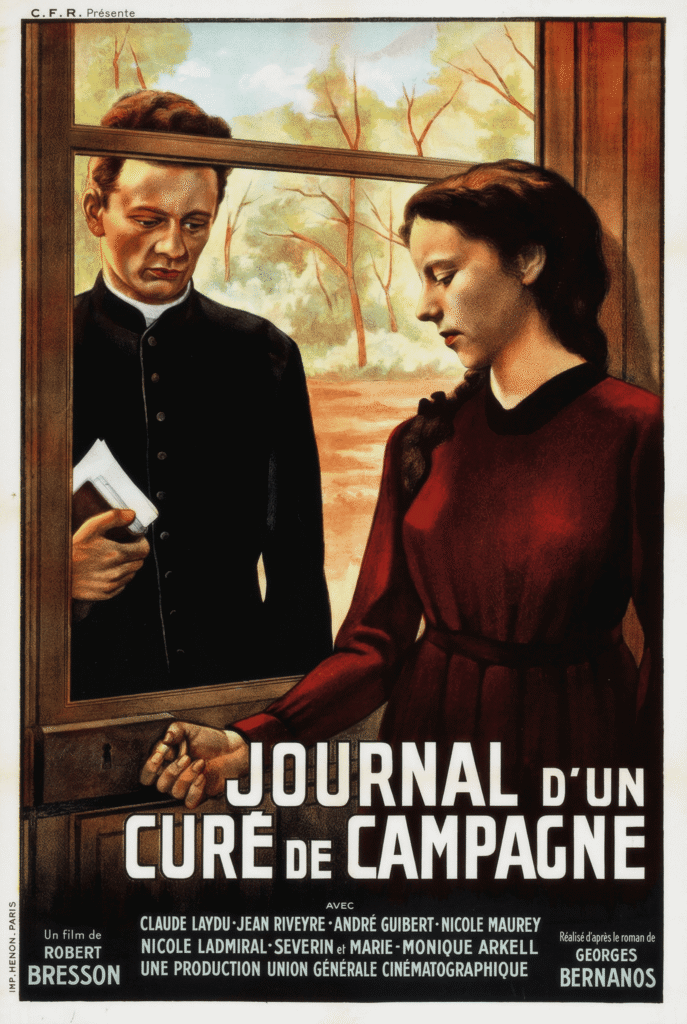
Original title: Journal d’un curé de campagne
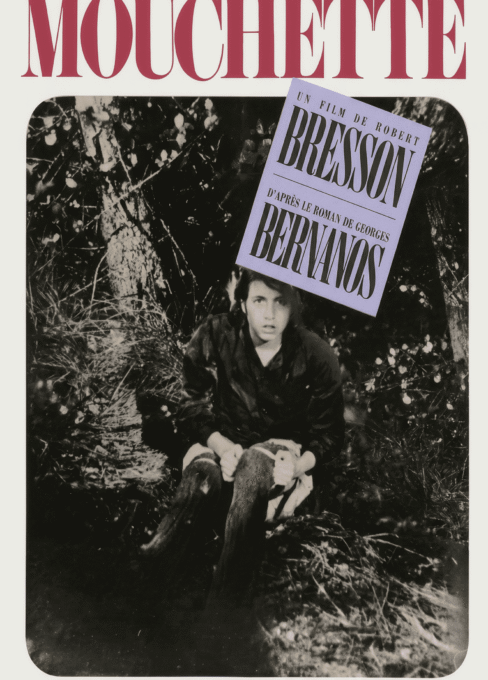
Based on: Novel by Georges Bernanos (1936)
Director: Robert Bresson
Screenplay: Robert Bresson (adaptation)
Cinematography: Léonce-Henri Burel
Music: Jean-Jacques Grünenwald
Cast: Claude Laydu, Jean Riveyre, Adrien Borel, Rachel Bérend, Nicole Maurey, Nicole Ladmiral, Martine Lemaire, Antoine Balpêtré
Filming locations: Eglise, Equirre, Pas-de-Calais, France
Subtitles: English (EN), Romanian (RO)
Synopsis and Main Themes: A young, sickly priest arrives in the rural parish of Ambricourt, where he is met with indifference, hostility, and quiet cruelty. Struggling with a mysterious stomach illness that allows him to consume only bread and wine, he persists in his pastoral duties — visiting parishioners who despise him, confronting a household consumed by bitterness, and recording his spiritual anguish in a diary. The film explores faith tested to its breaking point, the loneliness of genuine vocation, and the paradox of grace arriving precisely where all hope has been extinguished.
About the Director and Cinematic Style: Robert Bresson, in his third feature, achieves for the first time the austere, stripped-down style that would define his entire body of work. Rejecting theatrical performance entirely, he draws from his non-professional lead actor a presence rather than a performance — blank, suffering, luminous. The film’s visual language is spare and precise: close-ups of hands, objects, doorways, the priest’s face in candlelight. Bresson’s use of the diary as voiceover narration creates an intimate doubling of image and word that became one of cinema’s most influential techniques.
Critical Reception and Impact: Diary of a Country Priest won the Prix Louis Delluc in 1951 and the Grand Prize at the Venice Film Festival. André Bazin devoted one of his most celebrated essays to the film, arguing that Bresson had achieved a new relationship between cinema and literature — not adaptation but transformation. The film established Bresson as one of the most important and uncompromising voices in European cinema, admired by filmmakers as diverse as Tarkovsky, Schrader, and the Dardenne brothers.
Historical Context and Cinematic Legacy: Released in 1951, Diary of a Country Priest arrived at a moment when French cinema was dominated by the literary adaptations of the “Tradition of Quality” — polished, theatrical films that the young critics of Cahiers du Cinéma would soon rebel against. Bresson’s film, adapted from Georges Bernanos’s novel, paradoxically became a weapon in that rebellion: it demonstrated that fidelity to a literary source could coexist with radical cinematic invention. Paul Schrader’s influential study “Transcendental Style in Film” identifies this film as the purest example of a cinema that seeks to express the sacred through extreme restraint. Its influence extends through Tarkovsky, Dreyer’s late work, and virtually every filmmaker who has attempted to render spiritual experience on screen without sentimentality or spectacle.
You cannot copy content of this page

It's free. No subscription required
Comentarii (0)
Please login to comment.
Please login to review.