

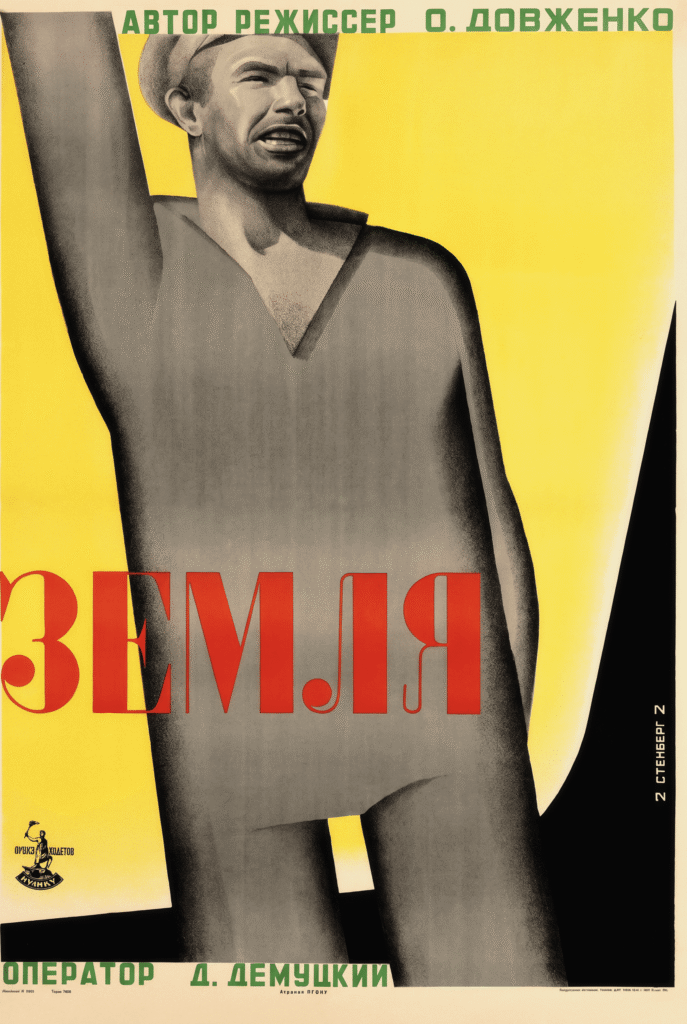
Original title: Zemlya
Based on: Original screenplay by Aleksandr Dovzhenko
Director: Aleksandr Dovzhenko
Screenplay: Aleksandr Dovzhenko
Cinematography: Danylo Demutsky
Music: —
Cast: Stepan Shkurat, Semyon Svashenko, Yuliya Solntseva, Yelena Maksimova, Nikolai Nademsky, Ivan Franko, Pyotr Masokha, Vladimir Mikhaylov, Pavel Petrik
Filming locations: Yaresky, Shyshaky Rayon, Poltava Oblast, Ukraine; Kyivska Kinofabryka (studios)
Subtitles: English (EN), Romanian (RO)
Synopsis and Main Themes: In a Ukrainian village on the eve of collectivization, three generations of a peasant family navigate the violent collision between old and new. When young Vasyl leads the community in embracing collective farming, he is murdered by a kulak landowner who sees his authority crumbling. Earth weaves death and regeneration into a single breath — the grandfather dies peacefully beneath an apple tree, Vasyl is shot during a moonlit dance — insisting that individual loss dissolves into the endless cycle of the land. Nature itself becomes the film’s true protagonist.
About the Director and Cinematic Style: Born in 1894 in the Chernihiv region of Ukraine, Aleksandr Dovzhenko came to cinema late, having worked as a teacher, diplomat, and painter. Earth (1930) completed an informal trilogy with Zvenigora (1928) and Arsenal (1929), establishing him as the preeminent voice of Ukrainian cinema. Where Eisenstein argued through intellectual montage, Dovzhenko worked through the senses — his editing breathes rather than argues, his close-ups of faces, wheat, and sunflowers carrying an almost painterly weight that is felt before it is understood.
Critical Reception and Impact: Released on April 8, 1930, Earth was banned by Soviet authorities nine days later, condemned as ideologically insufficient for dwelling on nature rather than political struggle. Yet international recognition came swiftly: the National Board of Review in the United States named it the top foreign film of 1930. At the 1932 Venice Film Festival, it received a nomination for the Audience Award. In 1958, at the Brussels World’s Fair international critics’ poll, Earth was voted number ten among the twelve greatest films in the history of cinema.
Historical Context and Cinematic Legacy: Earth arrived at a moment of catastrophic transformation in Ukraine — Stalin’s collectivization campaign was destroying the very peasant world Dovzhenko filmed with such tenderness. The Holodomor followed within years. This gives the film a tragic historical irony: its lyrical celebration of rural life documents a civilization on the edge of annihilation. Its legacy proved immense. Tarkovsky repeatedly cited Dovzhenko as a formative influence, and Earth’s pantheistic vision — the idea that cinema could render the sacred within the ordinary — runs directly through Mirror and The Sacrifice. Generations of filmmakers have returned to its images of wind moving through wheat as a benchmark of what cinema can silently contain.
You cannot copy content of this page

It's free. No subscription required
Comentarii (0)
Please login to comment.
Please login to review.