

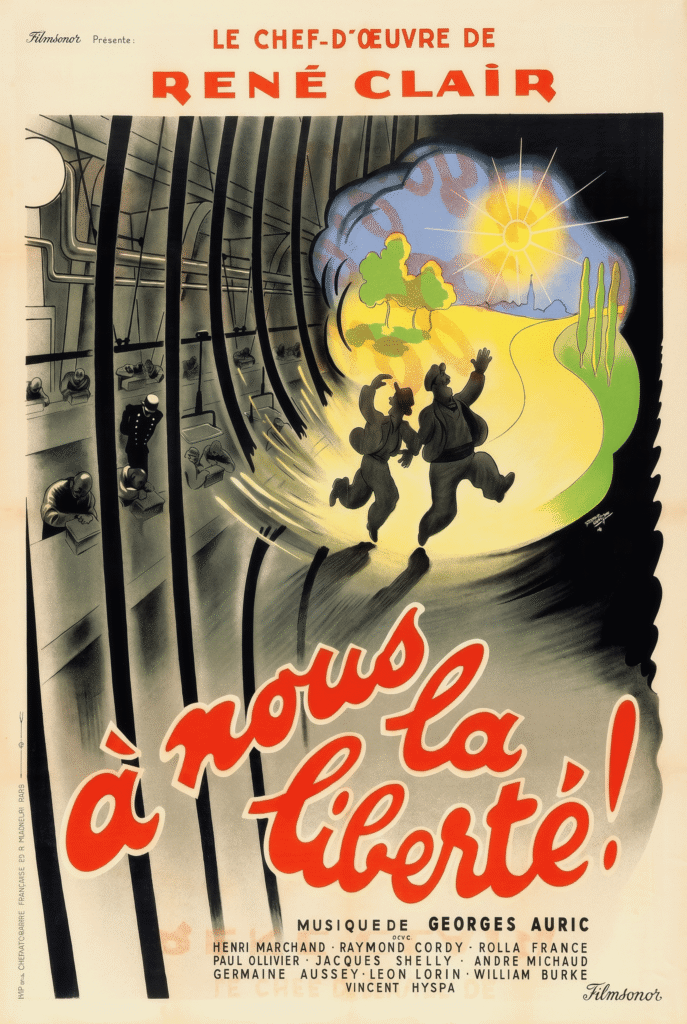
Original title: À nous la liberté
Based on: Original screenplay by René Clair
Director: René Clair
Screenplay: René Clair
Cinematography: Georges Périnal
Music: Georges Auric
Cast: Henri Marchand, Raymond Cordy, Rolla France, Paul Ollivier, Jacques Shelly, A. Michaud, Germaine Aussey, Léon Lorin, William Burke, Vincent Hyspa
Filming locations: Films Sonores Tobis Studios, France
Subtitles: English (EN), Romanian (RO)
Synopsis and Main Themes: Two prison cellmates share a dream of escape. Louis makes it out first and reinvents himself as a wealthy phonograph factory owner; years later, Émile is released and ends up — by ironic chance — working on Louis’s own assembly line. Their reunion unravels everything. À nous la liberté draws an unsentimental parallel between the prison and the modern factory: both are machines that consume human beings, reduce them to function, and punish any deviation. Underneath the comedy runs a persistent longing for a life beyond walls — any walls.
About the Director and Cinematic Style: René Clair was born in Paris in 1898 and had already established himself as one of French cinema’s most inventive voices through his silent films, including the Dadaist short Entr’acte (1924) and the urban comedy sous les toits de Paris (1930). À nous la liberté was his third sound film, and it demonstrated his mastery of the new medium — using music not as accompaniment but as structural counterpoint, letting Georges Auric’s score carry irony and emotion where dialogue stays silent.
Critical Reception and Impact: À nous la liberté made history at the 5th Academy Awards in 1932 as the first foreign-language film ever nominated for an Oscar, receiving a nomination for Best Art Direction for Lazare Meerson’s striking Expressionist sets. At the inaugural Venice Film Festival that same year, an audience referendum recognized it as the Most Amusing Film. The National Board of Review in the United States named it among the top foreign films of 1932, and Japan’s Kinema Junpo critics awarded it Best Foreign Language Film of 1933. The film also sparked a celebrated controversy when Tobis Film sued Charlie Chaplin, claiming Modern Times had plagiarized it — a suit Clair himself publicly opposed, calling it an honor to have inspired Chaplin.
Historical Context and Cinematic Legacy: Made at a moment when industrial capitalism was reshaping every aspect of European life and the Great Depression was exposing its contradictions, À nous la liberté arrived as both comedy and diagnosis. Its vision of the assembly line as a machine for erasing individuality would prove prophetic — and its influence on Chaplin’s Modern Times (1936) ensured it a permanent place in cinema history, even if that debt was contested in court. Beyond the Chaplin connection, the film stands as a landmark of early sound cinema: a demonstration that music, image, and comic timing could be orchestrated with a precision rivaling any silent-era masterwork. Clair was elected to the Académie française in 1960, the first filmmaker to receive that honor.
You cannot copy content of this page

It's free. No subscription required
Comentarii (0)
Please login to comment.
Please login to review.