

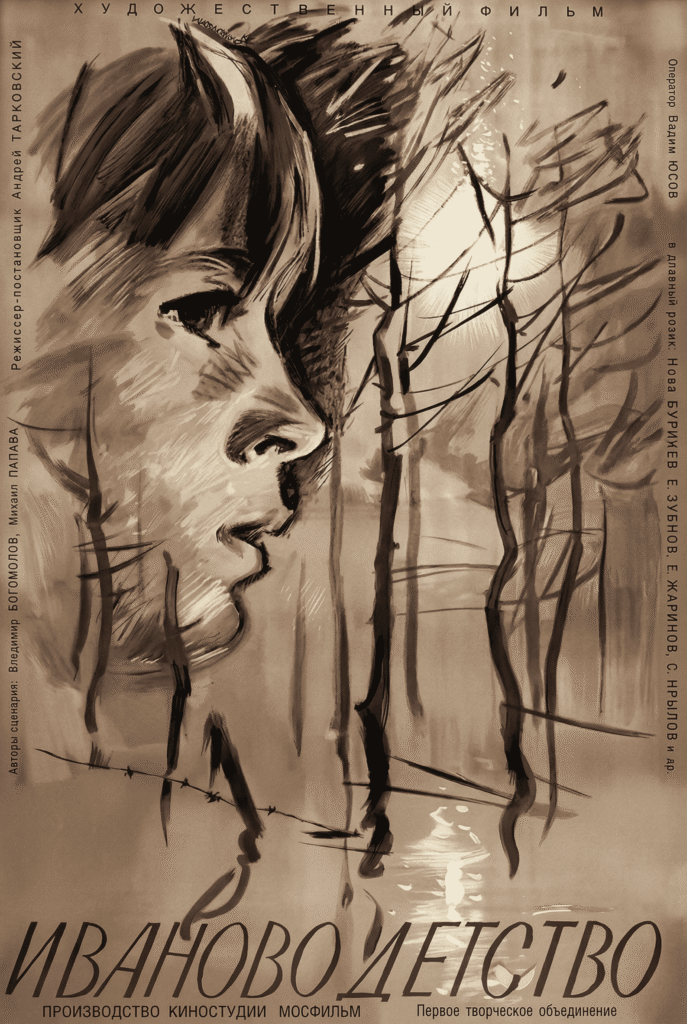
Original title: Ivanovo detstvo
Based on: The short story “Ivan” (1957) by Vladimir Bogomolov
Director: Andrei Tarkovsky
Screenplay: Vladimir Bogomolov, Mikhail Papava
Cinematography: Vadim Yusov
Music: Vyacheslav Ovchinnikov
Cast: Nikolay Burlyaev, Valentin Zubkov, Evgeniy Zharikov, Stepan Krylov, Nikolay Grinko, Dmitri Milyutenko, Valentina Malyavina, Irma Tarkovskaya
Filming locations: Mozhaisk, Moscow Oblast, Soviet Union
Subtitles: English (EN), Romanian (RO)
Synopsis and Main Themes: Twelve-year-old Ivan is a Soviet scout operating behind enemy lines during World War II. Having lost his entire family to the German occupation, he is driven by a ferocious desire for revenge that has extinguished his childhood entirely. Between dangerous missions, Ivan’s memories and dreams reveal a lost paradise — a summer, a mother, a world of innocence obliterated by war. The film explores the destruction of childhood by violence, the impossibility of return, and the cruel erasure of innocence by history.
About the Director and Cinematic Style: Ivan’s Childhood was Tarkovsky’s first feature film, made after he replaced director Eduard Abalov mid-production. The film immediately announced a radically new cinematic sensibility: a poetic, non-linear structure that weaves dreams and memories into the fabric of a war narrative. Cinematographer Vadim Yusov’s extraordinary use of chiaroscuro, deep shadows, and luminous dream sequences creates a visual language that belongs fully to Tarkovsky, even as the subject matter remains rooted in Soviet war cinema traditions.
Critical Reception and Impact: Ivan’s Childhood won the Golden Lion at the 1962 Venice Film Festival, placing Tarkovsky immediately on the international stage. The philosopher Jean-Paul Sartre wrote an admiring essay on the film, arguing for its artistic validity against Soviet critics who accused it of formalism. The film was celebrated for its fusion of wartime realism and oneiric poetry, and its success gave Tarkovsky the creative authority to pursue the far more ambitious Andrei Rublev as his next project.
Historical Context and Cinematic Legacy: Released in 1962, at the height of the Soviet Thaw, Ivan’s Childhood arrived in a cultural moment when Soviet cinema was opening cautiously to Western influences and personal artistic expression. Yet Tarkovsky’s vision went far beyond the liberalization of the era — it was a complete rupture with socialist realism, proposing cinema as a medium for inner truth rather than ideological instruction. The film redefined what a war film could be: not a narrative of heroism or sacrifice, but an elegy for a destroyed interior world. Its influence on subsequent generations of filmmakers — from Elem Klimov’s Come and See to Terrence Malick’s The Thin Red Line — has been immense, and it remains one of the most assured debut features in the history of cinema.
You cannot copy content of this page

It's free. No subscription required
Comentarii (0)
Please login to comment.
Please login to review.