

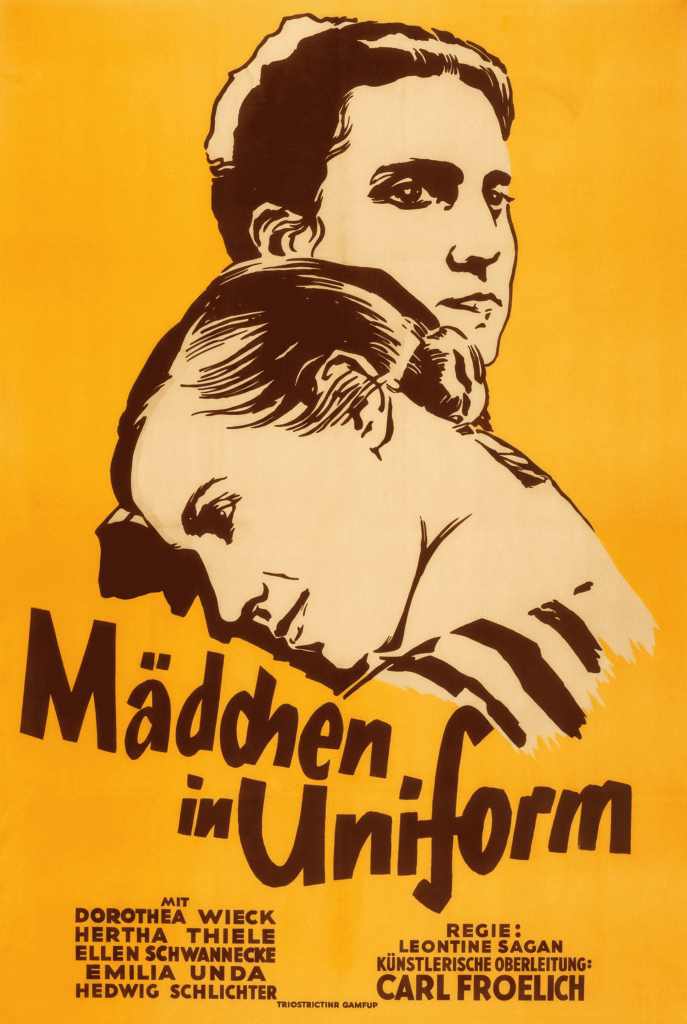
Original title: Mädchen in Uniform
Based on: Play by Christa Winsloe
Director: Leontine Sagan, Carl Froelich
Screenplay: Christa Winsloe, Friedrich Dammann
Cinematography: Reimar Kuntze
Music: —
Cast: Dorothea Wieck, Hertha Thiele, Emilia Unda, Hedy Krilla, Ellen Schwanneke, Lene Berdolt, Erika Biebrach, Margory Bodker
Filming locations: Bild und Ton Studio, Berlin, Germany
Subtitles: English (EN), Romanian (RO)
Synopsis and Main Themes: Manuela, a sensitive teenager, is sent to a Prussian boarding school for officers’ daughters after her mother’s death. In the suffocating grip of the headmistress’s regime — discipline and hunger as tools of obedience — she finds unexpected warmth in the kind teacher Fräulein von Bernburg, a feeling that grows into fervent, unmistakable love. The film holds two truths in tension: the crushing weight of authoritarian institutions on the individual spirit, and the subversive, irrepressible power of feeling that refuses to be uniformed away.
About the Director and Cinematic Style: Leontine Sagan was a South African-born, Vienna-trained theater director making her feature film debut. Working alongside the more experienced Carl Froelich, she brought to the screen a theatrical sensitivity visible in the patience with which the camera dwells on expressions, on silence, on what remains unspoken between characters. The film’s largely female cast and crew, its intimate close-ups of young women’s faces caught between longing and fear, and its fluid use of the newly mastered sound medium give it a warmth and immediacy that feels nothing like the studio productions of its era.
Critical Reception and Impact: Released in Berlin in late 1931, Mädchen in Uniform was a commercial triumph, grossing six million Reichsmarks across Germany and Europe by 1934. At the inaugural Venice Film Festival in 1932 — where no formal jury yet existed — an audience referendum awarded Leontine Sagan the prize for Best Technical Perfection. In 1934, Japan’s prestigious Kinema Junpo critics’ circle named it the Best Foreign Language Film of the year. In the United States, the film faced threatened censorship and was only approved for release after Eleanor Roosevelt publicly endorsed it.
Historical Context and Cinematic Legacy: Made in the final years of the Weimar Republic, Mädchen in Uniform captured a culture in the last moments of its extraordinary openness before the Nazi seizure of power. The Prussian boarding school became a transparent allegory: the headmistress’s creed — that discipline and deprivation forge strength — was the creed of what was coming. The Nazis would ban the film as decadent and attempt to destroy all existing prints; much of the cast and crew, many of them Jewish, were forced to flee or perish. The film’s legacy is double: as the first sound feature to treat same-sex love with dignity and seriousness, and as a formal model for the woman-centered ensemble film. Filmmakers from Fassbinder to Céline Sciamma have acknowledged the shadow it casts.
You cannot copy content of this page

It's free. No subscription required
Comentarii (0)
Please login to comment.
Please login to review.