

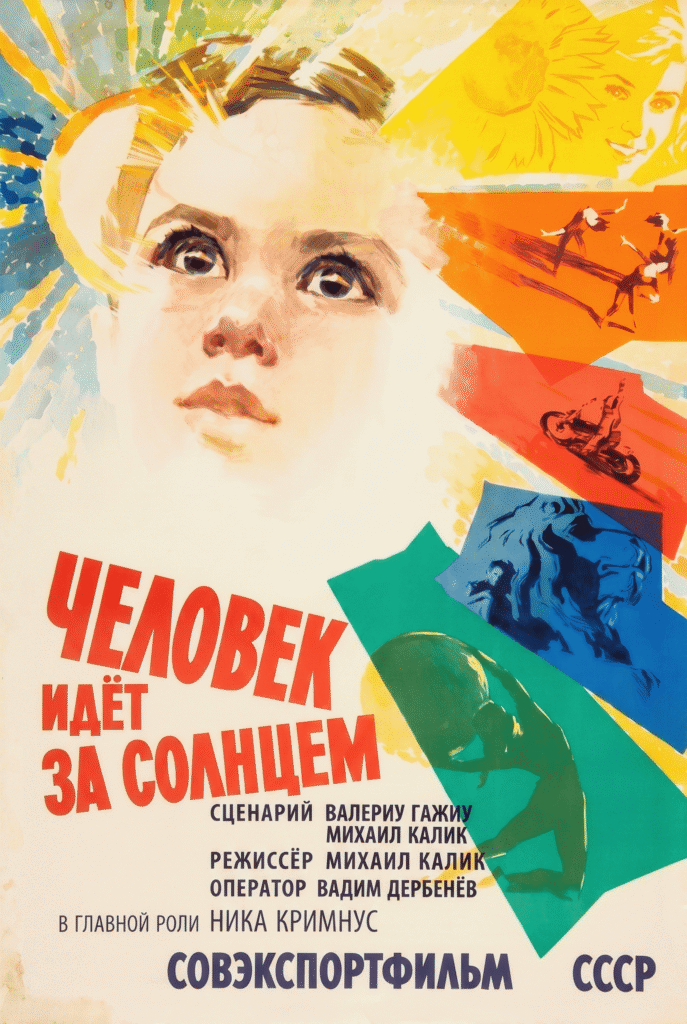
Original title: Chelovek idyot za solntsem
Based on: Original screenplay by Mikhail Kalik and Valeriu Gagiu
Director: Mikhail Kalik
Screenplay: Valeriu Gagiu, Mikhail Kalik
Cinematography: Vadim Derbenyov
Music: Mikael Tariverdiev
Cast: Nika Krimnус, Tatyana Bestayeva, Nikolay Volkov, Georgiy Georgiu, Maksim Grekov, Lyudmila Dolgorukova, Evgeniy Evstigneev, Valentin Zubkov, Larisa Luzhina, Anatoliy Papanov
Filming locations: Moldova Film Studios, Chișinău, Moldova
Subtitles: English (EN), Romanian (RO)
Synopsis and Main Themes: In the streets of Chișinău on a single summer day, six-year-old Sandu sets out on the trail of the sun — convinced that walking straight ahead will take him around the world and back home from the other side. His journey is a series of unexpected encounters with adults, strangers, and the city itself. The film’s true subject is the texture of pure childhood perception: wonder, disappointment, the dawning awareness of a world that does not bend to a child’s logic.
About the Director and Cinematic Style: Mikhail Kalik (1927–2017) studied at VGIK under Grigori Alexandrov, but his education was interrupted in 1951 when he was arrested during the Stalinist anti-cosmopolitan campaign and sent to a Gulag labor camp. Released after Stalin’s death, he resumed his studies and graduated in 1958. Man Follows the Sun was, by his own account, the first film in which he found his artistic voice — influenced by Lamorisse, Matisse, and Saint-Exupéry. His style is playful and visually inventive: fluid handheld movement, vivid compositions, and a musical rhythm that gives the film an almost choreographic quality.
Critical Reception and Impact: The film was received warmly within Soviet cinema circles as an exemplary work of the Thaw period, praised for its freedom of form and its refusal of ideological framing. No major international festival prizes have been confirmed for this title. What is documented is its cultural resonance: it became a touchstone for the Soviet generation of the 1960s as a manifesto of lyrical, personal cinema at odds with official aesthetics.
Historical Context and Cinematic Legacy: Man Follows the Sun belongs to a rich tradition of cinematic childhood — from Vigo’s Zero for Conduct to Lamorisse’s The Red Balloon — yet it carries a specifically Soviet-Moldovan inflection, shaped by Kalik’s personal history of persecution and his deep attachment to the culture of Soviet Moldova. Made at Moldova Film Studios in Chișinău, it captures a world on the verge of transformation, the brief window of relative openness before the cultural freeze of the Brezhnev era. Kalik himself cited it as a declaration of artistic independence. Forced into emigration to Israel in 1971 under renewed anti-Semitic pressure, he left behind a small but extraordinary body of work that remained underknown in the West for decades. Retrospectives in Berlin and elsewhere have begun to restore his place alongside Tarkovsky, Parajanov, and Khutsiev as one of the defining voices of the Soviet Thaw.
You cannot copy content of this page

It's free. No subscription required


Comentarii (0)
Please login to comment.
Please login to review.