

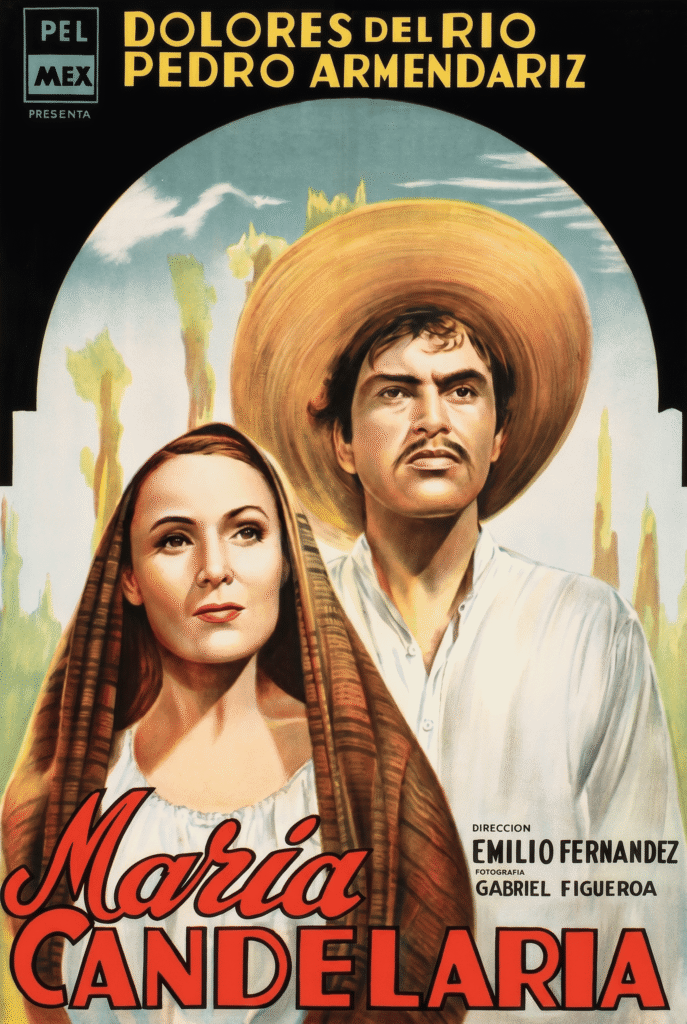
Original title: María Candelaria
Based on: Original screenplay by Emilio Fernández and Mauricio Magdaleno
Director: Emilio Fernández
Screenplay: Emilio Fernández, Mauricio Magdaleno
Cinematography: Gabriel Figueroa
Music: Francisco Domínguez
Cast: Dolores Del Río, Pedro Armendáriz, Alberto Galán, Margarita Cortés, Miguel Inclán, Beatriz Ramos, Rafael Icardo, Julio Ahuet, Lupe del Castillo, Lupe Inclán
Filming locations: Parque Ecológico de Xochimilco, Xochimilco, Mexico City, Mexico
Subtitles: English (EN), Romanian (RO)
Synopsis and Main Themes: In the lake village of Xochimilco in 1909, on the eve of the Mexican Revolution, María Candelaria and her beloved Lorenzo Rafael struggle against poverty, the malice of a predatory local merchant, and the collective hostility of a community that rejects María for the sins of her dead mother. When a painter asks to use her face for a portrait — completing the figure with another woman’s nude body — the village believes María posed naked, and the consequences are fatal. The film is a sustained meditation on communal violence, scapegoating, and the destruction of innocence by ignorance.
About the Director and Cinematic Style: Emilio “El Indio” Fernández was born in 1904 in Coahuila, Mexico, of mixed indigenous and Spanish descent, and spent years in exile in the United States — including time in Hollywood — before returning to Mexico in the late 1930s to forge a distinctly national cinema. By 1943 he had assembled the creative team that would define Mexican golden-age cinema: screenwriter Mauricio Magdaleno, cinematographer Gabriel Figueroa, and stars Dolores del Río and Pedro Armendáriz. In María Candelaria, Figueroa’s photography — vast skies, dramatic lighting, the still waters and chinampas of Xochimilco — transforms a melodrama into a visual poem of extraordinary formal beauty, informed equally by Eisenstein’s influence and by the muralist tradition of Diego Rivera and José Clemente Orozco.
Critical Reception and Impact: María Candelaria shared the Grand Prix du Festival — equivalent to the later Palme d’Or — at the inaugural Cannes Film Festival in 1946, becoming the first Mexican and first Latin American film to receive the festival’s highest distinction. Gabriel Figueroa also won the Best Cinematography prize at Cannes, shared with Los tres mosqueteros, and repeated the honor at the Locarno Film Festival in 1947. The film was both a popular and critical success in Mexico and internationally, establishing the Fernández–Figueroa partnership as the creative engine of Mexican cinema’s golden decade and securing Dolores del Río’s place as the pre-eminent star of the national screen.
Historical Context and Cinematic Legacy: María Candelaria was produced during the Second World War, when Hollywood’s suspension of operations in Spain and other markets opened a window for Mexican cinema to supply Latin America with Spanish-language films — a commercial boom that financed a decade of ambitious production. Fernández consciously positioned the film within the nationalist project of post-revolutionary Mexico, drawing on indigenismo — the cultural movement that idealized indigenous communities as the authentic soul of the nation — while simultaneously exposing the mechanisms of their oppression. The tension between romanticization and critique has made the film a contested object for later scholars. Its visual language, developed with Figueroa, influenced a generation of Latin American filmmakers, and Figueroa himself went on to work with John Huston, John Ford, and Luis Buñuel — carrying the aesthetic forged at Xochimilco into the international cinema of the 1950s and 1960s.
You cannot copy content of this page

It's free. No subscription required
Comentarii (0)
Please login to comment.
Please login to review.