

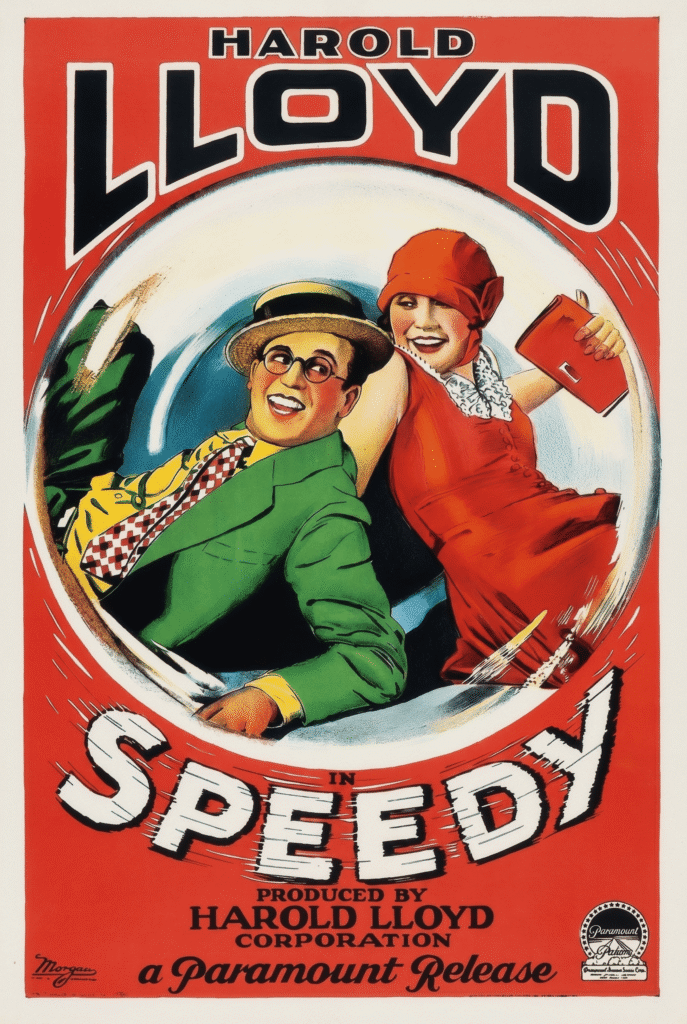
Original title: Speedy
Based on: Original screenplay by John Grey, Lex Neal, Howard Emmett Rogers
Director: Ted Wilde
Screenplay: John Grey, Lex Neal, Howard Emmett Rogers
Cinematography: Walter Lundin
Music: Carl Davis (1992)
Cast: Harold Lloyd, Ann Christy, Bert Woodruff, Babe Ruth, Byron Douglas, Brooks Benedict, King Tut the Dog, Lou Gehrig
Filming locations: Luna Park, Coney Island, Brooklyn, New York City, New York; Yankee Stadium, New York City
Subtitles: English (EN), Romanian (RO)
Synopsis and Main Themes: Harold “Speedy” Swift is a good-natured but restless New Yorker who can’t hold a job — partly because his devotion to the Yankees leaves little room for anything else. When his girlfriend’s grandfather, operator of the city’s last horse-drawn streetcar, is threatened by corporate interests determined to seize the line, Speedy throws himself into a chaotic battle to save it. The film balances slapstick and sentiment around the themes of loyalty, community, and the ordinary man standing his ground against progress that serves no one but the powerful.
About the Director and Cinematic Style: Ted Wilde built his career writing comedy scripts before stepping behind the camera, and Speedy represents the peak of his brief directing career — he died of a stroke the following year, at forty. Working closely with producer-star Harold Lloyd, Wilde crafted a film that uses New York City itself as an active participant: much of the footage was shot on location with hidden cameras, capturing the energy of real crowds, real streets, and real chaos, surprised on the fly. The result is a physical comedy with the pulse of a city documentary.
Critical Reception and Impact: Speedy premiered in New York to enthusiastic reviews and strong box office returns, grossing over two million dollars worldwide. At the first Academy Awards ceremony in 1929, Ted Wilde received a nomination for Best Director, Comedy Picture — a category created to recognize the specific craft of silent comedy and discontinued after that first edition. The award went to Lewis Milestone for Two Arabian Knights. Speedy holds the distinction of being the only Harold Lloyd film ever to receive an Academy Award nomination.
Historical Context and Cinematic Legacy: Speedy arrived at the precise moment when silent cinema was being overtaken by sound — released in April 1928, just months after The Jazz Singer changed the industry from its foundations. As Lloyd’s final silent feature, it functions as both a farewell to an era and a record of New York City at a particular instant: the streetcars, the elevated railways, Luna Park at Coney Island, Yankee Stadium. Its cameo by Babe Ruth, filmed at the actual stadium, gives the film an almost documentary weight. Lloyd was, at the time, the most commercially successful comedian in Hollywood, outpacing both Chaplin and Keaton at the box office — yet Speedy is rarely discussed alongside the canonical masterworks of silent comedy, an omission that later archivists and festival programmers worked to correct. Subsequent restorations brought the film to new audiences, reestablishing its place among the most exuberant comedies of the silent era.
You cannot copy content of this page

It's free. No subscription required
Comentarii (0)
Please login to comment.
Please login to review.