

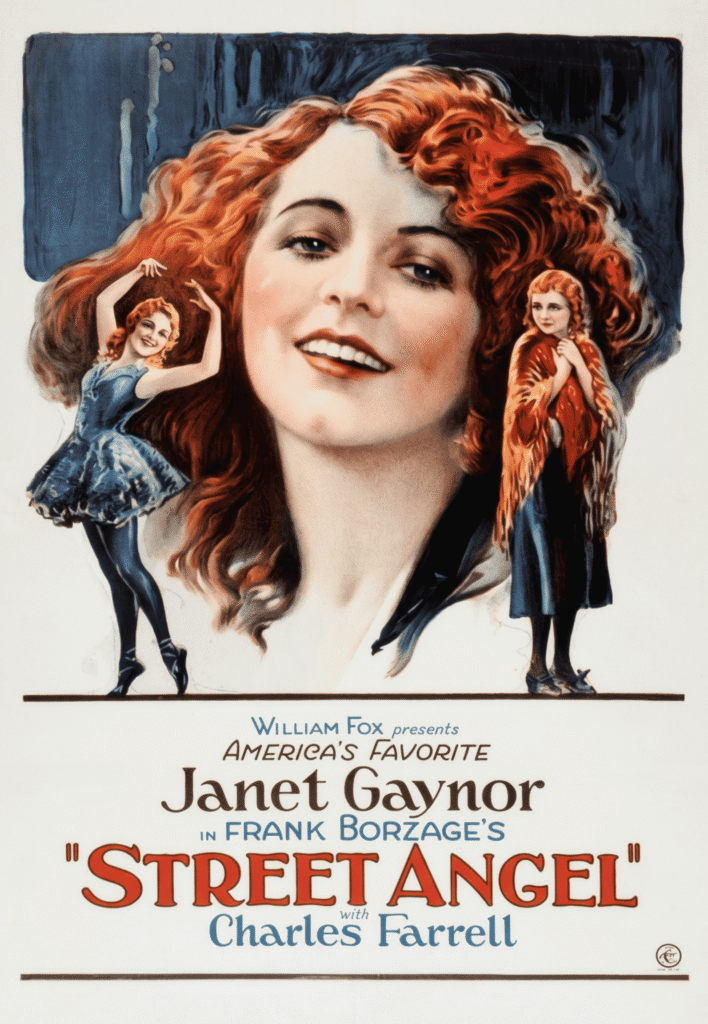
Original title: Street Angel
Based on: The play “Lady Cristilinda” (1922) by Monckton Hoffe
Director: Frank Borzage
Screenplay: Marion Orth, Philip Klein, Henry Roberts Symonds, H.H. Caldwell (intertitles), Katherine Hilliker (intertitles)
Cinematography: Ernest Palmer, Paul Ivano
Music: Ernö Rapée (Movietone soundtrack)
Cast: Janet Gaynor, Charles Farrell, Natalie Kingston, Henry Armetta, Guido Trento, Alberto Rabagliati, Helena Herman, Louis Liggett
Filming locations: Fox Film Corporation Studios, Hollywood, California
Subtitles: English (EN), Romanian (RO)
Synopsis and Main Themes: In the dark streets of Naples, young Angela desperately tries to obtain money for her dying mother’s medicine. When an attempt at prostitution fails, she tries to steal and becomes a fugitive from the law. Finding refuge in a traveling circus, Angela meets Gino, a poor painter who falls hopelessly in love with her. Their fragile happiness is threatened by the past Angela is hiding. The film explores themes of shame, forgiveness, and the transfiguring power of love in a world that mercilessly condemns its most vulnerable.
About the Director and Cinematic Style: Frank Borzage, profoundly influenced by German Expressionism and the presence of F.W. Murnau at Fox Studios, creates in Street Angel a visual universe of oppressive beauty — narrow streets shrouded in fog, weathered stone archways, plays of light and shadow that transform Naples into a landscape of the soul. Borzage minimizes intertitles in favor of a purely visual language, using emotionally charged camera angles and fluid tracking shots to convey the story through images rather than words.
Critical Reception and Impact: The 1928 premiere was enthusiastically received by American critics. Mordaunt Hall of the New York Times compared the film to an “operatic romance,” praising its artistic quality. Janet Gaynor received the first Best Actress Oscar in history, a distinction awarded cumulatively for her performances in Street Angel, 7th Heaven, and Sunrise. The film also earned Oscar nominations for Art Direction and Cinematography. However, in Italy, Benito Mussolini deemed the film a distortion of Italian life and banned it, replacing the censors who had approved its screening.
Historical Context and Cinematic Legacy: Released in the spring of 1928, Street Angel represents the pinnacle of an exceptional period at Fox Studios, where Murnau’s presence inspired an entire generation of directors — Frank Borzage, John Ford, Howard Hawks — to push beyond the limits of conventional narrative cinema. As a transitional film, Street Angel features a synchronized Movietone soundtrack including the melody “O sole mio” hummed by the protagonists, anticipating the organic integration of sound into narrative. The film directly influenced Chinese cinema of the 1930s, particularly the work of director Yuan Muzhi. The violent reaction of the Italian fascist regime — banning the film in Italy and Morocco — illustrates the paradox of art that disturbs precisely through its emotional authenticity. Street Angel remains one of the most refined examples of romantic expressionism in American cinema.
You cannot copy content of this page

It's free. No subscription required
Comentarii (0)
Please login to comment.
Please login to review.