

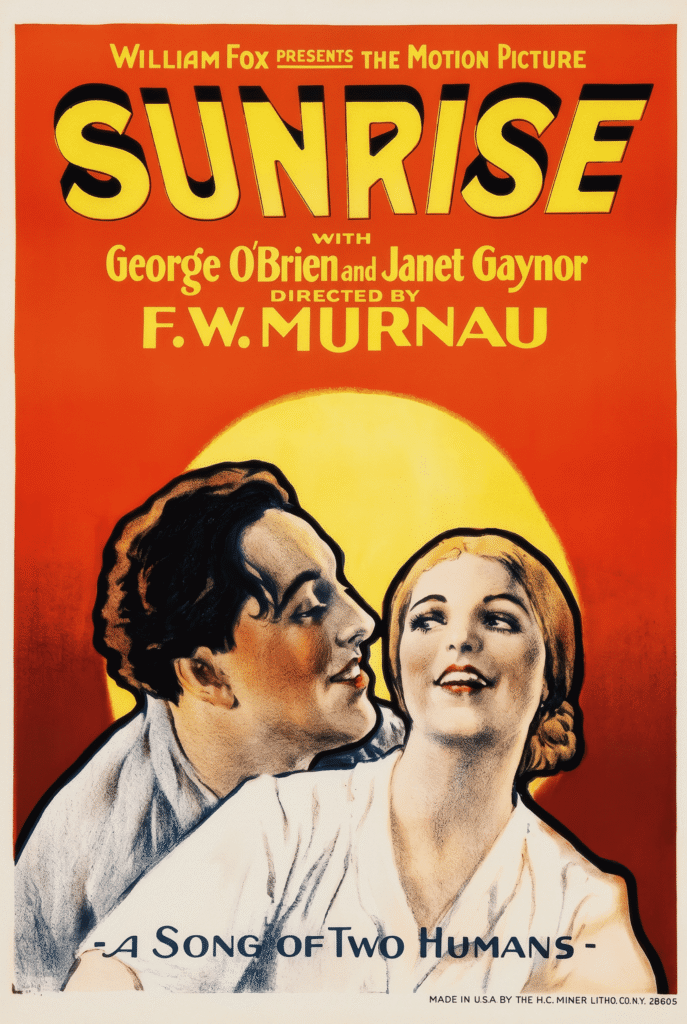
Original title: Sunrise: A Song of Two Humans
Based on: The novella “Die Reise nach Tilsit” (1917) by Hermann Sudermann
Director: F.W. Murnau
Screenplay: Carl Mayer
Cinematography: Charles Rosher, Karl Struss
Music: Hugo Riesenfeld
Cast: George O’Brien, Janet Gaynor, Margaret Livingston, Bodil Rosing, J. Farrell MacDonald
Filming locations: Fox Film Corporation Studios, Hollywood, California; Lake Arrowhead, California
Subtitles: English (EN), Romanian (RO)
Synopsis and Main Themes: A farmer from a quiet village falls under the spell of a sophisticated woman from the city, who persuades him to murder his wife and run away with her. Overcome with remorse, the man cannot carry out the plan. What follows is an emotional journey of husband and wife through the big city — from fear and shame to the rediscovery of love and the simple joy of being together. The film explores temptation, guilt, redemption, and the contrast between the purity of rural life and the dangerous seduction of the urban world, in a universal parable about the fragility and resilience of human bonds.
About the Director and Cinematic Style: F.W. Murnau, the master of German Expressionism who had already created Nosferatu and The Last Laugh, was given complete artistic freedom by producer William Fox to make Sunrise — his first American film. Murnau built elaborate sets, including an entire village on a lakeshore and a city using forced perspective to simulate depth. His style combines chiaroscuro lighting with revolutionary camera movements — fluid tracking shots on rails unprecedented in American cinema. Intertitles nearly disappear as the film progresses, the story told exclusively through image, light, and music.
Critical Reception and Impact: Though a commercial failure upon its premiere, Sunrise was acclaimed by critics and won three awards at the first Academy Awards ceremony (1929): Best Picture — Unique and Artistic Production (the only time this category ever existed), Best Actress (Janet Gaynor, cumulatively with 7th Heaven and Street Angel), and Best Cinematography (Charles Rosher and Karl Struss). Its historical paradox — a film now widely considered superior to the Best Picture winner Wings — inaugurated a long tradition of Oscar controversies over the best film of the year.
Historical Context and Cinematic Legacy: Released in September 1927, the same year as Metropolis and Napoleon, Sunrise marks the absolute pinnacle of silent cinema. The use of the Movietone synchronized sound system — with sound effects and a musical score but no dialogue — places the film precisely at the border between two eras of filmmaking. The New York premiere was preceded by the first sound newsreels in history, and the film was screened during the same period as The Jazz Singer, the first film with synchronized dialogue. The influence of Sunrise on world cinema is immeasurable — from the visual style of Orson Welles to the poetic sensibility of contemporary Asian directors. Selected in 1989 for the National Film Registry of the Library of Congress and ranked 11th in the 2022 Sight & Sound poll, the film is widely considered the greatest achievement of silent cinema.
You cannot copy content of this page

It's free. No subscription required


Comentarii (0)
Please login to comment.
Please login to review.