

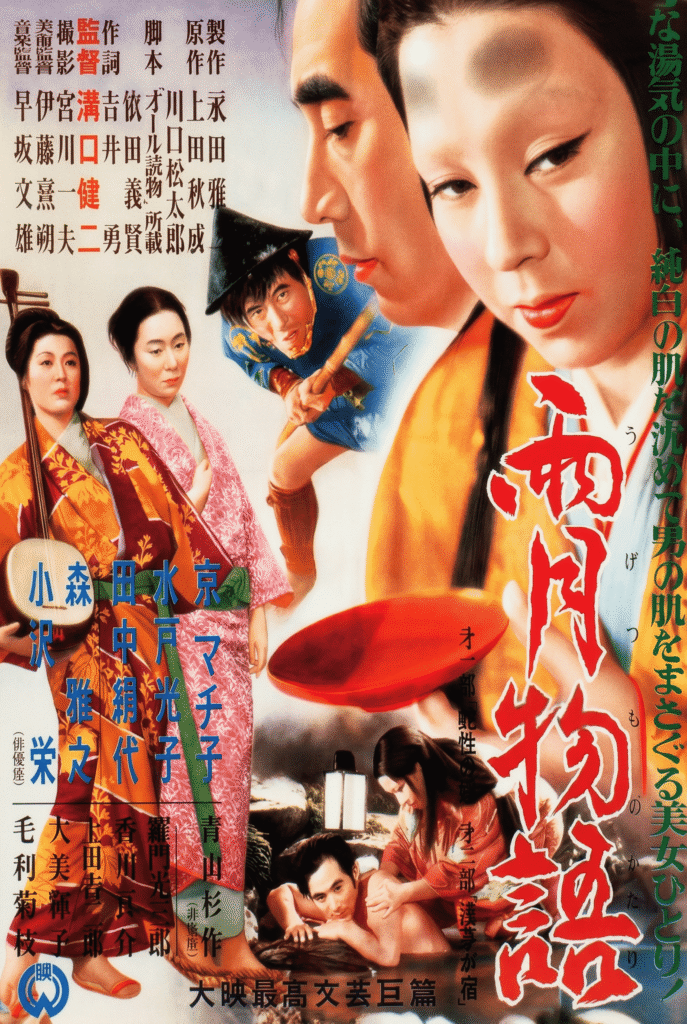
Original title: Ugetsu Monogatari
Based on: Stories “Asaji ga Yado” and “Jasei no In” from the collection Ugetsu Monogatari by Akinari Ueda (1776)
Director: Kenji Mizoguchi
Screenplay: Matsutarô Kawaguchi, Yoshikata Yoda
Cinematography: Kazuo Miyagawa
Music: Fumio Hayasaka, Tamekichi Mochizuki, Ichirô Saitô
Cast: Machiko Kyô, Masayuki Mori, Kinuyo Tanaka, Mitsuko Mito, Eitarô Ozawa, Sugisaku Aoyama, Mitsusaburô Ramon, Ryôsuke Kagawa
Filming locations: Daiei Studios, Tokyo, Japan
Subtitles: English (EN), Romanian (RO)
Synopsis and Main Themes: In 16th-century Japan, torn apart by civil war, two peasant men chase their ambitions beyond the village — one seeking fortune as a pottery merchant, the other glory as a samurai. Both abandon their wives to pursue their obsessions. Genjurō, the potter, is seduced by a spectral noblewoman whose love proves to be a trap from beyond the grave. Tōbei, the would-be warrior, achieves his dream only to discover what it has cost him. The film explores the destructive power of male ambition, the suffering of the women left behind, and the thin, permeable boundary between the living and the dead.
About the Director and Cinematic Style: Kenji Mizoguchi, one of cinema’s supreme masters of the long take and the moving camera, achieves in Ugetsu a fusion of the natural and the supernatural that has never been equalled. Kazuo Miyagawa’s luminous cinematography transforms Lake Biwa into a landscape suspended between worlds — the famous boat scene, gliding through mist, is one of the most hauntingly beautiful passages in all of cinema. Mizoguchi’s signature technique of observing his characters from a slight distance, refusing to invade their emotional space, gives their suffering a dignity that close-ups would destroy.
Critical Reception and Impact: Ugetsu won the Silver Lion at the 1953 Venice Film Festival, confirming Mizoguchi’s standing alongside Kurosawa as one of the two great masters of Japanese cinema known to Western audiences. The film was a revelation in Europe and America, where it introduced many viewers to the aesthetic and spiritual depth of Japanese filmmaking. It has since been consistently ranked among the greatest films ever made, appearing in virtually every major critics’ poll of the past seven decades.
Historical Context and Cinematic Legacy: Released in 1953, Ugetsu emerged from a postwar Japan still processing the devastation of the Second World War — and Mizoguchi channelled that collective trauma into a story set four centuries earlier, where war serves the same function: destroying ordinary lives for the sake of male vanity. The film adapts two tales from Ueda Akinari’s 18th-century collection of supernatural stories, blending them with a Maupassant-influenced narrative sensibility. Its influence has been immense: Martin Scorsese, Masaki Kobayashi, and Park Chan-wook have all acknowledged their debt to Mizoguchi’s masterpiece. The film’s central insight — that the ghosts who haunt us are made not of supernatural malice but of our own abandoned responsibilities — speaks as directly to the present as it did to the war-ravaged Japan of its making.
You cannot copy content of this page

It's free. No subscription required


Comentarii (0)
Please login to comment.
Please login to review.