

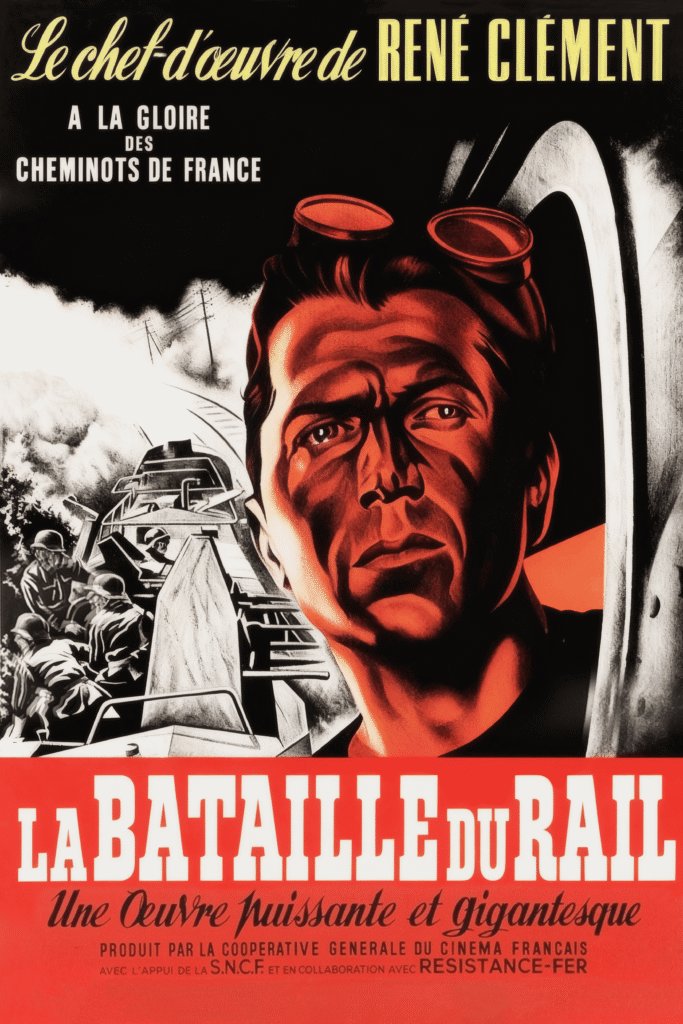
Original title: La Bataille du rail
Based on: Original screenplay by René Clément and Colette Audry
Director: René Clément
Screenplay: René Clément, Colette Audry
Cinematography: Henri Alekan
Music: Yves Baudrier
Cast: Marcel Barnault, Jean Clarieux, Jean Daurand, Lucien Desagneaux, François Joux, Pierre Latour, Tony Laurent, Robert Le Ray, Pierre Lozach, Léon Pauléon, Charles Boyer (narrator, uncredited)
Filming locations: Gare SNCF, Saint-Brieuc, Côtes-d’Armor, France
Subtitles: English (EN), Romanian (RO)
Synopsis and Main Themes: In the final years of the German occupation, French railway workers carry out a sustained campaign of sabotage: derailing trains, hiding Allied agents, and disrupting the Nazi war machine with the instruments of their daily labor. The film has no single protagonist — the collective itself is the hero, and the individual acts of courage are presented as expressions of a shared professional identity and civic duty. Beneath the patriotic surface runs a deeper current: the idea that ordinary work, turned against an occupier, is itself a form of resistance.
About the Director and Cinematic Style: René Clément was born in Bordeaux in 1913 and trained as an architect at the École des Beaux-Arts before turning to filmmaking through documentary shorts. La Bataille du rail was made with the active support of the French railway workers’ unions, who provided equipment, locations, and many of the cast — actual resistance fighters playing versions of themselves. Clément uses Henri Alekan’s photography — Alekan himself a former Resistance member who had escaped a Nazi POW camp — to give the film the texture of documentary testimony rather than staged reconstruction, alternating long observational takes with sequences of precisely choreographed mechanical action.
Critical Reception and Impact: La Bataille du rail won the International Jury Prize and the Best Director Award for René Clément at the inaugural Cannes Film Festival in 1946 — the only Best Director prize Clément would ever receive at Cannes. The film also won the inaugural Prix Méliès. It was a major popular success in France upon its release, though it was quickly withdrawn from circulation shortly afterward: with France at war in Indochina, the authorities feared its detailed depiction of railway sabotage techniques might reach the Việt Minh. In 2010, a fully restored version — completed by INA — was presented at Cannes Classics, reaffirming the film’s place in the French canon.
Historical Context and Cinematic Legacy: La Bataille du rail was produced at a moment when French cinema was being deliberately deployed to reconstruct a national identity around the myth of collective resistance — a myth that glossed over the far more complex reality of collaboration, passivity, and accommodation that had characterized much of the population under Vichy. Funded by the railway workers’ unions and made with no professional actors in the principal roles, it stands at the intersection of neorealism and national mythology. Its direct influence is visible in the Italian films of Rossellini and De Sica, which shared its commitment to non-professional casts and location shooting. Marcel Ophüls’ Le Chagrin et la pitié (1969) would later deliver the decisive counter-narrative to films like this one — but La Bataille du rail endures as an extraordinary piece of filmmaking, whatever the politics it was made to serve.
You cannot copy content of this page

It's free. No subscription required

Comentarii (0)
Please login to comment.
Please login to review.