

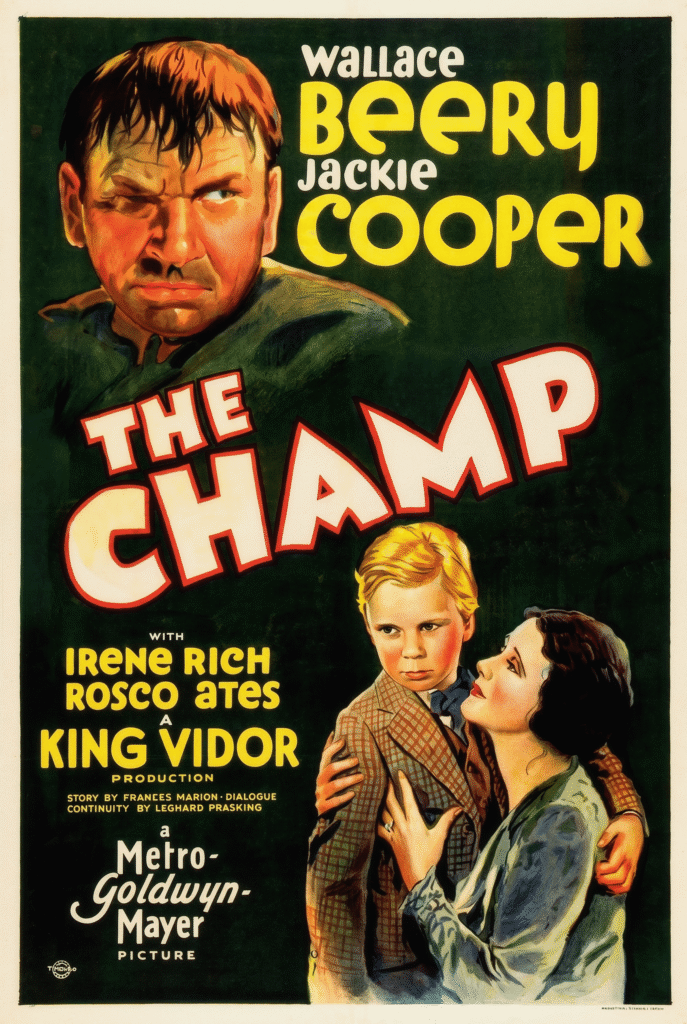
Original title: The Champ
Based on: Original screenplay by Frances Marion
Director: King Vidor
Screenplay: Frances Marion, Wanda Tuchock (additional dialogue), Don Marquis (dialogue)
Cinematography: Gordon Avil
Music: —
Cast: Wallace Beery, Jackie Cooper, Irene Rich, Roscoe Ates, Edward Brophy, Hale Hamilton, Jesse Scott, Marcia Mae Jones
Filming locations: Metro-Goldwyn-Mayer Studios, Culver City, California; Agua Caliente Racetrack, Baja California, Mexico
Subtitles: English (EN), Romanian (RO)
Synopsis and Main Themes: Andy “Champ” Purcell, a former heavyweight champion now reduced to drink and gambling in Tijuana, lives with his young son Dink, whose devotion is absolute and unconditional. When Dink’s mother — long absent, now wealthy — reappears and offers the boy a stable life, Andy must choose between his own self-destruction and the sacrifice that love demands. The film moves between tenderness and ruin, bound by the question of what a father owes a child he has already failed.
About the Director and Cinematic Style: King Vidor (1894–1982), born in Galveston, Texas, came to MGM in the early 1920s and established himself as one of Hollywood’s most socially engaged directors with The Big Parade (1925) and The Crowd (1928). Drawn to working-class subjects and humanist themes, he brought to The Champ a visual directness carried over from his silent-era mastery — painterly compositions, controlled use of darkness and moonlight, and an early experiment with tracking shots that trusted physical performance over dialogue to carry emotional weight.
Critical Reception and Impact: The Champ was a major commercial success, among the top box-office draws of 1932. At the 5th Academy Awards ceremony in November 1932, it received four nominations and won two: Wallace Beery shared the Best Actor award with Fredric March in a declared tie, and Frances Marion won Best Original Story. The film was also nominated for Best Picture and Best Director. In August 1932, it was among the titles selected for the inaugural Venice Film Festival — a noncompetitive event where an audience referendum stood in for official jury prizes. Time magazine acknowledged its popular force while criticizing its heavy reliance on pathos.
Historical Context and Cinematic Legacy: The Champ arrived during the brief pre-Code era, when Hollywood could depict alcoholism, gambling, and moral failure with a candor the Production Code would soon suppress. Against the backdrop of the Great Depression, its portrait of a broken man redeemed only by a child’s faith struck audiences with unusual force. The film’s influence reached beyond American cinema: it is considered one of the sources for Yasujirō Ozu’s Passing Fancy (1933), which transposed a similar father-son dynamic to a Tokyo slum. It was remade in 1952 as The Clown and again in 1979 by Franco Zeffirelli. Film critic Judith Crist argued that nearly every subsequent pairing of an adult actor and a child must be measured against the chemistry between Beery and Cooper. Frances Marion’s second consecutive Oscar win cemented her standing as one of Hollywood’s foremost screenwriters.
You cannot copy content of this page

It's free. No subscription required
Comentarii (0)
Please login to comment.
Please login to review.