

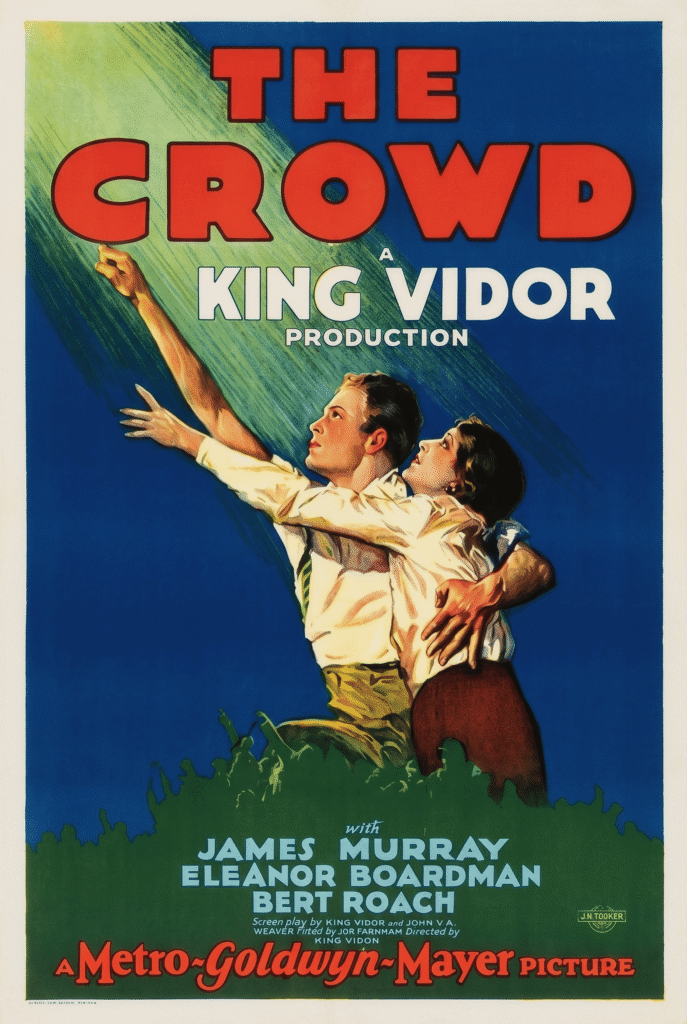
Original title: The Crowd
Based on: Original screenplay by King Vidor and John V.A. Weaver
Director: King Vidor
Screenplay: King Vidor, John V.A. Weaver, Joseph Farnham (titles), Harry Behn (adaptation)
Cinematography: Henry Sharp
Music: Carl Davis (1981)
Cast: Eleanor Boardman, James Murray, Bert Roach, Estelle Clark, Daniel G. Tomlinson, Dell Henderson, Lucy Beaumont, Freddie Burke Frederick, Alice Mildred Puter
Filming locations: Metro-Goldwyn-Mayer Studios, Culver City, California; Coney Island, Brooklyn, New York City, New York
Subtitles: English (EN), Romanian (RO)
Synopsis and Main Themes: John Sims arrives in New York on the Fourth of July, 1900, convinced that something great awaits him. He finds instead a desk among thousands in a vast insurance office, marries Mary, and builds a fragile life that tragedy and financial failure slowly erode. The film traces the collision between individual ambition and collective indifference — the crowd that celebrates with you but moves on without a second glance when you fall.
About the Director and Cinematic Style: King Vidor began directing in 1913 and rose to prominence with the WWI epic The Big Parade (1925), the highest-grossing silent film of its era. Building on the reputation earned with that film, he convinced MGM producer Irving Thalberg to fund an experimental work with no stars and no happy ending. In The Crowd, his camera moves with unprecedented fluidity — gliding up skyscraper facades, penetrating the city’s streets through hidden cameras, and capturing with the same cold eye the devastating intimacy of a couple pushed to their limits.
Critical Reception and Impact: Contemporary reception was divided: The New York Times praised its unflinching portrait of ordinary struggle, while Variety dismissed it as actionless and overlong. Audiences, riding the optimism of the late 1920s, largely stayed away. At the first Academy Awards ceremony in 1929, the film received two nominations — Best Director for King Vidor (losing to Frank Borzage for 7th Heaven) and Best Unique and Artistic Production (losing to Murnau’s Sunrise). In 1989, the Library of Congress selected it among the first twenty-five films inducted into the National Film Registry.
Historical Context and Cinematic Legacy: Released on the cusp of the Great Depression, The Crowd arrived when Hollywood was still selling the myth of self-made success. Vidor’s refusal to resolve John Sims’s story with triumph or consolation felt alien to audiences accustomed to redemptive arcs — yet it was precisely that refusal which gave the film its enduring weight. Jean-Luc Godard, when asked in the 1960s why cinema rarely depicted ordinary people, replied that The Crowd had already done it, making repetition pointless. Its innovations in mobile cinematography — the tracking shot ascending the office building, the overhead pullback dissolving John into an anonymous mass — became foundational grammar for urban filmmaking. Directors from Elia Kazan to Sidney Lumet to contemporary social realists drew on its template of the city as both promise and trap.
You cannot copy content of this page

It's free. No subscription required
Comentarii (0)
Please login to comment.
Please login to review.