

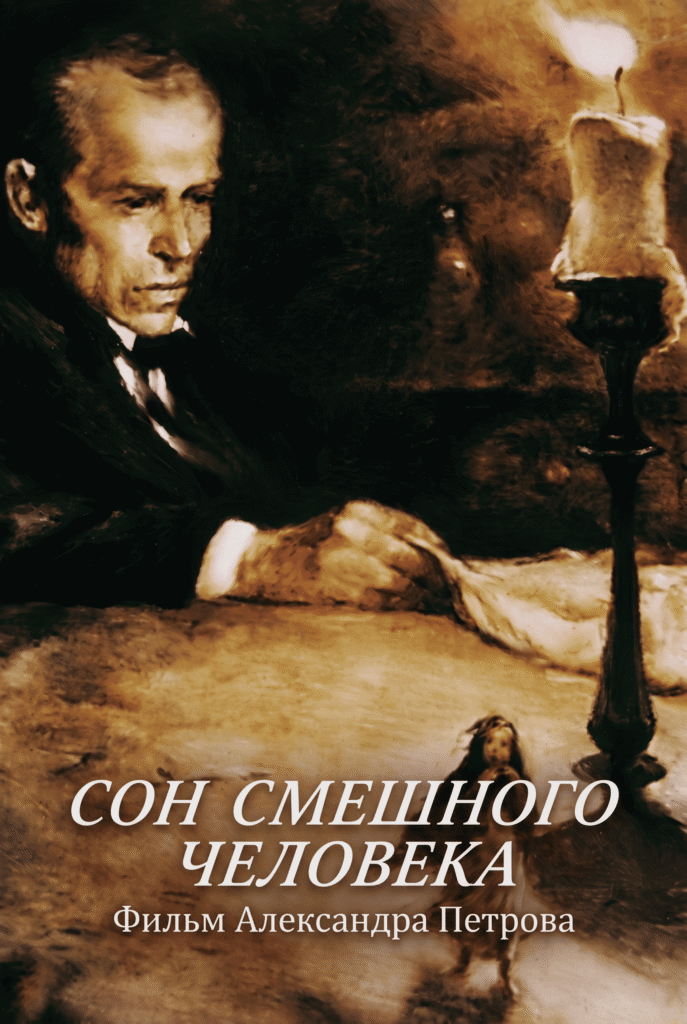
Original title: Son smeshnogo cheloveka
Based on: Based on the short story “The Dream of a Ridiculous Man” by Fyodor Dostoevsky
Director: Aleksandr Petrov
Screenplay: Aleksandr Petrov
Cinematography: Aleksandr Petrov
Music: —
Cast: Aleksandr Kaydanovskiy (Narrator, voice)
Filming locations: Sverdlovskaya Kinostudiya, Russia
Subtitles: English (EN), Romanian (RO)
Synopsis and Main Themes: A man consumed by misanthropy and the conviction that nothing in the world has meaning resolves to take his own life. Before he acts, a chance encounter with a desperate young girl unsettles him — and that night, he dreams. He is transported to an untouched world of innocence and harmony, only to corrupt it irrevocably through his mere presence. The film follows Dostoevsky’s meditation on guilt, moral responsibility, and the paradox of a man who discovers the value of existence only through destroying it.
About the Director and Cinematic Style: By 1992, Aleksandr Petrov had carried the paint-on-glass technique through two short films and had fully internalized its possibilities. The Dream of a Ridiculous Man is his most ambitious work to that point — a twenty-minute adaptation that moves fluidly between the grim, rain-soaked realism of a Petersburg night and the luminous, dreamlike vistas of an uncorrupted world. Petrov had been drawn to Dostoevsky’s story since his student years, and the film bears the mark of that long attachment: every frame feels deeply considered.
Critical Reception and Impact: The film was received with strong recognition at international animation festivals. At the Ottawa International Animation Festival (1992), it won both the Audience Award and the prize for Best Production between ten and thirty minutes in length. At the Cracow Film Festival (1993), it received a Special Mention for the treatment of a crucial subject through animation. It was also nominated for the Nika Award for Best Animated Film, Russia’s principal national film prize.
Historical Context and Cinematic Legacy: Dostoevsky’s 1877 story belongs to the final, visionary phase of his work — a compressed philosophical fable in which a single dream encompasses the full arc of human history, from paradise to corruption. Petrov’s adaptation arrived in 1992, in the immediate aftermath of the Soviet Union’s collapse, when Russian culture was reckoning with decades of enforced aesthetic doctrine and searching for new footing. Adapting Dostoevsky — long claimed by Soviet ideology but never fully domesticated by it — carried its own resonance in this context. The film deepened Petrov’s reputation as the foremost practitioner of paint-on-glass animation and confirmed that the technique was capable of carrying the weight of major literary and philosophical material. It remains among the most searching animated adaptations of Dostoevsky in existence.
You cannot copy content of this page

It's free. No subscription required
Comentarii (0)
Please login to comment.
Please login to review.