

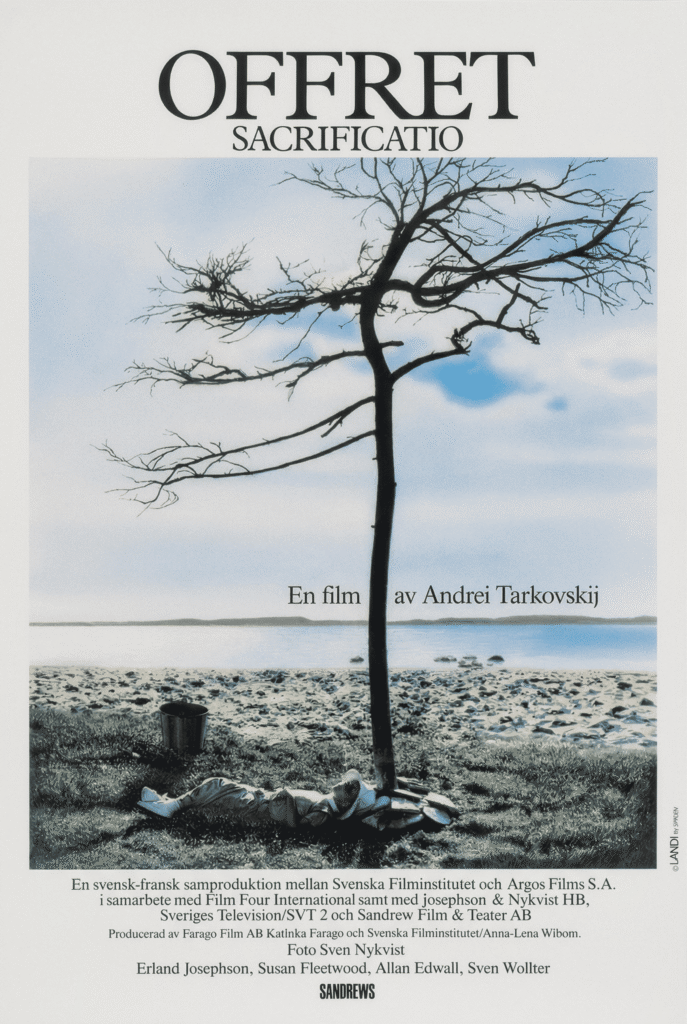
Original title: Offret
Based on: Original screenplay by Andrei Tarkovsky
Director: Andrei Tarkovsky
Screenplay: Andrei Tarkovsky
Cinematography: Sven Nykvist
Music: Johann Sebastian Bach; traditional Swedish folk music
Cast: Erland Josephson, Susan Fleetwood, Allan Edwall, Guðrún Gísladóttir, Sven Wollter, Valérie Mairesse, Filippa Franzén, Tommy Kjellqvist
Filming locations: Gotland Island, Sweden
Subtitles: English (EN), Romanian (RO)
Synopsis and Main Themes: On his birthday, Alexander — a retired actor and intellectual on a remote Swedish island — learns that nuclear war has begun. In absolute despair, he makes a private bargain with God: if the catastrophe can be reversed, he will sacrifice everything he loves — his home, his voice, his family — forever. The film turns on whether this sacrifice will be accepted, and what it means to keep such a promise. The Sacrifice explores faith as an extreme act, the willingness to destroy one’s own life for the salvation of others, and the terrifying intimacy of a conversation between a man and his God.
About the Director and Cinematic Style: Tarkovsky made The Sacrifice in Sweden with a largely Scandinavian cast and crew, in collaboration with cinematographer Sven Nykvist — Ingmar Bergman’s longtime collaborator — whose mastery of natural light gives the film an extraordinary visual authority. The long, unhurried takes reach their most extreme expression here, holding on faces and spaces with almost unbearable attention. The film is structured around silence and waiting, as if time itself has thickened before the catastrophe. The dedication at the end — “to my son Andriusha, with hope and confidence” — transforms the film into a personal testament.
Critical Reception and Impact: The Sacrifice won the Grand Prix Spécial du Jury, the FIPRESCI Prize, and the Prize of the Ecumenical Jury at the 1986 Cannes Film Festival. It also won the BAFTA Award for Best Film Not in the English Language. Tarkovsky died of cancer in December 1986, just months after completing the film. The Sacrifice was immediately recognized as a major work and a fitting conclusion to one of the most singular bodies of work in cinema history.
Historical Context and Cinematic Legacy: Made at the height of Cold War nuclear anxiety, The Sacrifice captures the atmosphere of an era in which the end of the world felt genuinely possible. But Tarkovsky refuses to make a political film: the catastrophe is a spiritual occasion, not a geopolitical one. He completed the film while dying of cancer — a disease likely caused by the contaminated locations where Stalker was shot years earlier. The house burning at the film’s climax, filmed in a single unbroken take that had to be reshot after a camera malfunction, is one of cinema’s most shattering images — and one Tarkovsky did not live to see distributed worldwide. The film stands as the concluding statement of a filmmaker who spent his entire career asking what it means to believe — in God, in art, in the possibility of saving the world through a single private act. Its legacy is inseparable from the man who made it: a sacrifice that was real.
You cannot copy content of this page

It's free. No subscription required
Comentarii (0)
Please login to comment.
Please login to review.