

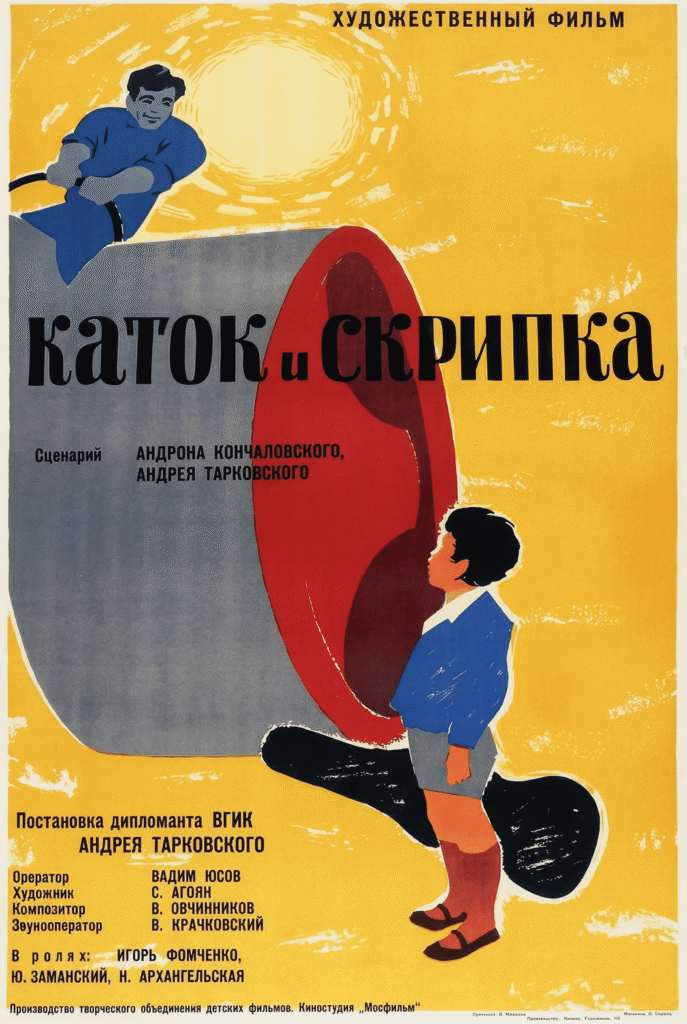
Original title: Katok i skripka
Director: Andrei Tarkovsky
Screenplay: Andrei Tarkovsky, Andrei Konchalovsky, S. Bakhmetyeva
Cinematography: Vadim Yusov
Music: Vyacheslav Ovchinnikov
Cast: Igor Fomchenko, Vladimir Zamanskiy, Natalya Arkhangelskaya, Marina Adzhubei, Antonina Maksimova, Lyudmila Semyonova
Filming locations: Mosfilm Studios, Moscow, Soviet Union
Subtitles: English (EN), Romanian (RO)
Synopsis and Main Themes: Seven-year-old Sasha practices the violin every day under the pressure of his parents’ ambitions. Withdrawn and isolated by his routines, he finds an unexpected friendship with Sergei, a steamroller operator working in his Moscow neighborhood. Through their brief but transformative bond — crossing boundaries of age, class, and social convention — both discover warmth and human connection in the rigid landscape of Soviet daily life. The film explores themes of innocence, class distinction, the longing for freedom, and the redemptive power of genuine human encounter.
About the Director and Cinematic Style: The Steamroller and the Violin is Andrei Tarkovsky’s diploma short film from VGIK, made when he was 28. Already in this early work, the essential elements of his mature visual language are present: a lyrical use of color and light, mirror reflections, the poetic observation of ordinary objects, and a deep sensitivity to childhood perception. Tarkovsky and cinematographer Vadim Yusov saturated the film in vibrant reds and yellows — an unusual departure from the grey tones typical of Soviet cinema.
Critical Reception and Impact: The film won First Prize at the New York Student Film Festival in 1961, marking Tarkovsky’s first international recognition. Critics and scholars have long considered it a remarkable debut — accessible, warm, and technically assured — and an illuminating counterpoint to the harsher, more austere works that followed. Though modest in scope compared to his later epics, the film demonstrated a fully formed artistic sensibility that immediately set Tarkovsky apart from his Soviet contemporaries.
Historical Context and Cinematic Legacy: Produced at Mosfilm as a student graduation project in 1960, The Steamroller and the Violin stands at the threshold of one of the most extraordinary careers in cinema history. It captures a Soviet Union still shaped by ideological constraints, yet already showing cracks through which personal vision and artistic individuality could emerge. The film’s exploration of a boy’s inner world, mediated through color, music, and light, anticipates the autobiographical depth of Mirror and the spiritual questioning of Andrei Rublev. It is not merely a student exercise but a fully realized work of art, shot with the confidence and curiosity of a director who already knew what cinema could be.
You cannot copy content of this page

It's free. No subscription required
Comentarii (0)
Please login to comment.
Please login to review.