

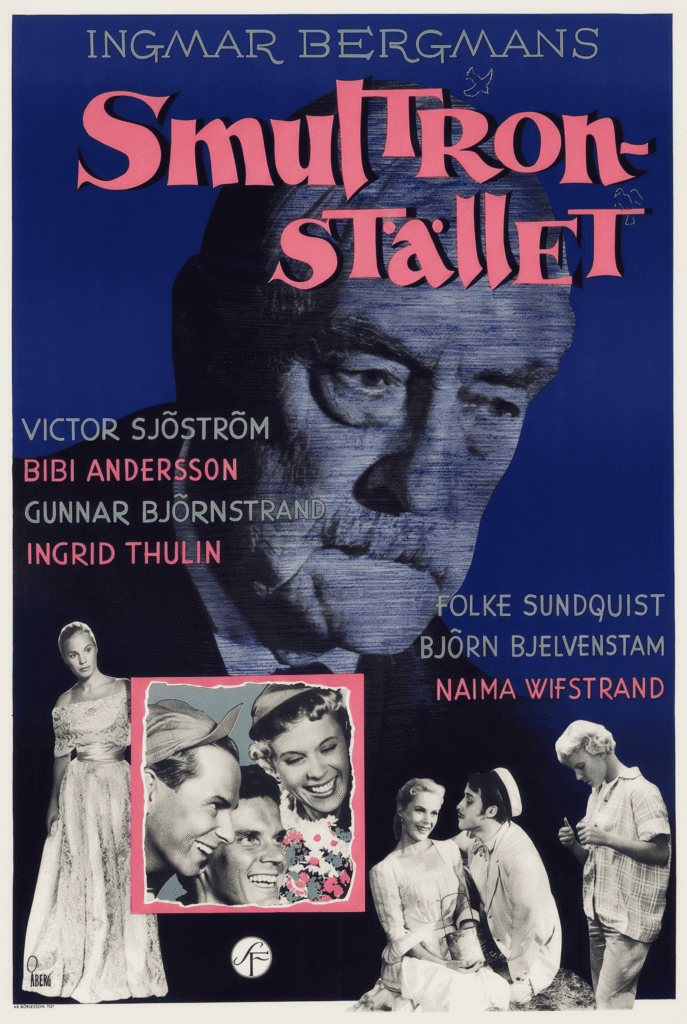
Original title: Smultronstället
Based on: Original screenplay by Ingmar Bergman
Director: Ingmar Bergman
Screenplay: Ingmar Bergman
Cinematography: Gunnar Fischer
Music: Erik Nordgren
Cast: Victor Sjöström, Bibi Andersson, Ingrid Thulin, Gunnar Björnstrand, Jullan Kindahl, Folke Sundquist, Björn Bjelfvenstam, Naima Wifstrand
Filming locations: Dalarö, Stockholms län, Sweden; Filmstaden, Råsunda, Stockholm
Subtitles: English (EN), Romanian (RO)
Synopsis and Main Themes: Professor Isak Borg, a 78-year-old physician, drives from Stockholm to Lund to receive an honorary degree. Along the way — accompanied by his daughter-in-law Marianne, who quietly resents him — he picks up hitchhikers, revisits the summer house of his youth, and is overtaken by dreams and memories that force him to confront the emotional coldness that has defined his life. A beloved wild strawberry patch from childhood becomes the landscape of everything he lost by choosing intellect over feeling. The film explores old age, regret, the archaeology of memory, and the fragile possibility of reconciliation at the end of a life lived at a distance from others.
About the Director and Cinematic Style: Ingmar Bergman wrote Wild Strawberries during a period of personal crisis, and the film bears the marks of an artist confronting his own emotional failures through a surrogate. The casting of Victor Sjöström — the legendary director of silent Swedish cinema, then 78 years old — as Isak Borg gives the film an almost documentary gravity: Sjöström’s face carries decades of real life within it. Bergman interweaves dream sequences of startling surrealist power — a faceless clock, a coffin that opens, an examination where every answer is wrong — with naturalistic road-trip scenes of disarming warmth.
Critical Reception and Impact: Wild Strawberries won the Golden Bear at the 1958 Berlin International Film Festival and was nominated for the Academy Award for Best Original Screenplay. The film was a critical and commercial success that cemented Bergman’s international reputation and introduced his work to audiences far beyond the art-house circuit. Victor Sjöström’s performance was universally praised as one of the great achievements of screen acting — a portrayal of such depth that it is impossible to separate the character from the man.
Historical Context and Cinematic Legacy: Released in 1957, Wild Strawberries arrived at the moment when Bergman was transitioning from accomplished Swedish filmmaker to one of the towering figures of world cinema. The film’s structure — a physical journey that becomes a journey through memory and dream — has become one of cinema’s most enduring templates, echoed in films from Fellini’s 8½ to Wim Wenders’s Paris, Texas to Alexander Payne’s About Schmidt. Bergman later admitted that Isak Borg was a self-portrait drawn in advance — a warning to himself about the consequences of emotional withdrawal. Victor Sjöström died just three years after the film’s release, and Wild Strawberries stands as the final, luminous testament of Swedish cinema’s founding father — a film in which two of the country’s greatest artists, separated by a generation, meet in a single work of art about the terror and grace of looking back.
You cannot copy content of this page

It's free. No subscription required

Comentarii (0)
Please login to comment.
Please login to review.