

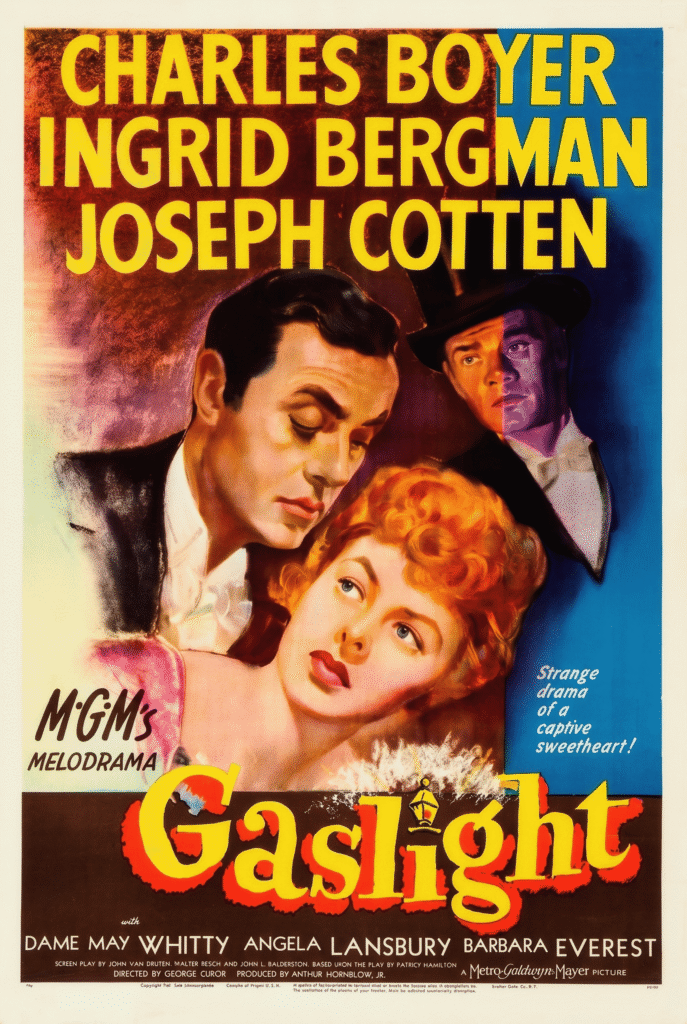
Original title: Gaslight
Based on: Based on the play Angel Street (1938) by Patrick Hamilton
Director: George Cukor
Screenplay: John Van Druten, Walter Reisch, John L. Balderston
Cinematography: Joseph Ruttenberg
Music: Bronislau Kaper
Cast: Charles Boyer, Ingrid Bergman, Joseph Cotten, May Whitty, Angela Lansbury, Barbara Everest, Emil Rameau, Edmund Breon, Halliwell Hobbes, Tom Stevenson
Filming locations: Metro-Goldwyn-Mayer Studios, Culver City, California
Subtitles: English (EN), Romanian (RO)
Synopsis and Main Themes: Paula, a young woman who witnessed the murder of her aunt as a child, returns to London years later with her new husband Gregory — charming, cultivated, and with a threat concealed beneath every gesture. Gregory systematically manipulates Paula into believing she is losing her mind: objects disappear, sounds drift from sealed rooms, and the gaslights dim without explanation. The film turns the Victorian domestic interior into a theater of psychological terror, probing how falsified love, imposed isolation, and betrayed trust can be weaponized to erase a person’s grip on reality.
About the Director and Cinematic Style: George Cukor was born in New York in 1899 and built his reputation on Broadway before moving to Hollywood in 1929. By the time he made Gaslight, he had already directed Dinner at Eight (1933), David Copperfield (1935), and The Philadelphia Story (1940), establishing himself as a supreme director of actors across comedies and literary adaptations. Gaslight shows a different register: Cukor uses Joseph Ruttenberg’s photography — high-angle shots, deep shadows, gaslit interiors — to transform a stage thriller into something genuinely suffocating.
Critical Reception and Impact: Gaslight received seven Academy Award nominations at the 17th Academy Awards (1945), winning two: Best Actress for Ingrid Bergman — the first of her three Oscars — and Best Art Direction in black and white. Charles Boyer received a Best Actor nomination, and Angela Lansbury, in her film debut, was nominated for Best Supporting Actress. Ingrid Bergman also won the Golden Globe for Best Actress that year. The Hollywood Reporter praised the film upon release as an extraordinary attraction, built on exceptional characterizations. The film was entered into the Official Competition at Cannes in 1946.
Historical Context and Cinematic Legacy: Gaslight arrived at a moment when Hollywood was developing a sustained cycle of domestic thrillers — alongside Rebecca, Suspicion, and Shadow of a Doubt — in which the home becomes a site of menace and the husband a potential predator. The film drew on Patrick Hamilton’s 1938 London stage play Gas Light, previously adapted in Britain by Thorold Dickinson in 1940. Cukor’s version, with its MGM production values and Bergman’s international star power, gave the story a permanence the British original never achieved. Its cultural afterlife has been extraordinary: the word “gaslighting” entered common psychological and eventually popular usage to describe the very form of manipulation the film depicts, making Gaslight one of the rare films to have genuinely altered the language. In 2019 it was inducted into the National Film Registry by the Library of Congress.
You cannot copy content of this page

It's free. No subscription required
Comments (0)
Please login to comment.
Please login to review.