

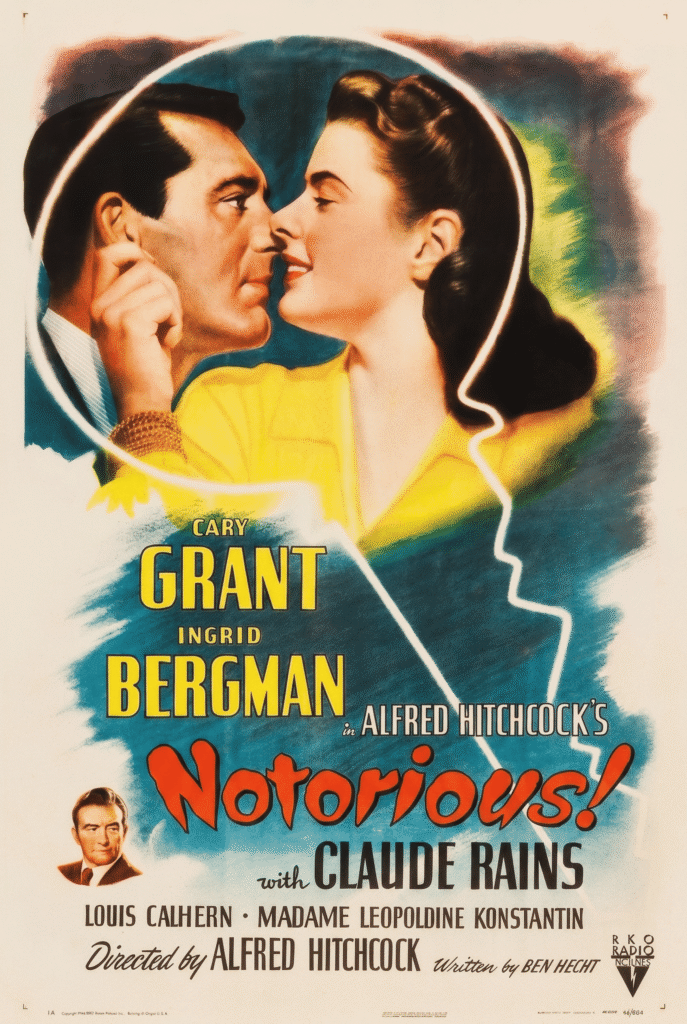
Original title: Notorious
Based on: Original screenplay by Ben Hecht
Director: Alfred Hitchcock
Screenplay: Ben Hecht
Cinematography: Ted Tetzlaff
Music: Roy Webb
Cast: Cary Grant, Ingrid Bergman, Claude Rains, Louis Calhern, Leopoldine Konstantin, Reinhold Schünzel, Moroni Olsen, Ivan Triesault, Alexis Minotis, Wally Brown
Filming locations: RKO Radio Pictures Studios, Hollywood, California; Rio de Janeiro, Brazil (establishing shots)
Subtitles: English (EN), Romanian (RO)
Synopsis and Main Themes: Alicia Huberman, the American daughter of a convicted Nazi spy, is recruited by U.S. intelligence agent Devlin to infiltrate a cell of German émigrés in postwar Rio de Janeiro. Her mission requires her to seduce — and ultimately marry — Alex Sebastian, a Nazi industrialist who once loved her. What begins as espionage becomes a study in cruelty disguised as duty: Devlin sends Alicia into danger while punishing her with his silence, and the film turns on the unbearable cost of love that refuses to declare itself.
About the Director and Cinematic Style: Alfred Hitchcock was born in London in 1899 and made his first feature films in Britain in the 1920s before moving to Hollywood in 1939, where Rebecca immediately won him the Academy Award for Best Picture. By 1946 he had already directed Shadow of a Doubt, Lifeboat, and Spellbound, consolidating his mastery of psychological suspense. In Notorious, his camera work reaches a particular refinement: the celebrated crane shot descending from a ballroom chandelier to a key concealed in Alicia’s hand announces a filmmaker in complete command of cinematic space and tension.
Critical Reception and Impact: Notorious received two Academy Award nominations at the 19th ceremony (1947): Best Supporting Actor for Claude Rains and Best Original Screenplay for Ben Hecht. The film was also nominated for the Grand Prize at Cannes in 1946. Bosley Crowther in The New York Times called it velvet smooth in dramatic action, charged with intense emotional appeal, and a remarkable blend of love story and expert thriller. Roger Ebert later added it to his Great Movies list, describing it as the most elegant expression of Hitchcock’s visual style. In 2006 it was selected for preservation in the National Film Registry by the Library of Congress.
Historical Context and Cinematic Legacy: Notorious was made in the immediate aftermath of World War II, when Nazi fugitives in South America were a documented reality and the moral compromises of wartime intelligence were a raw subject. The FBI had actually briefed Hitchcock and Ben Hecht on the possibility of Nazis attempting to develop atomic weapons — a detail that became the film’s central MacGuffin. Beyond its historical moment, Notorious established a template for the espionage thriller in which emotional devastation carries as much weight as geopolitical stakes. Its influence runs through the spy cinema of the following decades, from Carol Reed’s The Third Man to the films of John le Carré adaptations. Cahiers du cinéma ranked it among the hundred greatest films ever made, and on the centenary of Hitchcock’s birth, a panel of filmmakers assembled by the British Film Institute placed it third in his canon, behind only Psycho and Vertigo.
You cannot copy content of this page

It's free. No subscription required
Comments (0)
Please login to comment.
Please login to review.