

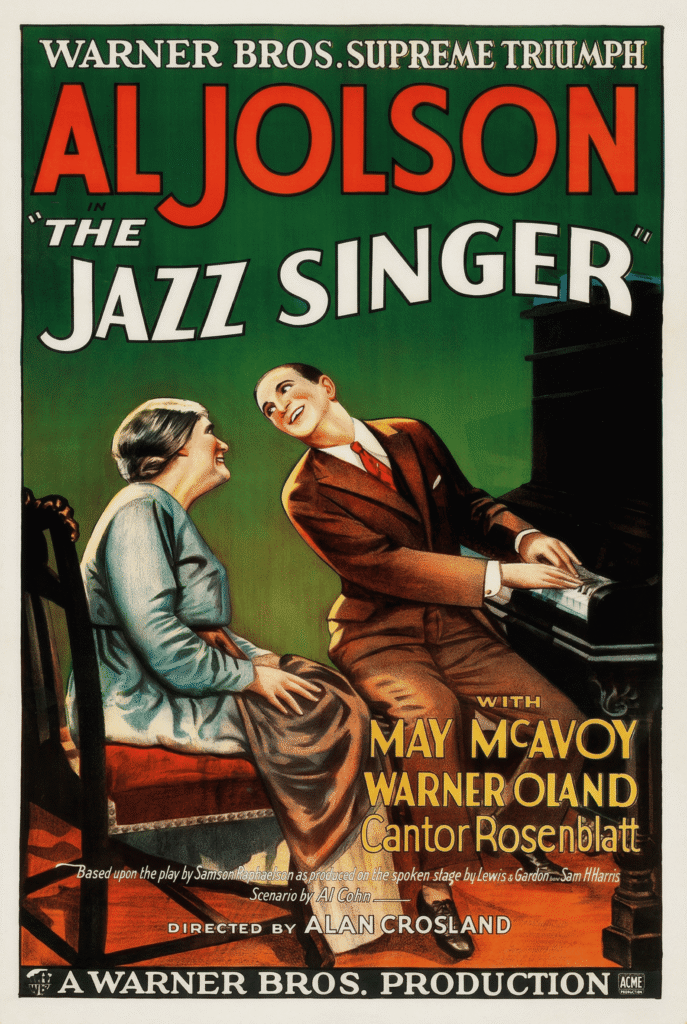
Original title: The Jazz Singer
Based on: The play “The Jazz Singer” (1925) by Samson Raphaelson, based on his short story “The Day of Atonement” (1922)
Director: Alan Crosland
Screenplay: Alfred A. Cohn (adaptation), Jack Jarmuth (intertitles)
Cinematography: Hal Mohr
Music: Louis Silvers (Vitaphone arrangement and synchronization)
Cast: Al Jolson, May McAvoy, Warner Oland, Eugenie Besserer, Otto Lederer, Robert Gordon, Richard Tucker, Yossele Rosenblatt, William Demarest
Filming locations: Warner Bros. Studios, Hollywood; Lower East Side and Winter Garden Theatre, New York
Subtitles: English (EN), Romanian (RO)
Synopsis and Main Themes: Jakie Rabinowitz is the son of a Jewish cantor from the Lower East Side, destined to continue a five-generation family tradition. But Jakie dreams of Broadway, not the synagogue. After a bitter argument with his father, he leaves home and, under the name Jack Robin, spends a decade trying to become a jazz star. When success is within reach, he learns his father is dying — and the night of his big premiere coincides with Yom Kippur, when he should sing the Kol Nidre in his father’s place. The film explores the conflict between tradition and individuality, between duty and ambition, between inherited identity and chosen identity — a universal dilemma told through the lens of the Jewish-American experience.
About the Director and Cinematic Style: Alan Crosland, a director experienced in Vitaphone films, constructs The Jazz Singer as a hybrid between silent and sound cinema — most scenes use traditional intertitles, but the musical sequences and a few moments of dialogue are synchronized through the Vitaphone sound-on-disc system. The moment when Jolson turns to the camera and declares “Wait a minute, wait a minute, you ain’t heard nothin’ yet!” became one of the most famous lines in cinema history — and one of the most prophetic. The film’s power lies in Jolson’s electrifying presence, whose vocal and physical energy transcends the limitations of primitive technology.
Critical Reception and Impact: The premiere on October 6, 1927, irreversibly changed the film industry. Variety called it “the best thing Vitaphone has ever put on the screen.” Its extraordinary financial success transformed Warner Bros. from a minor studio into a major Hollywood power. Sam Warner, the creative force behind the project, died one day before the premiere. At the first Academy Awards ceremony (1929), the Academy awarded Warner Bros. a Special Award “for producing The Jazz Singer, the pioneer outstanding talking picture, which has revolutionized the industry.” The film was also nominated for Best Adapted Screenplay.
Historical Context and Cinematic Legacy: The Jazz Singer was not the first sound film, nor the first with synchronized dialogue, but it was the one that convinced audiences and the industry that the future of cinema belonged to sound. Released during the same period as Murnau’s Sunrise — the supreme achievement of silent cinema — it marks an inflection point without equal in the history of art: the end of one era and the birth of another, in a single cinematic season. Jolson’s use of blackface, a theatrical convention of the era, remains today the film’s most controversial aspect, generating ongoing debates about racism, assimilation, and cultural representation. Beyond the controversy, the film has been included in the National Film Registry of the Library of Congress and in the AFI’s list of the 100 most important American films. It remains an essential document of the moment when cinema learned to speak.
You cannot copy content of this page

It's free. No subscription required
Comments (0)
Please login to comment.
Please login to review.