

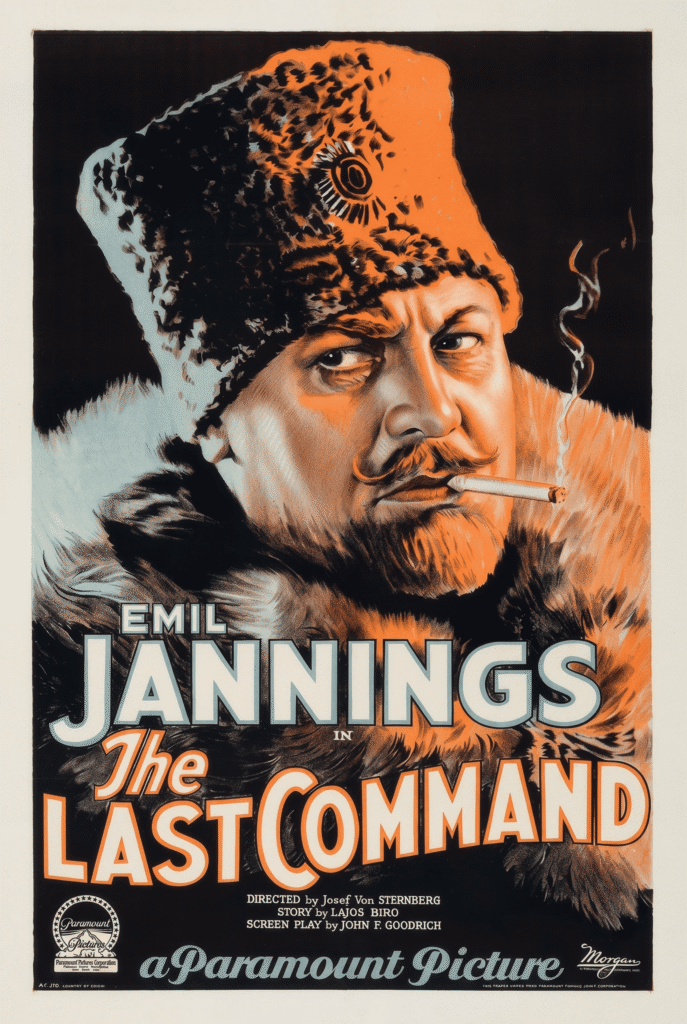
Original title: The Last Command
Based on: A story by Lajos Bíró, inspired by the real life of General Feodor Lodyzhensky
Director: Josef von Sternberg
Screenplay: John F. Goodrich, Herman J. Mankiewicz (intertitles), Lajos Bíró (story)
Cinematography: Bert Glennon
Music: —
Cast: Emil Jannings, Evelyn Brent, William Powell, Jack Raymond, Nicholas Soussanin, Michael Visaroff, Fritz Feld
Filming locations: Paramount Studios, Hollywood, California
Subtitles: English (EN), Romanian (RO)
Synopsis and Main Themes: Hollywood, 1928. An old, trembling extra is handed a general’s uniform for a film about the Russian Revolution. But Sergius Alexander is no ordinary extra — he is a former imperial general and cousin of the Tsar, once one of the most powerful men in Russia. Through flashback, the film reveals his vertiginous fall: from military glory to revolutionary humiliation, from a tragic love with a Bolshevik revolutionary to anonymous exile in America. Now forced to reenact his own life on a film set, the boundary between reality and fiction unravels irreversibly. The film explores themes of power and humiliation, identity and illusion, in a bitter meditation on the price of pride and the cruelty of history.
About the Director and Cinematic Style: Josef von Sternberg, the director who would become famous for his collaboration with Marlene Dietrich, demonstrates in The Last Command his full artistic maturity. His style is characterized by an obsessive attention to light, shadow, and décor — less interested in direct action, Sternberg prefers to leave the most violent moments off-screen, suggesting them through poetic montage. Camera movements construct revolutionary chaos with orchestral precision, and the contrast between the opulence of imperial Russia and the austerity of Hollywood studios creates one of the most refined visual commentaries of the silent film era.
Critical Reception and Impact: Emil Jannings won the first Best Actor Oscar in history for his performance in this film and The Way of All Flesh — the only time the award was given cumulatively for multiple roles. Playwright Preston Sturges called it “perhaps the only perfect picture he had ever seen.” Though an extraordinary critical success, the film faced commercial difficulties and studio interference from Paramount, which attempted to block distribution due to its satirical portrayal of Hollywood and controversial depictions of Russian revolutionary leaders.
Historical Context and Cinematic Legacy: Produced at the end of 1927 and released in January 1928, The Last Command sits at the intersection of two worlds in transformation — post-revolutionary Russia and Hollywood in its heyday. Inspired by the real life of General Feodor Lodyzhensky, who after exile from Russia opened a restaurant in New York and then worked as an extra in Hollywood, the film anticipates by decades themes that cinema would later explore — metanarrative, fiction within fiction, the hall-of-mirrors interplay between identity and spectacle. Selected in 2006 for the National Film Registry of the Library of Congress, the film is recognized as one of the most profound meditations on the power of cinematic illusion and the fragility of human dignity in the face of history.
You cannot copy content of this page

It's free. No subscription required
Comments (0)
Please login to comment.
Please login to review.