

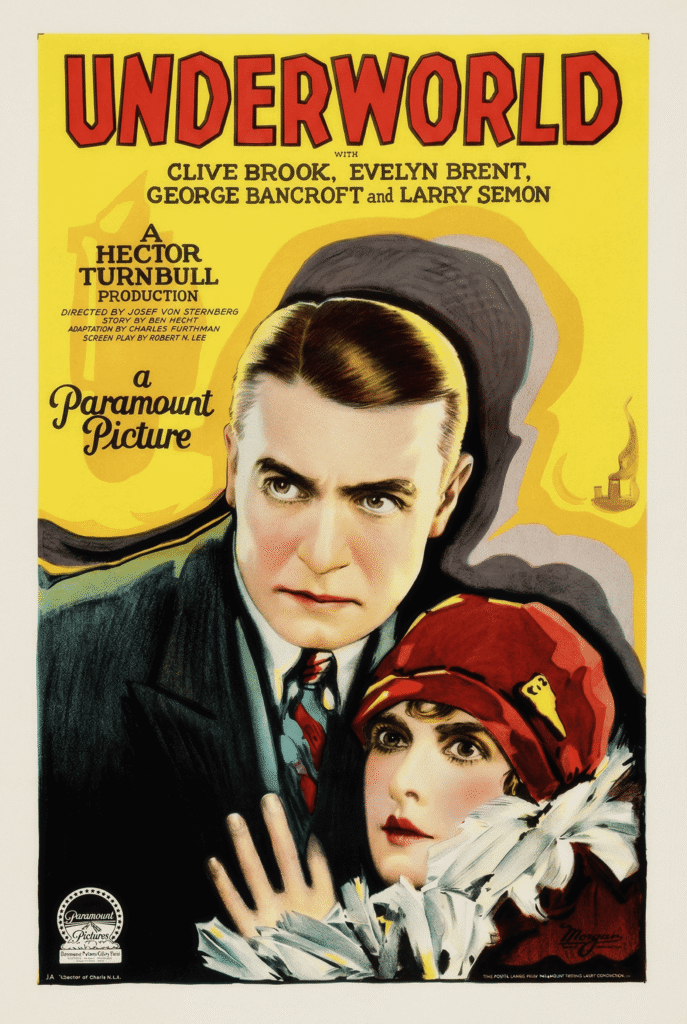
Original title: Underworld
Based on: Original story by Ben Hecht
Director: Josef von Sternberg
Screenplay: Robert N. Lee (adaptation), Charles Furthman (adaptation), George Marion Jr. (intertitles)
Cinematography: Bert Glennon
Music: —
Cast: George Bancroft, Clive Brook, Evelyn Brent, Fred Kohler, Larry Semon
Filming locations: Paramount Studios, Hollywood, California
Subtitles: English (EN), Romanian (RO)
Synopsis and Main Themes: “Bull” Weed, a flamboyant Prohibition-era gangster, rescues “Rolls Royce” Wensel — a former lawyer who has fallen into alcoholism — and makes him his right-hand man. But complications arise when Rolls Royce falls in love with “Feathers” McCoy, Bull’s girlfriend. Meanwhile, rival gangster “Buck” Mulligan threatens Weed’s territory. Jealousy and betrayal spiral into violence that ends tragically. The film explores loyalty and betrayal, the destructive power of jealousy, and the paradox of a criminal who, though ruthless, remains capable of profound love and a generosity that humanizes him.
About the Director and Cinematic Style: Josef von Sternberg, in what would become his breakthrough film, demonstrates remarkable visual command for a director still at the beginning of his career. Shot in just five weeks, Underworld is distinguished by Bert Glennon’s dark, expressionistic cinematography, by Sternberg’s preference for close-ups that reveal characters’ souls through eye movements and hand gestures, and by a sobriety of violence — the harshest moments occur off-screen, suggested through editing and atmosphere. Critic Andrew Sarris noted that Sternberg “does more with a hand movement than most directors do with a monologue.”
Critical Reception and Impact: Paramount predicted a flop, and screenwriter Ben Hecht demanded his name be removed from the credits. Both were profoundly wrong. When the film was screened in a single New York theater at ten in the morning to avoid critics, Times Square was blocked within three hours by crowds flocking to see it. Paramount was forced to organize round-the-clock screenings. Ben Hecht won the first Oscar for Best Original Story — ironically, for a film he had tried to disown. The film inaugurated the gangster genre in American cinema.
Historical Context and Cinematic Legacy: Released in 1927, Underworld emerged in the midst of Prohibition-era Chicago, when Al Capone dominated newspaper headlines and mob violence was a daily reality. Ben Hecht, a former crime reporter in Chicago, infused the screenplay with authentic details — front flower shops, funeral hearses used for criminal activities. But Sternberg transformed the journalistic material into a romantic tragedy, a love triangle set against an underworld backdrop that anticipated not only the gangster films of the 1930s but the entire film noir genre that would flourish two decades later. The film remains the point of origin of one of America’s most enduring cinematic traditions and proof that a single film can give birth to an entire genre.
You cannot copy content of this page

It's free. No subscription required
Comments (0)
Please login to comment.
Please login to review.